
When I was three, I cut my hair with safety scissors just to hear the sound of the blade. Straw-colored strands feathered down into the trash can, and my mother screamed at me. Tried her loving best to even out the pieces.
Before factory farms and milk machines, particles of hay dust would fall into open milk buckets. When farmers made the milk into cheese, the hay particles would weaken the curd structures, trapping tiny pockets of gas inside. The holes we know formed like secrets.
My grandma loves Swiss. Before my mother and I visit, she buys it from the local market and cuts it up into pale yellow cubes for us. Arranges it on a paper plate with ring bologna and mustard. My mother and I pop the cheese into our mouths, and isn’t it something how, every time, we fail to consider what it means to be a thing defined by missing parts?
***
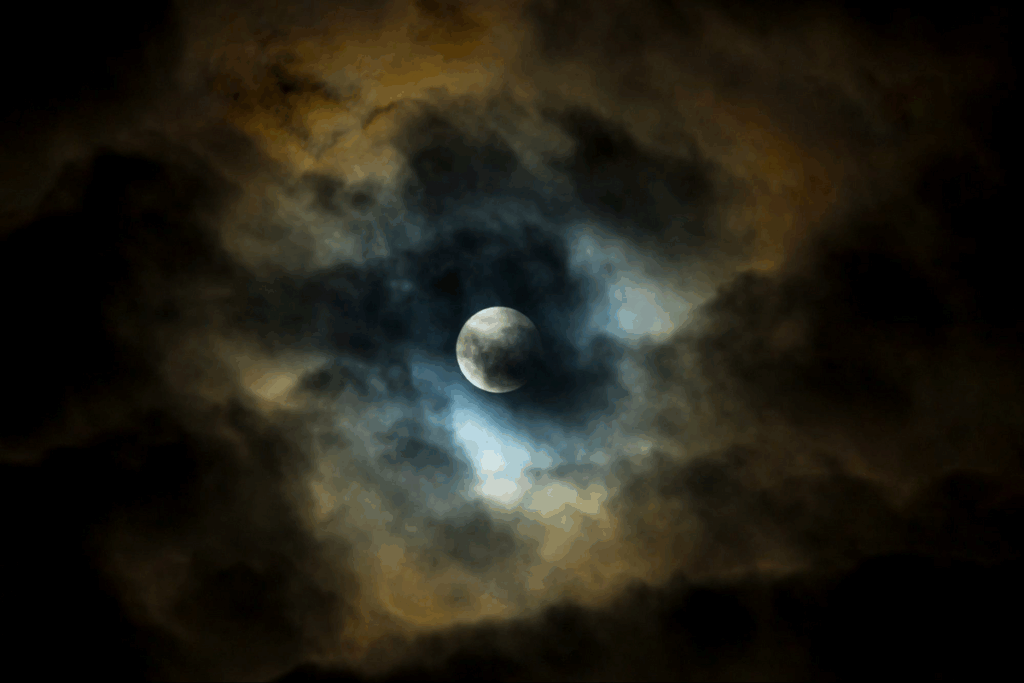
I don’t know it yet, but tonight I am hanging in the balance. I am eighteen, and the lunar eclipse is about to begin. Over the treetops, the Super Blood Wolf Moon is rising on its strand of silk. The moon is full—as close to Earth as it will ever be—and we are passing directly between it and the sun. In just a few minutes, the light will refract through our atmosphere. The moon will glow red-orange like Mars, and we will achieve totality. I might just be as happy as I’ve ever been.
Outside, frost glitters in a thin crust over the grass. Cold, the absence of heat. My breath plumes in misty clouds, and my father hands me his binoculars. Looking down the thick, dark tubes, I can finally see every crater, every scar, the reflection of my own eye blinking. Why does the moon have more craters than Earth?
I’m nonbinary and queer, but Dad doesn’t know it yet. We’re still friends. It’s nice to think of us this way, to imagine our impending rupture as holes so far away, we need binoculars to see them.
On Earth, Dad says, we have craters too, but they get washed away by plate tectonics, erosion—the things we call healing. On the moon, he says, there is only the reflection of light.
***
How to explain it? A reversal of position, order, form, or relationship. The condition of being turned inside out or upside down. An act or instance of changing to the contrary. A situation in which something is changed to be the opposite of what it was before.
Grammar. A change in normal word order. The placement of a verb before its subject. Examples: From the mouth, screamed the mother. In the sky, rose the moon. Never has the father looked so peaceful. Such is the stuff of dreams.
Psychiatry. No longer in use. Sexual inversion. Early 19th and 20th century term for homosexuality. Behavior that is considered non-normative for one’s assigned sex, historically involving both gender non-conforming and transgender expression or gay and lesbian sexual orientation.
As in, how could they put Doc Martens, daffodils, septum piercings, floral dresses, rainbows, bow ties, binders, HRT, monsteras, monsters, and mullets into a medical textbook?
As in, never has my mother looked at me and not seen a series of inversions: the space on my shoulders where the hair should be, the shirt collar where the necklace goes, the eyelid missing its liner. All these shapes I cannot be.
***
Consider now: the silence after a snowstorm. That breath when the bluejays, the sparrows, and even the mourning doves stop singing, and the world is shimmering in white froth, and even the trees tonight sleep with their pillows. Is silence the absence of sound?
When my mother screamed at me, for real this time—when I came home from college with all my hair cut off—it was about inversion. The absence of womanhood. A presence of something not. I saw the love drain from my mother’s face. How twisted, my father’s mouth.
What have you done, she said, you looked so pretty, why didn’t you tell me, you are she, there is no they, you will never get a boyfriend now. Sometimes, I can still hear it. Like the ring after an explosion. Here, the wound. There, the ripples of a scar expanding out.
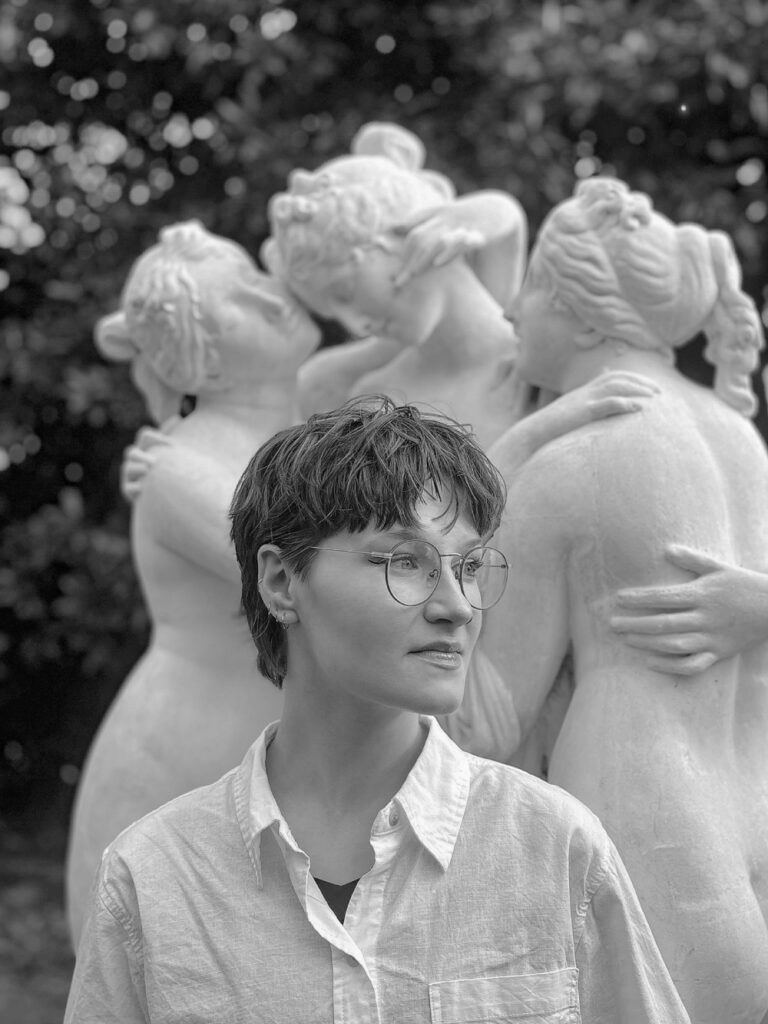 A.N. Weissman is an MFA student in fiction and creative nonfiction at Virginia Commonwealth University. From 2023–2024, they were the senior nonfiction editor at Blackbird and now serve as assistant art editor at Split Lip Magazine. A Lambda Literary Fellow, their work appears or is forthcoming in Pithead Chapel, Arts & Letters, the Lambda Fellows Anthology, Emerge. They live in Richmond, Virginia.
Image Credit: Flickr Creative Commons/DatarkNZ