Interviewed by Hillary Moses Mohaupt

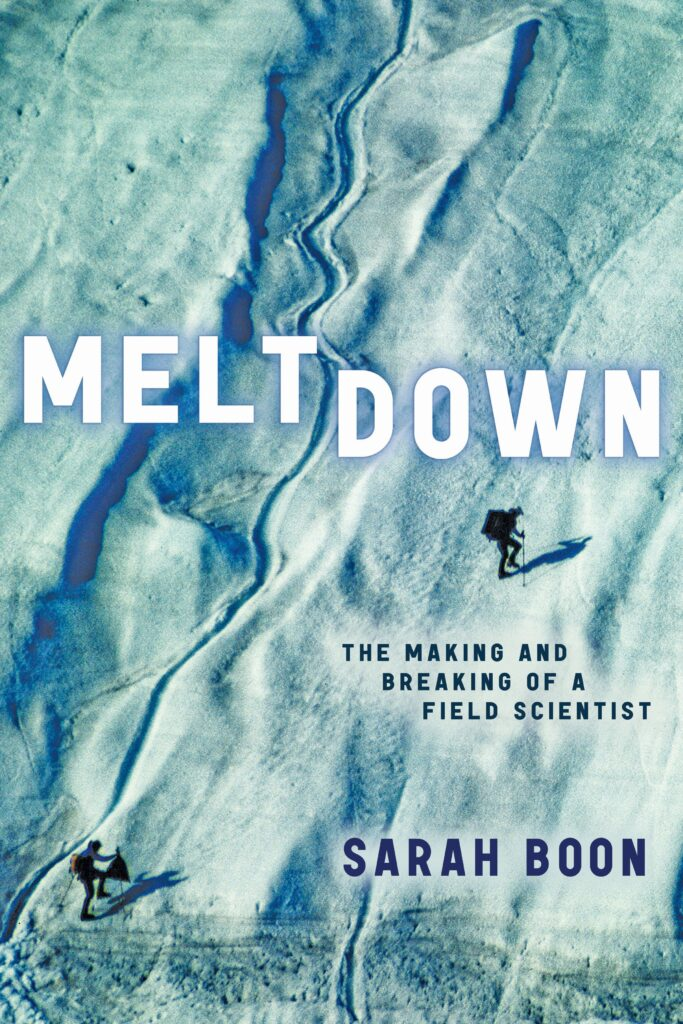 Sarah Boon’s memoir, Meltdown: The Making and Breaking of a Field Scientist (University of Alberta Press), is the story of a glaciologist who forges her path in the male-dominated field of glacial hydrology, then finds her way to writing after a mental health crisis that ended her field research and academic career.
Filled with rich descriptions of snowy landscapes and the scientific processes through which Boon conducted her fieldwork, Meltdown helps readers understand the crises facing our climate and as well as those in western academia, bringing them down to a human and individual level.
To do her work, Boon must battle the threats of polar bears and patriarchal systems alike. She weaves throughout the book the stories of women scientists, both past and present, who have transformed scientific fields, and environmental sciences in particular, making fieldwork and other kinds of research more accessible for women in the future.
Towards the end of Meltdown, Boon writes, “What I learned from fieldwork translated well into writing: be ready and willing to spend time on your own or with very few companions; observe, observe, observe; persevere even when challenges feel insurmountable; prepare for the worst and make the most of the best.” Hers is a memoir in which perseverance and observation pay off.
I spoke via Zoom with Sarah Boon from western Canada.
 Hillary Moses Mohaupt: First, congratulations on this book, which I found so engaging and meditative, steeped both in science and in an awe for the natural world, and such a great book about creating a writing life. In the prologue you write, “Field researchers thrive on a specific set of skills and attributes: resilience, self-reliance, creative problem-solving, and the ability to focus on the moment to decide what needs to be done.” (xvii) At the end of the book you talk about the ways that fieldwork and writing are similar, but to what extent do you think these same field skills are useful to writers?
Sarah Boon: I would say resilience is a big one because it helps you deal with things like rejection, which happens a lot in writing, so resilience is really important. Self-reliance is good because you need to promote yourself. No one is going to do that for you, so that’s your job. It’s also your job to write. You have to rely on yourself to make yourself write, make a schedule, whatever works for you, but you can only rely on yourself to do that writing.
Creative problem-solving – that one’s pretty obvious, if you think about it. You’re writing a book, something’s not working. Is it the scene that’s wrong, is it the plot that’s wrong? You have to problem-solve and figure out what it is that’s not working so that you can fiddle with it and adjust it and make it work. And the ability to focus on the moment is important because when you’re writing you can’t be thinking about other things like, I have to get my teeth cleaned. or I have to go buy groceries. You have to be there, in the moment, writing, and then you can get into a flow state. So those are all the ways that I think fieldwork is like writing, because you need to have the same attributes for both.
HMM: Do you find that you do get into a flow state when you’re writing?
SB: Sometimes, yeah. When I was writing the last two chapters of my book I got into a pretty good flow state.
HMM: I like what you had to say about creative problem solving because I don’t think of writing as a problem solving activity. But the way that you framed it reminds me that there is a puzzling together that you have to do.
SB: Yes!
HMM: I also loved the way you wove into this book the stories of other women scientists across time. One of the first you mention is Elizabeth Parker. You write, “To me, Parker was a kindred spirit: not a serious mountaineer, but a writer who simply loved being in the mountains.” Actually you inspired me to read more Rachel Carson –
SB: Oh good!
HMM: Yes! And I was struck by the fact that she wanted to be a writer and a scientist. It seems to me that some of the most well known women environmental champions have been writers – Rachel Carson, of course, Terry Tempest Williams, Robin Wall Kimmerer, Lauret Savoy. Why do you think that is?
SB: I wonder if it’s because writing is the most common form of communication. Writing is how we communicate with each other. It could be that there are other women who communicate in other media, like sculpture, who also promote climate narratives or environmental change narratives, but we don’t know about them. We know a lot about writers because that’s who we are, but maybe there are artists who don’t work in words who also champion environmental causes.
HMM: That makes me want to look at landscape paintings.
SB: Yeah, I wonder. I know what you mean – it seems like writers are the one talking about the environment. But then I started thinking that there are other kinds of artists who are doing something other than writing, and I don’t know who they are, so maybe they’re championing the environment, too.
HMM: I could talk with you about Rachel Carson forever, because you mention that she is one of your heroes, but I’m curious whether you have other heroes.
SB: I really don’t have a lot of heroes – Rachel Carson, for sure, because she was able to write so brilliantly while also being a scientist. I would die to write the way she did and communicate science the way she did. I think I only have one other hero, and that’s Terry Fox. I don’t know if you know about Terry Fox in the States.
HMM: Oh yeah, you wrote about him in your book!
SB: He was in his early twenties and he got cancer and one of his legs was amputated at the knee, and then he started a run across Canada to make money for cancer research, but he only made it to Ontario before he got sick again and died. But he’s one of my heroes because he had so much grit and determination. And he wasn’t thinking about himself, he was thinking about other people, even though it would have been easy to just think about himself and his illness. He was thinking about cancer treatment and other people with cancer and he was out there doing something that he knew might wear him out and might make him more susceptible to the cancer. He’s a hero because of that.
HMM: Incredible. That reminds me that Rachel Carson didn’t talk publicly about her cancer diagnosis when she was working on Silent Spring because she didn’t want anyone to discount her work by thinking she had a personal vendetta. You talked about Carson in your book, and I think most people know who she is, but you also shared the perspectives and experiences of other women in your field and other related fields, like Dr. Bea Alt and Chris Czajkowski. How did you decide whose stories to include here? And how did you go about collecting and organizing those stories?
SB: I knew who I wanted to include before I started writing the book, and these were women that I knew about, had read about or had met in person. It was basically a case of where to put them in the book. For example, I had Chris Czajkowski in a different section of the book, and it didn’t really work – there’s that creative problem-solving. So I had to put her in a different part where it made more sense. I tried to have one woman in each chapter, and I tried to make their story match with the chapter. I only had to do two interviews because I knew the women, but needed a bit more information, but the others I already knew about or had already interviewed for a previous project. I picked their stories because I knew them, and I knew they would fit in my book, and I just had to fit them in the way that felt right.
HMM: The stories of these women did the beautiful work of reminding readers about the universal elements of your own story. In the first chapter you describe writing in your journal or diary almost religiously, using it as a way to document what you’re experiencing as a scientist and a writer, and download what you were working on – or what you wish you’d been working on instead. Did journaling help you figure out how to navigate both your love of fieldwork and writing?
SB: Journaling was great, and it was really helpful for me to see in my journals what I should be doing. But then I didn’t listen to my journals. I would write in my journals, “I shouldn’t be a scientist, I should be a writer.” And then I would go out and science things and think, “Oh, I don’t think I can be a writer, I’m not very good at it.” And then I’d go back to my journal and write, “Yeah, this is great, I’m such a good writer” – and then go away from my journal again and say, “No, I need to be a scientist.” So I would write in my journal and, like you said, download my experiences, and I would dissect them in a way and think about what they meant and what they meant to me personally. And then, like I said, I would have these great inspirations, and then I wouldn’t follow up on them. So that’s something I’m trying to be better about now. Because if you’re not going to listen to yourself, how do you trust yourself?
HMM: How do you hold yourself accountable?
SB: I journal every day and I will often look at the previous day’s notes and see if I’ve put into practice things that I’ve suggested in my journal, seeing if I’ve accomplished what I wanted to accomplish or if I’ve pushed myself in one direction or another. I use those previous days as a marker for things that I feel that I should do or things that I need to do for my mental health.
HMM: Read yourself! That’s both simple and powerful – pay attention to what you wrote. So, early on in the book, you describe how and why you didn’t always use the fanciest tools for field work but rather depended on in-person, on-site observations. You used the tools you needed, but not the flashiest things, though they did evolve over the course of time you describe in the book. So we talked about journaling a little bit – what about other tools for writing?
SB: Basically a pen and a Moleskine notebook. Those are my go-tos, and then basic word processing software. I just got a copy of Scrivener, so I’ve been playing around with that to see if it will help me with my next book. I know a lot of people use a lot of different things, but for me it’s mostly pen and paper, desktop, Scrivener.
HMM: That feels very parallel to the way you described using tools when you were doing fieldwork – let’s not overcomplicate it with fancy tools, let’s use the tools that help you pay attention.
SB: Yeah, I think so. I think I’m old-school.
HMM: I’m with you. One of the things that I appreciated about your descriptions of your work time on the John Evans Glacier was that you write that you were certain about one thing: you liked to get outside, then come home and write about it. This practice seems to ebb and flow over the course of the time that you write about in this book. We talked about this a little bit already but I’m curious what your writing practice looks like now.
SB: It’s kind of haphazard right now. I’m starting my second book but I’m still thinking about it, so I’m not sitting down for an hour and purposefully working on it. And I have all these small things that take my attention – writing something for the National Association of Science Writers about my book or other promo things are taking up my time right now. Sometimes I’ll have half an hour here and there, and I’ll type something out that I can use later. I write a weekly blog as well, and so I carve out time to write that blog but that’s at different times throughout the day. So my writing practice is all over the place right now. I’m hoping to reset it – I think I need some time off after my first book, and I should just be thinking about my second book but not actually working on it very hard, making notes now and then.
HMM: Do you think of things like that – thinking, making random notes – as writing?
SB: To me it counts as writing. I’m reading a lot of books related to the second book, too, and to me that counts as writing as well, because I’m not just reading them to read them, I’m looking at their structure, I’m looking at their content, I’m looking at who is writing what, and who’s out there writing things that are comparable to what I want to write. I see that as writing. And same with writing notes to myself – that’s writing, it’s just not very organized.
HMM: What advice do you have for writers who are interested in pursuing science writing, or science communication, or simply shifting, as you did from one career to focusing more on writing?
SB: I would recommend The Open Notebook, which is a website that has so many resources for science writers and it’s really helpful for beginners as well. The editor has also written a book called The Craft of Science Writing, and on the website they have pitching samples, article examples, and they break them down to say why something worked. Another book I recommend is The Science Writers’ Handbook: Everything You Need to Know to Pitch, Publish, and Prosper in the Digital Age. I also recommend joining a science communication group in your area, and another thing you can do is find science writers in your area or ones on Zoom and just say, I’ll grab you a coffee if I can pick your brain about science writing.
HMM: Classic. Again, there’s no reason to overcomplicate it. I really appreciated reading your book, and it inspired me to read more science-based books.
SB: It’s really interesting to be interviewed by Hippocampus Magazine, because I had a review of my book in Science magazine and I was on the Let’s Talk Memoir podcast, so my book is going through science channels but it’s also going through memoir and writing channels.
HMM: It speaks to both scientists and writers who are interested in craft. Is that a surprise to you?
SB: Yes, because to me it means that I actually did something right.
 Hillary Moses Mohaupt’s work has been published in Barrelhouse, Brevity, Lady Science, Dogwood, The Rupture, Split Lip, the Journal of the History of Biology, and elsewhere. She lives in Delaware with her family.