
When the elevator shudders to a halt, I reach out to steady myself, to quell the rise of bile in my throat. I look up to Dr. Edwards beside me – I still call him that in my head – and force a thin smile.
“Uh-oh,” he says.
I’m not sure I can speak. I’ve tried before, at this phase of the cresting wave, and found myself cupping a pool of vomit in my hands.
The elevator’s buttons all light up simultaneously, a grotesque machine-orange, then fade out. There’s suddenly complete silence, and we’re unmoving, suspended precariously between floors.
“Well,” he says. “This isn’t good.”
***
When I got pregnant again, I’d hoped that this time, things would be different. For the first few days, I’d allowed myself to wonder if I might finally be on the precipice of the kind of experience other women seemed to so easily access. The kind of experience that was somehow both dew-pink and robust, elegant and strong-rooted. The kind that shimmered inescapably across screens and billboards, the kind enjoyed by mothers-to-be strolling among sun-colored daffodils, smiling in serene triumph, hands resting lovingly, inevitably, on pleasantly convex bellies. I struggle not to feel resentful of these images and their implicit promise. It was only a week after the most recent positive test that I fell ill again.
Hyperemesis gravidarum. It had received only passing mention in medical school. A footnote at the end of an otherwise overstuffed lecture on the complications of pregnancy. “Severe version of morning sickness, supportive treatment.” Morning sickness: if morning was long enough to consume all day, every day, day after day. And supportive treatment: a medical euphemism for “no known cure; do what you can and hope for the best.” Nothing of its casually callous effects, nothing of how it rained misery on its victim, wrapping its unyielding grip around her stomach, leaving her wrung out and quivering as she wished for it all to be over (a wish she couldn’t let herself wish because she wished for a baby even more).
I learn about how revulsion wins, as far as primitive emotions go. How it squeezes out all other feelings and proclivities, dwarfs and overshadows them, renders them trivial and irrelevant. Little else matters when one’s insides are roiling, lava-like, threatening and omnipotent. I feel revulsion for everything, all the time, every moment of every waking hour. Everything makes my stomach churn, rotate on its own axis, convulse and tremble.
Disgust is constant, and I become acquainted with its subtleties. Disgust for scents: the tendrils of aroma that wind, serpent-like, through the air to my nose, drawing tears from my eyes and weakening my resolve. Disgust for solids — liquids, too. Though I’m preoccupied by thirst, a glass of water held close to my lips makes me heave. And if I force down a tenuous sip, its texture is viscous, its flavor unbearably acidic. I have disgust for touch, disgust for temperature, disgust for sunlight, disgust for movement. When I feel warm, when a necklace grazes my throat, when a friend’s palm lands on my back, when I bend to pick up my keys, my innards tremble and I must concentrate to maintain equilibrium.
I continue to work, despite my husband’s dismay, to see patients in clinic, to round on the inpatient wards. Sometimes, I vomit in our communal bathroom between encounters. Patients express frustration about ailments milder than mine, about suffering milder than mine, and I try hard to empathize. I wonder, sometimes, if any of them detect my effort, or sense that I’m fighting hard not to vomit on their shoes or laps.
One man notices the bottle of water I carry with me. I lie and tell him I have a sore throat, so need to sip as we talk. I don’t tell him I’m using these sips to swallow my own saliva, which my glands have taken to producing in repulsive quantities, and which, in its unadulterated form, I’m not able to gulp down. I start to suspect my body of playing games, of doing things heretofore undescribed just to multiply my distress. So I look it up. I discover it has a name, this appalling, abhorrent symptom: ptyalism. Something else I hadn’t learned about in medical school, but at which I now excelled.
***
“I…. don’t do well in small spaces,” Dr. Edwards says.
Me neither, I want to say, but don’t.
He looms over me like a massive oak. His hair is sparse, what’s left of it insistently grey and impeccably combed. His eyes, usually sharp and penetrating, are filled with anxiety, the map of lines around them pulled taut. His mouth is pursed, his jowls tense.
He keeps the same customs of dress he did when I was an intern: a tasteful bowtie under his white coat, his massive dress-shoes, polished and glowing. I feel comparatively shabby in my scrubs and beat-up runners, but it’s the most I can manage these days.
“I… I’m claustrophobic,” he says.
“Oh,” I reply, uselessly.
“I can usually cope because the rides are short, a couple of floors, you know. But… this is different.”
In all the years I’d known him, no crack had ever allowed anyone to peer through. He’d never been especially harsh as far as attendings went, but he had demanding standards and held himself aloof the way most men of the old guard tend to do. One time, his phone rang when we were reviewing our overnight admissions, and he became obviously flustered. When he excused himself to take the call, my fellow intern had joked that men of Dr. Edwards’ generation were most embarrassed by being human, by having human needs and human families. I’d wondered what he was like with his “human family,” but it wasn’t for me to ask or know. Like all his contemporaries, he’d curated a line between his personal and professional lives as wide and foreboding as the desert.
When I’d completed my seemingly countless years of training, and Dr. Edwards and I finally became colleagues, he admonished me, numerous times, for continuing to address him formally (“we’re peers now, you can call me Peter”), but I couldn’t break the habit. It felt impossible to update my perception of him as teacher, senior, mentor, not least because I held him in such high esteem. Even though we now had the same titles and job descriptions, I couldn’t conceive of us as equals.
I notice now that he’s sweating, and it makes me feel strange. His usually placid, pallid face flushes furiously, and pearls of sweat coalesce at his sideburns and stream down onto his stiffly starched collar. His hands, when he reaches up to wipe his forehead, shake like the last leaves of autumn. He slackens his bowtie and leans his head against the elevator wall.
“I need to sit,” he says, his voice frail and unsure, then he collapses his weight like a felled tree.
“Me too,” I say and slowly lower myself to join him on the floor. The steel of an invisible vice compresses my stomach, so I pace my breathing.
“Call for help?” he asks.
I nod.
***
I’ve memorized the design on my bathroom tile. All the time I’ve spent laying on it, trying to collect myself, has insinuated its indigo floral design into my soul. I despise it.
I want so much for this to be over, to not feel anything anymore. I fantasize about never eating or drinking again, never forcing anything down against a closed gullet, never compelling my body to partake of something against its own will.
I learn about extremes and endpoints. I come to understand how foundational loathing and aversion can be – and how we weren’t designed to bear them indefinitely. And I watch as the sensations transform over time, involuting my psyche away from an oblivious world, isolating and depressing and spending themselves finally in a kind of resigned exhaustion – a curdled-milk surrender.
I read that Charlotte Bronte had this condition, and that she died of it. I imagine her growing weaker by the week, without access to the “supportive care” we’re now able to offer. I feel a sort of pitiful affection for her, and perhaps childishly, I hope her physical antipathy hadn’t generalized to her love of words and language and thought. I don’t want the sickness to have taken from her what she held most dear.
My obstetrician tells me vomiting is a sign of a healthy pregnancy, that it’s evidence of a strong placenta, releasing hormones at a desirably elevated level. She signs another prescription for pills that do little. I’m too tired to challenge her, to point out that I was just as sick the first two times, and both of those had ended in miscarriage. All those months of debilitation, terminated by the rheumy eyes of an ultrasound tech who whispered only, “you’ll hear from your doctor.”
When I returned to work after the second time, bereft and hollowed out, one of my colleagues – a friend since residency – had closed the door of my office to confess, “I’ve had one too. At home. I passed the tissue into the toilet.”
She’d paused.
“It broke my heart to see it there, among the blood and piss and shit.”
I tell her this is some sort of metaphor for life, and she looks at me confused.
“I mean… the best things among the worst things. Something like that.”
But I’m not sure she got my meaning.
***
“You haven’t been yourself,” he says.
His breathing is rapid and shallow. I imagine a wounded animal.
“No?”
“And you have ruptured capillaries around your eyes.”
“I’m pregnant,” I say, relieved that my roomy scrubs have concealed my new, subtle roundness. “And…” I continue, “…hyperemesis.” I’m relieved that he’ll be familiar with the condition, if not its daily torment.
“I see.” He pants a little. “So, what are you doing here?”
“What do you mean?”
“If you’re sick, why are you at work?”
I’m surprised by the question. We’re doctors. We work unless we’re utterly incapable, and we sometimes work even then. I assumed he’d uphold the custom.
“It… would be too much time to take off,” I say.
“There are ways around that,” he responds. “I know you drive hard, but you need to leave room for yourself.”
I don’t have an answer. Saliva’s starting to pool in my mouth, and I panic a bit. It would be mortifying to vomit in this enclosed space, in full view of Dr. Edwards, especially given his current state. I steel myself and try to swallow. I gag, but that’s all, so say a silent prayer of gratitude.
The fire department had said they were en route, but couldn’t give an ETA, calling us “low priority.” Said they might not get to us until after noon. Dr. Edwards’ face had contorted painfully at that news. Most of the other staff hadn’t even come on morning shift yet. Dr. Edwards had just always started rounding obscenely early, and I’d unthinkingly inherited the practice from him. Maybe because of that, our predicament strikes me as fitting in an awful, unwelcome way – this long morning ahead of together-waiting.
Looking at my co-captive now, a shoot of sympathy sprouts up inside me. His phobia seems to have diminished – not him, per se – as much as my fear of him. He doesn’t strike me as less respectable or all-knowing or impressive, but more human. It’s suddenly odd to me that I’d ever been so intimidated by him.
“I don’t brush my teeth anymore,” I say.
“No? How come?”
“Toothbrush makes me gag.”
“Oh.” He thinks for a second. “You’re not worried about cavities?”
“That’s another thing I don’t do anymore: worry. Don’t have the energy for it.”
He nods.
I can tell he’s grateful for my effort to engage him, even over something so trivial. A moment passes as I try to think of what other distraction I might conjure. We rarely discuss much besides our patients and their diagnoses.
“Do you like working here?” I ask.
“Sure. Been here since I was an intern, much like you.”
“Ever work anywhere else?”
“A few locums, when I was starting out.”
I’m not sure where to take the conversation. It’s hard to talk to someone in the throes of a panic attack.
“Have I ever shown you my kids?” he suddenly asks, pulling out his wallet. “They’re not really kids anymore.”
“I met your daughter, I think? When you won the Teaching Excellence Award last year?”
“Oh yes, Sharon came to that, didn’t she?”
“Yeah. Really lovely woman.”
He smiles despite himself.
“I have two,” he says, extending his wallet toward me. It was opened to reveal a faded photo in its laminated fold.
“I didn’t know,” I say, and glance down at the family beneath the sheer plastic. The photo had been taken at an amusement park; there was a Ferris wheel in the background, and someone wearing a Mickey Mouse costume off to a side. In the center stand a young Dr. and Mrs. Edwards, both wearing 90s-style t-shirts and jeans, flanking their kids between them. One is presumably Sharon. She holds a voluminous cloud of cotton candy in one hand, and squats beside a boy in a wheelchair. All of them sport toothy smiles.
“Beautiful family,” I say.
“Beautiful indeed,” he echoes, taking his wallet back and looking down at the photo himself. “Sharon’s a vet, not sure if it came up when you met her.”
“No, but that’s great.”
“She lives about an hour away, has two kids of her own. Couldn’t be prouder,” he says, but doesn’t need to. The fear on his face has yielded to paternal pride.
“And John’s on his own now. It was hard when he was small. Doris left her job to look after him. Just… just the most remarkable woman, taught me so much,” he says and has to stop talking. I struggle to imagine anyone teaching Dr. Edwards anything.
“He’s doing really great now, teaches fifth grade. Best sense of humor.”
He turns to me then.
“How does a man like me deserve all that?”
I open my mouth, but nothing comes. This is just as it always was when I was training – Dr. Edwards asking questions I didn’t know how to answer.
But I try.
“Maybe… I think sometimes… no one really deserves what they have or don’t have.”
Then I shake my head because I feel I’ve said something insensitive, but he doesn’t seem phased.
“That’s true, very true,” he agrees.
“I… I don’t mean you don’t deserve your life,” I quickly add.
“No, I know, I’m not offended.”
“Good, I’m relieved.”
“I’ve wanted to retire for a while, you know.”
“Really? I can’t imagine you not doing this work,” I answer, though I could perhaps not imagine it a bit less resolutely than an hour ago.
“I’m not so young anymore. My knees ache, I’ve less stamina, I’m slower cognitively.”
“Never. You can still rhyme off a differential longer than anyone.”
“Ha. Well, perhaps. Regardless, it’d be nice to spend more time at home with Doris, with the grandkids, but we need the income. John’s care is expensive, and since Doris gave up her work…”
I nod.
“But,” he continues, “doesn’t really matter. Just the small agonies of love,” he says, matter-of-factly.
Agonies of love. What a phrase. I’d never imagined, in all the years I’d worked under and alongside this stiff, gruff, giant of a man that he’d be capable of such a tender sentiment.
“He’s had a rough go, my boy,” he says. “And Doris, too. Mothers, you know – you will know – they live and die with their children a thousand times an hour. But I’d choose it all, all over again, and I know she would, too. The price is worth paying, that’s been my experience.”
***
I have a small plant in my kitchen — a Peperomia hope. The garden store label said it was a unique hybrid of two other plants, and that it was easy to care for. Avoid direct sunlight (or its tender leaves would scorch and shrivel). Water infrequently.
I’ve never been one for plants, always found them uninteresting and not worth the effort. But I love my Peperomia now, love it more than most anything. Maybe it’s because of how inert it is, how it emits no smell or sound, has no expectations, imposes nothing on the world it inhabits. It sits, simply, un-askingly, in the windowsill, its small, succulent leaves waiting passively for the occasional watering.
This seems the only kind of relationship I can manage in my state. Perhaps that’s why I insist on managing it. When I have no energy to dress or shower or feed myself, still I tend to the Peperomia. I water it, or just stand beside it and stroke its lustrous greenness. And as I do, I plead with it, inside myself: Please live. Please survive. Please unfurl your trailing vines, please draw from the world what you need to grow and keep growing.
***
When the fire department finally pries open the doors, Dr. Edwards looks like he might cry from relief. He rises to his feet quickly and I try to, too, but everything spins and I hesitate. I close my eyes and see my bathroom floor’s wretched indigo flowers. I’m not sure I can do it.
Dr. Edwards offers me his clammy hand and I pull myself erect. I know he wants nothing more than to be out of the prison-box, but he insists that I climb up and out before him. When he follows me out, he re-tightens his bowtie and wipes his face with a handkerchief from his pocket. He looks very much like he always has, and I wonder if I’d exaggerated his elevator vulnerability.
We thank the crew and prepare to take our leave of one another.
“You’re alright?” he asks me.
“Think so,” I answer. “You?”
“I’ve started a day in better ways,” he admits.
“Right,” I say. “Well… have a good day, Dr. Edwards — Peter, I mean.”
“You too,” he says. “Chin up, yes?”
I nod. “I’ll try.”
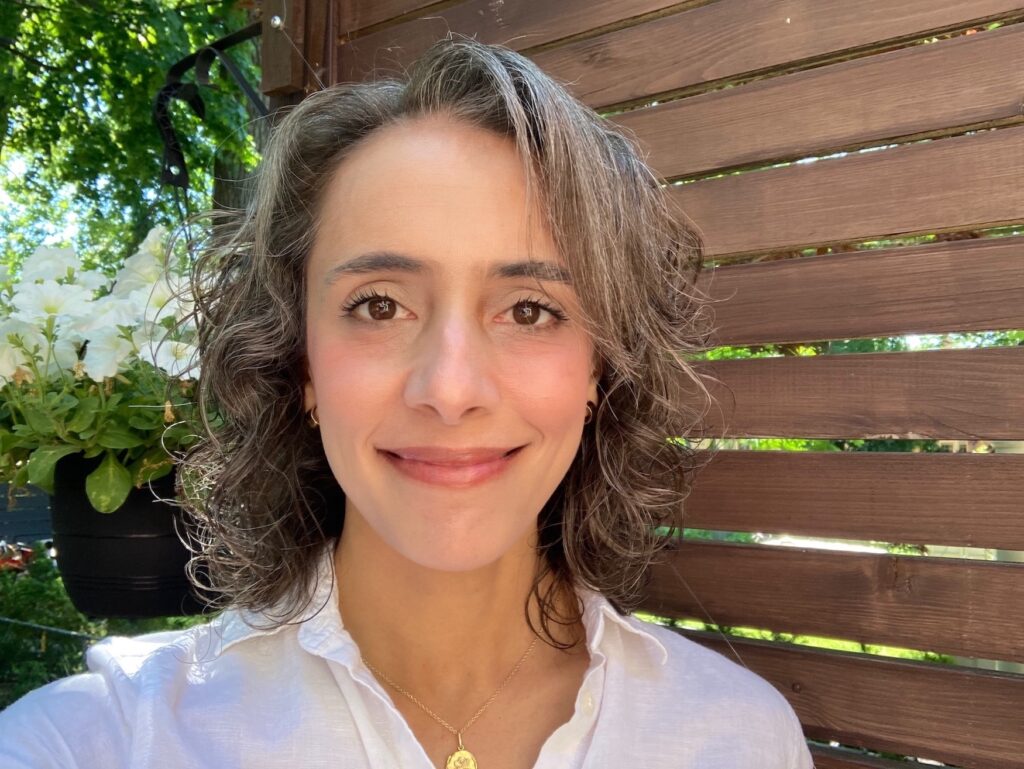 Diana Toubassi is a physician by training; she practices and teaches at the University of Toronto Faculty of Medicine. In addition to medical papers, she has published a number of narrative essays, including a piece in The COVID Journals: Health Care Workers Write the Pandemic (2023). She has just completed her first novel.
Image Source: lens. via Flickr Creative Commons