

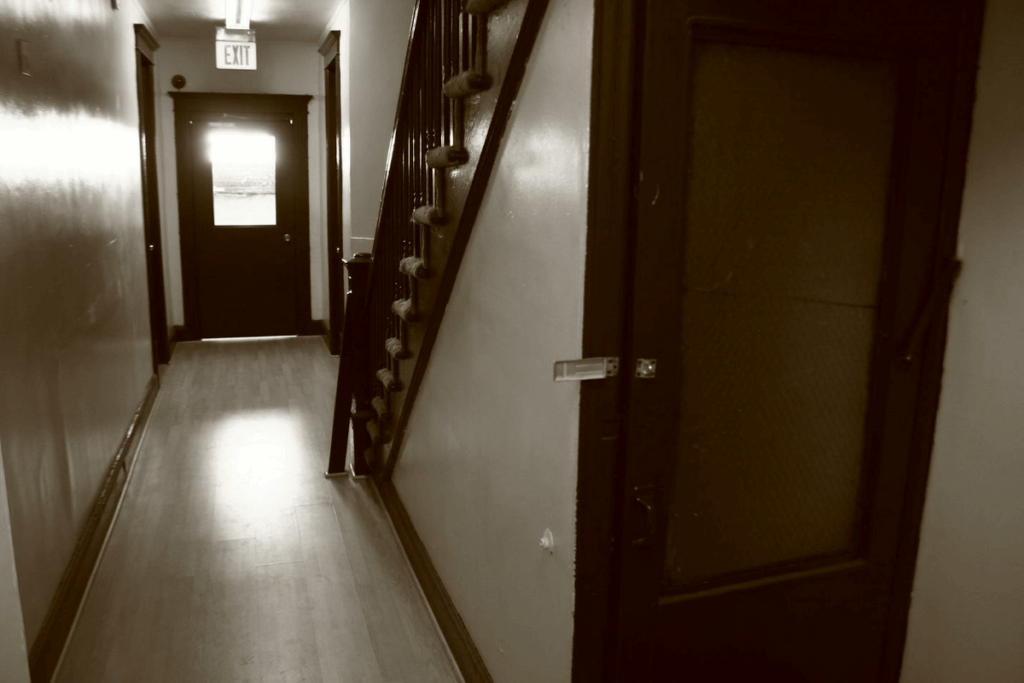
On October 9, I receive four texts from Gretchen, my upstairs neighbor and self-appointed building manager. They’re frantic, but the gist of them is the same.
“Do you smell that sewage smell?”
“No. But I really can’t smell.”
Cigarettes, gasoline, and fish markets. Those are the three things I can actually smell.
“I’m gonna tell Ang we need a plumber.”
“Your call.”
“Last time it smelled like this, we had a sewage backup, and I called the plumbers, and they came and fixed it.”
Should Ang be the one calling plumbers at the moment? Yes. But the thing about Ang is that she’s been telling me she’s eighty-three for the last five years, and she doesn’t want to deal with this and that. The other thing about Ang is that she hasn’t raised the rent in those same five years. Since we’d like to keep it that way, we, and by “we” I mean Gretchen, often take the helm on remedying such issues like backed-up sewer pipes.
Over a week later, I find Gretchen banging on Unit 2 as I leave to go work out, yoga bag slung on my back.
“She hasn’t taken her notice down.” Gretchen has already posted notices on all our doors letting us know the plumbers will be in the next day and we need to be home to flush our toilets, or else she’ll be headed in to do it for us.
“So?”
“So,” she bristles. “How do we know if she knows she has to flush the toilet? The plumbers are coming tomorrow!”
“What, did she die in there or something?” I carelessly toss the words out.
“I mean, did she see it and just not take it down?” Gretchen persists. “She needs to be here to flush the toilets, or I’ll have to enter and flush them for her.
“Naw,” I shrug. “I’m sure she’s in there. She probably just didn’t take it down.” The Woman in Unit Two was reclusive, and we frequently didn’t see her for days at a time. Actually, we all frequently didn’t see a lot of people for days at a time. It’s an apartment building, not a retirement community. Where anybody is none of anyone’s business and certainly not mine. I leave Gretchen to the futile task of trying to summon this woman and shuffle off to my yoga class.
It’s the next morning, and I trip over myself trying to get out of my bed and to the door. A chorus of clanging is already in full swing as the metal of hammers smacks against the metal of my fire escape, and this is only accented by the hollow thuds of pipes being dropped on concrete. But everything is punctuated by the sound of Gretchen’s wails. Cartoonishly loud and bearing a striking resemblance to a Wilhelm scream, I feel certain I already know what this scream means. Because the last nine days have felt a bit off. Because my neighbors have been a bit more vocal about the stench that has been wafting through the building this time around. Because I let the words escape my mouth flippantly the night before, all crassness and sarcasm.
I wrench my door open, preparing for an unfortunate exchange but not the unfortunate stench. A fourth smell is added to my sensory lexicon and it greets me in all its glory, wafts up a flight of stairs, and punches me in the throat.
“Hello?” I choke the words out.
“What?” a male voice belts back up at me, clearly aggravated.
“Well, is everything okay?” I return his tone despite already knowing what the scream and smell mean. “Someone’s screaming bloody murder.”
“Oh, yeah. A woman died down here.”
“Oh.” I slam my door shut; the fourth smell is already in my unit. She’s wafting into my home and lodging herself into my throat.
I pace a bit, thinking that I want to leave. I don’t want to be here. I don’t want the noise, and I don’t want this smell near me. But if I dare go outside, then it means letting more of her into my space; she’ll creep in and make even more of a home here, settling into the fabric of my towels and pillows and bedsheets. If I open a window, can I liberate her? Is that how scent works? Will she fly away if given the opportunity?
I stare at the coffee pot, thinking that maybe I can rinse my mouth out with the bitter black and wash her away, but there’s no water. They turned it off to replace the pipes. I wander into my bathroom and look at my toothbrush, wishing to scrub her off my teeth, but I run into the same problem, and I’m stuck standing there, chewing on the fourth smell. Whatever, I tell myself, no water? So what? I go to work ripping minty bristles against my gums, furiously trying to expel her from my body and spit into the sink. I can’t rinse, so I stand there rubbing grainy toothpaste between my teeth. I’m certain I’m still gnawing on her, chewing away on a concoction of death and peppermint.
I sit down at my workstation and go about life as normal, but it’s no use. For three hours, banging rings out behind me on the fire escape while plumbers clang down in the basement and EMS static infiltrates the liminal space between. And since this isn’t enough, Microsoft Teams dings to let me know a colleague has a message, and the neighbors are thumping down the steps to escape, and my group chats are utterly feral. And because of the noise and the fourth smell and the thought of a dead woman lying one floor beneath me, I nearly scream because I need to leave.
“My neighbor died this morning, I think I need to take a walk.” I message Lisa, my boss.
“Of course. Go.”
“Thanks.”
“This isn’t like your fourth dead neighbor. Go take a walk.”
And with those words, I’m a bit more liberated.
Gretchen gives me the okay to walk out. I figure it’s been three hours. What more can there be to do at this point anyway? Surely, the ribbons are tied on this whole sordid affair. I pull on a fleece and look around at what I might need. Keys, definitely my phone. A book. I can sit down by the docks and read my book, at least until the commotion calms down.
With my provisions in tow, I brace myself for the fourth smell again, unclear if scent wears off that quickly.
It doesn’t.
I open my door one more time, and the thickness of death hanging in the air floods into my unit once again as I run out of it as fast as I can. I hold my breath and thump down the steps at an even pace, trying to hold on to some semblance of composure. Why? I don’t know. Who am I trying to impress? Gretchen, who provided me with the Wilhelm scream hours ago? The cop standing just outside the building entrance? Or is it me, someone who’s only ever encountered death in the sterile format of closed casket funerals for the elderly or unfamiliar?
Come to think of it, why is there still a cop outside? It’s been three hours; they surely would have finished their work by now. And why does it still smell so bad? Does it linger that long all the time? It must. People complain about skunks stinking for ages, and this woman was certainly larger than a skunk. I look at the cop standing there with a buzz cut and forlorn expression. Was there more for them to do? I thump down those final few steps and realize Unit 2’s door is still open. Why? Can’t they just open her windows and close off the unit to the rest of the building? Is it because she is, or was, a hoarder? Maybe they can’t get to them.
I hit the bottom landing and glance to my right out of habit, realizing my grave error in making assumptions. Several feet away from me is the threshold of her door. Several feet away from that is her.
There she is, lying face down, moments from her exit route. A deep, dimensionless black had crawled through her flesh. I quickly snap my eyes up, looking for anything else to focus on. There’s too much going on in her unit, too many items to lock in on, and so they settle on the flesh flies that have been feasting on her, now suspended above her body. Their presence brings me back to reality, and I clench my jaw closed again, but it’s too late. I can taste her again, stronger than before. I inhale a slipstream of scent; it coats my tongue and soaks itself back into my gums, taking up a far more stubborn residence than before. I trip down the exterior stone steps and avoid any further eye contact with the cop, unable to be on the receiving end of some sort of pitying, withered look.
Gretchen is waiting in the alley. This is the third time I’m speaking to her in the last two weeks. We stand there now, trapped in a shared experience.
“Holy shit,” is all I manage.
“I know. It’s a mess.”
“Poor Angie, do you think we should check on her? She was her tenant for, like, thirty years or something.”
“Well, I already contacted the family.” She says this very matter of fact.
“Angie’s family?” I’m confused.
“What? No. The lady’s family. Someone needs to pay for the clean-up.”
“What?!” How did that conversation go? Hi, your sister kicked it, wanna pay for a hazardous waste crew to come through?
“Look. First, fire escapes needed repairs, and Ang had to pay for that to get fixed, then she had to call the plumbers. Now we have to deal with this. That’s more money. And don’t forget, they raised property taxes on her. She’s pissed. But this’ll put her in a better mood if she doesn’t have to cover the cost. We don’t need the rent getting raised on us.”
“Oh.” And with that very definitive statement, we embark on a walk, our first pit stop being Angie’s.
Angie is at the far end of her shop. Her back is turned, but I know she is dragging on a cigarette. It’s the first smell, after all, and a far more welcome one than what my morning has held for me so far.
“Angie,” I say, but she doesn’t turn.
“Ang!” Gretchen belts out with far more vigor.
Her small frame turns, and her eyes connect with us.
“How are you doing?” I ask as we approach closer, and she can have an easier time hearing me.
“She lived here for years.” Angie doesn’t usually look her age, whatever that age may be, except for this moment. I know she’s small, but today she looks like she’s shrunk a bit more. The cigarette smoke streams upward, creating a little cloud above the three of us.
“Do you want a hug?”
She doesn’t answer but simply accepts it.
Gretchen merely looks on. “I’m Irish. We don’t hug.”
I’m unsure of the validity of such a claim and wonder briefly if I should share my ethnic background and propensity for hugs, but we’re interrupted by a fleet of nephews, and it’s clear there’s not much for us to do here, and so we set off again, aimlessly weaving our way through our neighborhood.
“Well, Gretch,” I ask someone for the second time that day. “How are you doing?”
Gretchen seemingly doesn’t hear me and proceeds to list off the various affairs that need to be put into order, forecasts whether or not the nephews being present will result in any implications for us, and rattles off various pieces of information about what she saw. But she isn’t answering my question, so I stop walking and stand firmly on the edge of the sidewalk, teetering into the street as oceanside winds beat up both our faces and turn our cheeks a raw red and ask yet again. “Yeah, Gretch, but how are you doing?”
Every time I blink, I can see her lying in her kitchen, surrounded by filth, the hardened blood in her veins changing the color of her flesh, a decaying woman slowly melting into her hardwood. This was the work of a quick glance, a flash in the pan, a small visual snack, if you will. What Gretchen had was a veritable feast for the eyes, grotesque in any and every sense.
What Gretchen also has now is a desire not to talk about it whatsoever, because she abruptly stops walking a few paces later and belts out, “I have to go. I have a meeting!”
She hurls herself down the street and away from the danger of identifying and expressing an emotion. I have no choice but to continue wandering, not wanting to return too soon.
I order a coffee on autopilot and meander past shop owners replacing Closed signs with Open ones, tourists gazing up at buildings, and commuters sleepwalking their way to work. There’s nothing to do but wait for the bitter taste of black coffee to cover the sour taste of death. It’s no use, however. Whether real or imagined, I’m still sipping on her. I look down at my clothes as I continue to walk along aimlessly, wondering if the Woman in Unit 2 had attached herself to them as well.
After several hours, when I’m certain the coast is clear, I walk an unnecessarily long route back home. The plumbers are mostly loitering by their truck and only a few remain in the alley. To my relief, the cop is gone, and thankfully, this time, so is the Woman in Unit 2. A large, oblong-shaped stain is all that remains of her. A footprint of her life nestled amongst piles upon piles of garbage. The stench hasn’t improved despite the removal, and much to my horror, I’m escorted up to the second floor by the flesh flies, who no longer have a meal to feast on.
Up in my unit, the water still isn’t back turned on, so I sit greasy-faced with a mouth full of stale coffee, still chewing on that dreadful fourth smell, listening to the mumbling of plumbers exclaiming that, “she went through the floors,” while Angie’s nephews hack up a lung with every attempt to wade through the junk and rotting food to turn off her oven, which had been producing heat and undoubtedly speeding up the rate of her decomposition.
I sit through my only meeting of that day not really listening to anything, trying to plug my nose and block my ears from any scent, real or imagined, and any sounds erupting from outside the protective walls of my unit until l can’t take it anymore. I hang up from my call and start shoving a random assortment of possessions into my backpack. I’ll be nomadic for a few days until this is settled. I dealt with helping Angie clean up all those dead rats in our alley back in August; dead bodies are where I draw the line.
In the days to come, I will repeat this story a million times over to mixed reactions. Boomers want to know her age. Millennials seem more preoccupied by the fact that no one had called in a wellness check. A final subset of the population asks if this means there will be an available apartment in the building. The answers I’ll give are seventy-six, not terribly healthy physically or mentally, and that yes, the unit will be available if you want to live in a graveyard.
There will also be a flurry of activity within the building group chat as the Woman in Unit 2 slowly magnetizes us together. Gretchen upstairs finally connects the family to Angie so that, yes, they will pay for the clean-up, and Frenchie up in eight will sit with Angie for hours to arrange for the HAZMAT crew to come through. Some make demands about comped rent, while I try to calm them down and squelch out their threats to call the city. There we’ll all be, in the orbit of this woman.
No matter who I speak with, though, no one seems to want to think about being the Woman in Unit 2. We will never know how long she was in there or what her life was actually like. We can only tell ourselves stories. The story that perhaps due to her perpetual chain-smoking and stockpiled garbage, she wasn’t particularly healthy. The story that perhaps she had a heart attack and fell to her knees. Or that her final resting place was so close to the door because she was trying to crawl towards help. Maybe each one of us thundered up and down the stairs and passed her as she lay five feet away from us on the other side of a wall gasping at her final breaths. Maybe one day, one of us will be doing something similar, carrying out a pedestrian task in our homes or retirement villages, and we’ll greet death in a similar way. We might be arguing over the toxicity of a decaying corpse or the pro-rating of rent now, but in the future, we’ll all just be soaking through floorboards with our stink hanging in the air, hugging the curtains and curling under the doors, wafting through hallways, praying we alert someone of our demise. Maybe one day we’ll all just be the Woman in Unit 2.
Rachel Veznaian is a Boston-based writer and a graduate of the University of Massachusetts Amherst with a degree in English. Her work has appeared in Watershed Review and Half and One.
Image Source: Kai Schreiber via Flickr Creative Commons

Beautiful work. Vivid details. I enjoyed the summation re: our collective mortality by the essay’s end.
It felt like I was there. The author’s words transported me there. Wow! What a well-written article. Now I need to go gargle! 🙂