
Reviewed by Amy Goldmacher

 “Oh my god, here it is: it’s coming for me.”
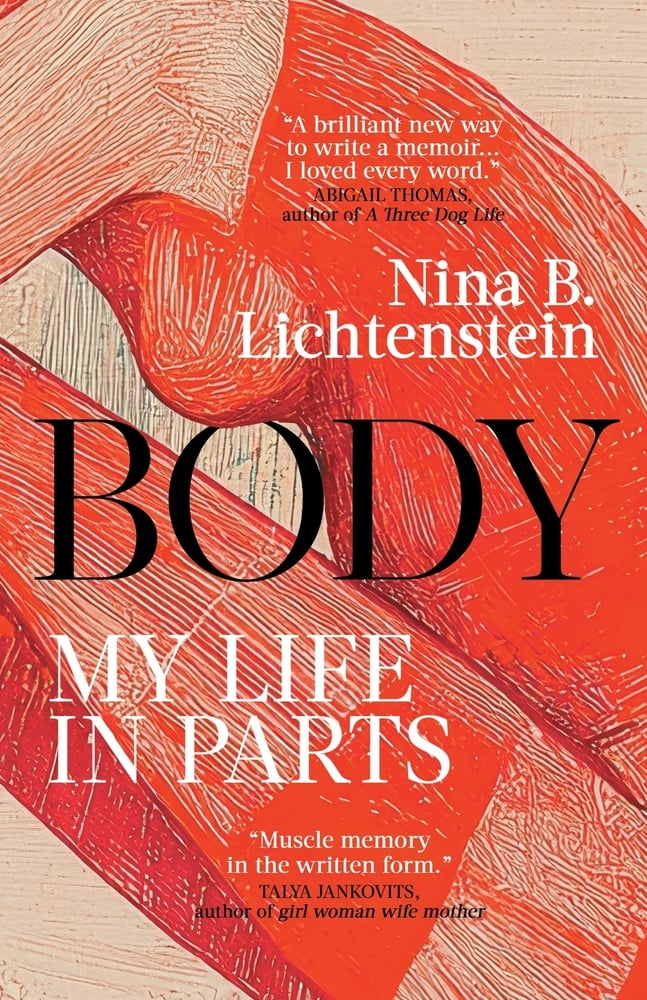
In Body: My Life in Parts (Vine Leaves Press; May 2025), Nina B.Lichtenstein reckons with middle age, menopause, and the uncertainty of health and wellness in this phase of life. On a middle-of-the-night bathroom run, Lichtenstein experiences a sudden and severe pain in her hip:
What was this pain about?… As I limped back to bed in the dark, I thought, why not write about the memories lodged within my various body parts? Before it’s too late, my morbid internal voice chimed in. I wanted to understand how I’ve gotten to this past-the-midpoint in life, and I imagined my body would be the most reliable record-keeper. In that moment, I felt an urgent intimacy and need for complicity with my body to make sense of it all. Use me to account for your story, it whispered. Eyes, breasts, hips, and feet: they will collaborate with you and guide your remembrances, it promised.
For this reader at least, unfamiliar aches and pains incite intense reflection, if not rumination, about what lies ahead for this body and its parts. But instead of allowing fear to guide her pen, Lichtenstein takes honest inventory of the parts that made her and make her who she is.
Body reminds me of one of my favorite books of all time, Mortal Lessons: Notes on the Art of Surgery by Richard Selzer. Selzer, a surgeon who practiced from 1960-1985, wrote beautifully about the human body and the human condition. Both Lichtenstein and Selzer have a chapter called “Belly,” in which they each dissect its position, purposes, and dispositions. For Lichtenstein, this body part incubated her three Viking-sized sons, digests the rich and delicious foods and drinks that make life good, and is a comfortable home for her organs. It is also the place that intuition originates: When we say “I have a gut feeling” about something, this is not just some hokey or superstitious expression, but an actual way our body communicates stored knowledge. Bellies can be soft or hard, and, as Lichtenstein learns, a belly is neither a moral failing nor criterion for worthiness: fat and fit is the best of all worlds.
I adore the structure of this story in parts. Even though each body part is a discrete container, characters weave throughout. We meet her father in “Nose,” where he teaches Lichtenstein to catch, clean, and cook mussels from the family boat. She is transported back to idyllic Nordic summers with family and friends through scent: garlic, thyme, and white wine; cigarette smoke; engine oil; bacon. In “Hair,” Pappa does not approve of her boyfriend when she is a young adult. He soothes a bike scrape when she’s a child and looks out for her joints when she’s a teen riding a moped in “Knees:” my knees have this unique connection to fond and funny memories of my dear pappa.
In “Belly,” Lichtenstein takes her children to Norway to care for her father as he recovers from lung cancer surgery in 2005. And then in “Heart,” she shares her heartbreak when he dies eight years after the surgery and the bittersweet experience of scattering his ashes in their beloved Norwegian Sea. A father’s presence and absence is a theme I return to in my writing and appreciate in others’ stories, as my father died when he was 48 and I was 20, and now I’m older than he got to be.
Even though the content is organized by body part rather than chronology, Lichtenstein’s story is cohesive and whole. Though we look through the lens of a part, we see a life well lived. She navigates growing up, going through a divorce, and growing more comfortable with herself. Parts that function as a whole are a privilege to be appreciated. Rather than worry about body parts failing and giving out, Lichtenstein shows by example that our relationship to our parts changes over time, and can be used to re-member:
It’s the generative partnership between body and mind I explore in these pages, as body parts get a turn in the driver’s seat to steer me toward remembering… Let’s imagine that to re-member — to bring together a body of disparate memories—is an attempt to gather and make whole that which has been dis-membered, broken, or forgotten. The shape of Body: My Life in Parts resonates with how our memories are formed: by interconnected fragments that communicate with one another, build upon one another.
And generously, at the back of the book, Lichtenstein provides body memory writing prompts to help a writer on their own journey of re-membering.
 Amy Goldmacher is a writer and a book coach. She is the winner of the 2022 AWP Kurt Brown Prize in Creative Nonfiction, and her experimental glossary-form memoir, Terms & Conditions, will be published by Stanchion Books in Fall 2026. She can be found on social media at @solidgoldmacher and at amygoldmacher.com.