Reviewed by Melissa Oliviera

 When the lyric essay first showed up on my radar several years ago, my early reading involved The Next American Essay series as well as a handful of wonderful magazines including this one, Brevity, The Seneca Review, River Teeth’s “Beautiful Things,” and others.
Generally, before anthologies like Randon Billings Noble’s excellent A Harp in the Stars: An Anthology of Lyric Essays came on the scene, I just sought out practitioners whose work I enjoyed and learned by following their work and finding, in the other places they wrote, more people to read. My all-you-can-read lyric essay buffet was satisfying but full of digressions and, to be honest, I didn’t feel like I really understood it as a genre. Over time, the bin in my brain marked “lyric essay” expanded ever further. I couldn’t really pin down what a lyric essay was, though I knew I loved it. Still, when it came to talking about the lyric essay, I didn’t quite have the right vocabulary.
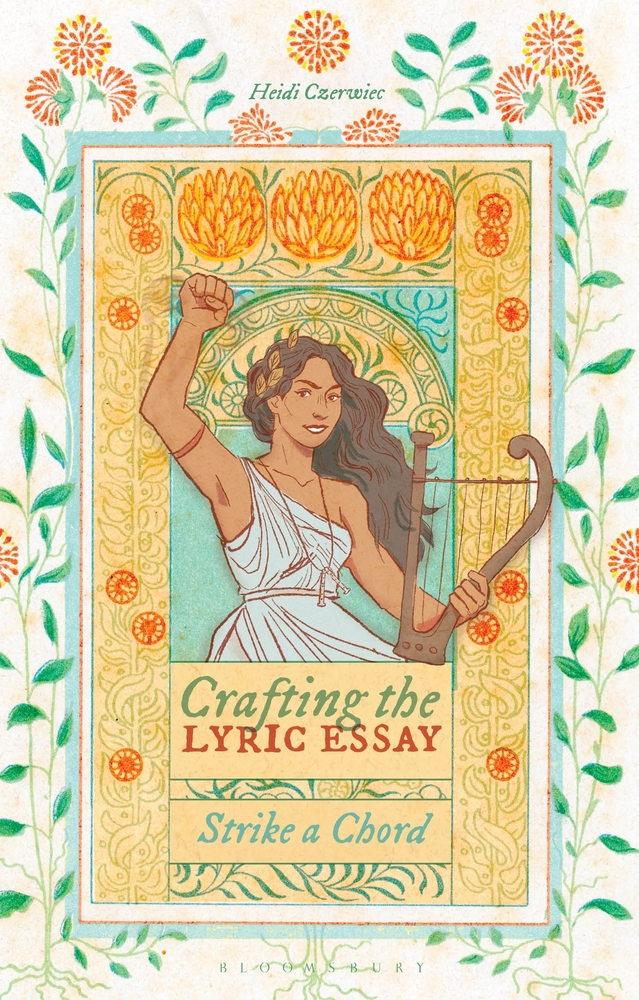
In Heidi Czerwiec’s wonderful Crafting the Lyric Essay: Strike a Chord (Bloomsbury; March 2024), I found a whole education on the topic of what we could mean when we talk about lyric essays. It’s a genre that has been growing now for over 20 years, but the term “lyric essay” could still be used to describe a nonfiction piece with any or all of the following: pretty writing, hybrid form, heavy use of imagery, more associative (less rigidly narrative) in mode, use of white space, and so on.
But is a beautifully written essay automatically a lyric essay? Does any nonfiction prose work that is experimental or unconventional count as a lyric essay? Is every miscellaneous, messy, everything-but-the-kitchen-sink essay also a lyric essay, or can we identify stricter formal concerns? As Czerwiec writes, “Lyric thinking, composed of these patterns, may shape itself into various forms, but ultimately, the lyric essay is a structure of thinking, a way of functioning on the page and in the ear, not a form.” Crafting the Lyric Essay serves as a kind of hybrid craft book and anthology of the lyric essay, and I can’t recommend it enough.
Crafting the Lyric Essay offers a smart, simple way of thinking about the lyric essay: if you want to understand what a lyric essay is, look to the lyre. Or as Czerwiec, a poet by training, puts it herself, “the lyric essay depends on the lyre, on lyric mode — a focus on patterning, and on resonances of sound and silence and image on the level of the language.” In other words, we can look to poetry and poetics to help us talk about lyric essays. Czerwiec’s book, itself born of conversations, is itself a kind of conversation, with dialogue built into the structure of it. Chapters move back and forth between more traditional craft essays about some topic and hybrid essays showing those craft topics at work.
So, for example, the lyric craft essay “Mind the Gap: Writing Around Absence” invites us to think about and experience gaps in time and memories, and the traditional craft essay “Negative Capability” (part of which originally appeared in Hippocampus as “Of Fragments and Segments”) talks more directly about white space. In this way, Czerwiec builds these dialogues between craft and practice, her book moving through discussions of time, space, punctuation, imagery, form, and so on. There’s also an epilogue with suggestions on actually performing your work, which typically doesn’t get anywhere near enough attention.
Crafting the Lyric Essay isn’t dogmatic about genre boundaries, though. Czerwiec writes, “I’ve tried to amass in this book the discussions taking place, creative nonfiction is still fairly theory-less, still in its early stages.” Crafting the Lyric Essay, then, is intended to open the conversation, to urge it beyond the The Next American Essay series and towards “having a shared language to discuss these distinctions.” It’s very successful at this, as in the process of reading we experience two aspects of the craft, and two ways of understanding it: one more theoretical and one more experiential.
As a reader, my favorite essay pair had to do with resonance and pattern: “Strike a Chord: The Lyre that Makes the Lyric” and “The Resonance of Lyric Essays, or Lyre, Not Liar.” This thinking about sound and patterning, just as we do with poetry — refrains, repetition, rhymes, rhythm and so on — helped me so much in considering the language I use when I talk about lyric essays.
As a writer, I loved Czerwiec’s essay pair on forms. “Using Poetic Forms in Creative Nonfiction” opened up such possibilities. Poets are, I think, accustomed to thinking about letting forms guide their content. But Czerwiec urges her nonfiction students to think harder about how they can employ form in shaping their essays: by using an adapted sonnet form for an argument, for example, or a sestina to convey obsession. Since the lyric essay can be so open, I found myself excited about the possibilities such constraints could suggest in an essay.
Crafting the Lyric Essay: Strike a Chord is for any and all lovers of the lyric essay, but mostly for those who are interested in exploring the genre more deeply. It is an excellent addition to the ongoing conversation about lyric essays, and belongs on your shelf alongside anthologies and craft books like Family Resemblance (edited by Marcela Sulak and Jacqueline Kolosov), A Harp in the Stars (edited by Randon Billings Noble) and Bending Genre (edited by Nicole Walker and Margot Singer). And for those of you who, like me, feel freshly inspired after reading Crafting the Lyric Essay, you’ll be happy to learn that Czerwiec is coediting a forthcoming Field Guide to Writing the Lyric Essay as well, due out in 2026 from Rose Metal Press.
Melissa Oliveira
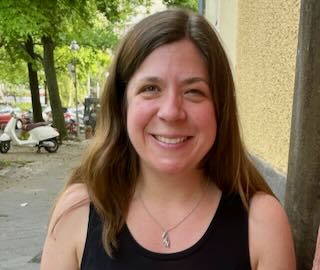
ReviewerMelissa Oliveira’s essays, poems and stories are published in Ploughshares Solos, AGNI, Post Road, BOAAT Journal, The Normal School and others. Her work was listed as a Best American Essays Notable, nominated for the Best of the Net Anthology and has received honorable mention in Glimmer Train’s Short Story Award for New Writers. She is a regular book reviewer for Hippocampus Magazine, and her reviews have also appeared in The Kenyon Review Online, Brevity, and more. She is a graduate of the University of Colorado (MA) and the University of Connecticut (BA). She lives in Berlin, Germany.