Reviewed by Dorothy Rice

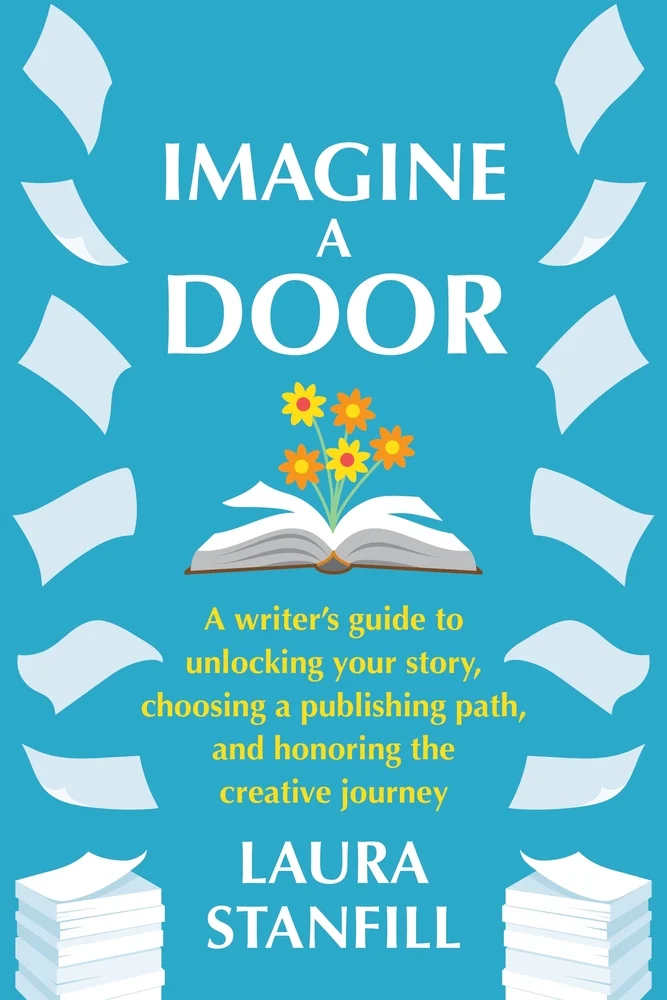 Based solely on the title, Imagine A Door:A Writer’s Guide to Unlocking Your Story, Choosing a Publishing Path, and Honoring the Creative Journey (Forest Avenue Press, April 2025), I expected to find writing prompts for tapping into creativity and imagination.
Imagine a door, the words themselves, reminded me of a popular prompt used with youth writers at the nonprofit where I facilitated workshops for years (a tempting array of photographs of literal, touchable doors — from castle gatehouses to mysterious trap doors — the prompt is to write to wherever your chosen door takes your imagination and your pen).
Stanfill’s Imagine a Door contains plenty of exercises for unlocking creativity, helping writers find their “why” and their desired path (or door) forward, and more. But that’s the tip of the proverbial iceberg. This non-genre-specific, just under 500-page tome covers all phases and aspects of the writing journey, including helpful responses to most of the questions new writers and writers new to a community tend to ask (like, how do I find a writing partner or critique group, where are the literary events, the classes and workshops, and, how do submissions work?) There’s also an index for searching specific terms, names and concepts.
Throughout, the author’s observations and advice are supplemented with references and quotes from the many interviews she conducted with authors and subject matter experts while conceiving Imagine a Door – such as literary agent Daniel Lazar, publishing industry expert Jane Friedman, authors Lidia Yuknavitch, Rosanne Parry and Beth Kephart (who provides the book’s Foreword), among many others.
Like many writers, I have amassed a bookshelf of craft books, some well-thumbed, some less so. That said, I can’t think of another writing resource that covers so much terrain and from such a variety of perspectives. It isn’t only the breadth of topics —from initial concept, drafting and revising, to querying, publication paths and more — that makes Imagine a Door such a rich resource. Apart from the information, tips and lessons learned, Stanfill’s refreshing philosophy, her belief in the importance of community, generosity, gratitude and accessibility for all writers, published and not, mainstream and otherwise —provide an open invitation.
Stanfill writes, she’s “been there, done that, and here’s what I want to share with you.” She brings the accumulated knowledge acquired during her own writing and publishing journey: from journalist to struggling to be published in literary journals and find community, coping with rejection and imposter syndrome, to book author in search of a press, then published author finding the right way for her, as a neurodivergent author, to show up in the world while protecting her physical and mental health. Add to that journey, Stanfill’s experience in publishing, as editor and founder (in 2012) of a small press (Forest Avenue Press).
“From this place, in the middle of my publishing journey,” she writes, “I hold out these pages to you. I hope they recalibrate your sense of success and help you feel less lonely.” With passages like the following, she does just that:
“I’ve seen author defined as someone who has a signed book contract, someone who makes money from writing, and/or someone who has been published. Writers, these guides suggest, are the rest of us. Depending on the person trying to establish the hierarchy, how published you are might matter too. Like, a full-length book would count: congrats, you’re an author! But an essay in a small-circulation journal might not. But I say all of it counts. If you’re writing, that’s as legitimate a practice as anyone else’s. Hierarchical definitions pit us against each other. They make some of us doing the work of writing feel smaller or lesser. They also are intended to shore up outdated societal structures—ones that have historically promoted racist and ableist thinking.”
Imagine A Door is a valuable go-to for those times when writers lose the path forward, wonder whether they have anything worthwhile to say, feel like an imposter, or are weighed down by rejection and indifference (isn’t that all writers?). It’s also a powerful resource for once the book is cooked and the writer scratches their head and wonders, what now? Stanfill’s experience and expertise, bolstered with insights and examples from her many interviews, are evident in the book’s sections on the variety of publishing paths, querying, deciding on a title, determining comps, and, ultimately, finding the right fit for both author and book. She provides a nonjudgemental, comprehensive explanation of the different paths to publication, from traditional “big five” publisher, to independent presses (small and not so small) and literary presses, to hybrid and self-publishing, including the strengths and pitfalls a writer might encounter with each (such as small presses closing, or losing their distributor as happened for many presses when Small Press Distribution closed, and hybrid presses that promote themselves as “traditional.”) She writes:
“The traditional way into publishing—getting an agent who then sells your book to a press—is not the only path. There are so many others. Part of our journey needs to be identifying the options. Another part is being really clear with ourselves about our goals. What do we want and why? Are they realistic goals? What’s the backup plan? How about a backup backup?”
As someone who has published two books with small presses (one of which no longer exists), the section that really piqued my interest was on book distribution, something I hadn’t fully considered, or, as I learned thanks to Stanfill, understood. She describes distribution as the biggest factor in getting a published book out into the world and into the hands of readers and details the various modes of distribution (from in-house and full-service distribution to what she calls no frills distribution, and down the line to fulfilment, self-distribution and print on demand). Writers will want to pay special attention to this section, particularly if they hope to find their title in bookstores and libraries, and ultimately reader’s hands by means other than hand selling at events and entering into individual consignment agreements with book sellers. Stanfill explains:
“If you’ve dreamed about a big five deal but are tired of looking for an agent, or if your agent couldn’t sell your book, a press with full-service distribution might be able to meet your goals. Small presses with full-service distribution can compete with big five titles—Braiding Sweetgrass by Robin Wall Kimmerer (Milkweed Editions) and The Hidden Life of Trees by Peter Wohlleben (Greystone) are two best-sellers by small presses distributed in the US by Publishers Group West, which also distributes Forest Avenue Press. PGW also distributes Europa Editions, which published the New York Times number one best book of the twenty-first century, My Brilliant Friend by Elena Ferrante, translated by Ann Goldstein. It only takes one title like that to sustain a press financially for the long term.”
In the final pages of Imagine a Door, Laura Stanfill brings the focus back to what writing is in the first instance, and ideally always — art, a conduit for the writer, the individual, to tap into and express who they are in the world:
“Whether your book finds a home and readers or whether you give up, the best next thing is to find a new project.
To imagine a door.
To consider which stories are waiting to be told.
Which ones are yours for the telling.
What creatures and characters and emotions you might conjure with your imagination.
Where your brain might pull you.”
The image of that imagined door (which I see as weathered wood on a cottage in the forest) transported me back to classrooms of kids studying photographs of their chosen doors, then scribbling excitedly in their notebooks, spinning stories, conjuring places and characters only they could have brought to the page. In stepping through their doors and recording what only they could see, I hope they felt the power of their unique voice. I believe they did.
Imagine A Door is so much more than a craft book for writers. It’s a powerful reminder of a fundamental truth and right: everyone is a writer; what we choose to do with our words, whether and how we share them involves myriad choices, none more right or wrong than the other. Once we imagine a door, the possibilities are limitless.
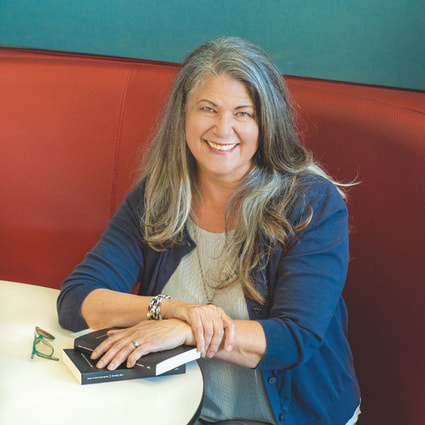 Dorothy Rowena Rice is a writer, freelance editor, managing editor of the nonfiction and arts journal Under the Gum Tree and a board member with the Sacramento area youth literacy nonprofit, 916 Ink.
Her published books are The Reluctant Artist (Shanti Arts, 2015) and Gray Is the New Black (Otis Books, 2019). She is the editor of the anthology TWENTY TWENTY: 43 stories from a year like no other (2021, A Stories on Stage Sacramento Anthology). At age 60, after retiring from a 35-year career in environmental protection and raising five children, Dorothy earned an MFA in creative writing, from UC Riverside, Palm Desert. Learn more and find links to many of her published stories, essays, reviews and interviews at www.dorothyriceauthor.com