Reviewed by Brian Watson

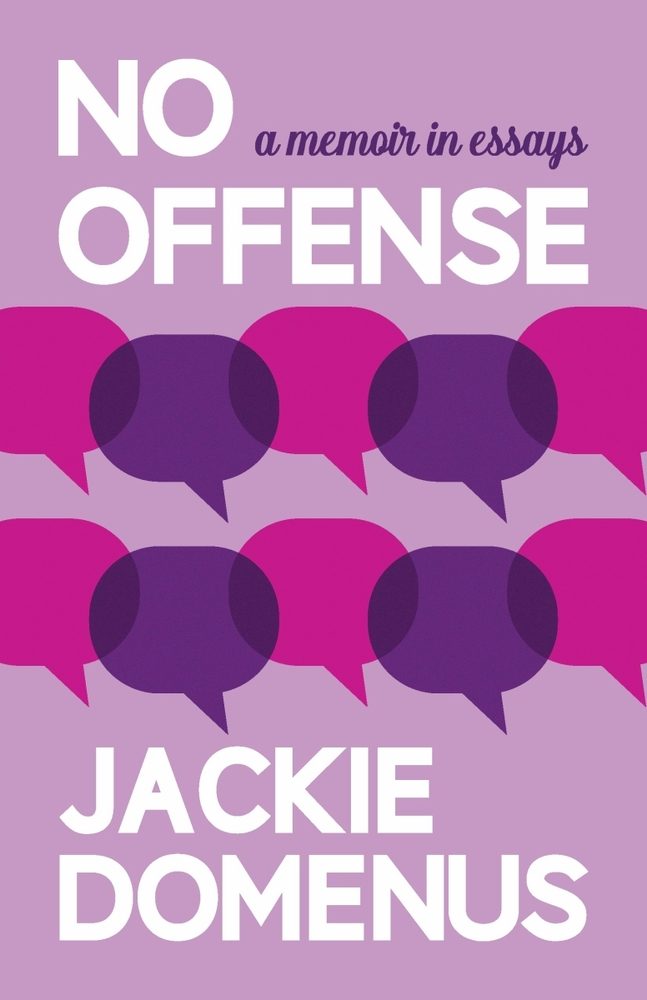 No Offense: A Memoir in Essays, by Jackie Domenus (ELJ Editions; February 2025) is the type of memoir I thought had gone out of style — and had been told as much by a literary agent who shall remain nameless.
No Offense is a coming-out memoir that details the many twists and turns Jackie experiences as they not only grapple with their own authentic identities, first as a lesbian, then as a nonbinary person, but also as they struggle to claim and share those identities.
When I first began reading works from authors living on the rainbow back in the 1980s and 1990s, the coming-out memoir and coming-out as a trope in fiction were not only common, they were necessary. Our liberation as queer people had only just begun, and people, myself included, yearned for guideposts, for examples, that we could emulate, particularly when the challenge of coming out occurred during the early years of the hiv/aids pandemic.
Fast forward three, four decades, and some people in publishing suggest that the next wave of coming-out stories must exceed that foundational trope. That the reading public wants queer authors to go beyond the coming-out moments to something more. Coming out and, they describe this new genre. Indeed, there are queer memoirists who deliver on that and. Jeremy Atherton Lin. Melissa Febos. Edgar Gomez. Greg Mania. George M. Johnson. Neel Patel. Manuel Betancourt. Among many others.
And yet, it was Mark Twain who quipped that “history doesn’t repeat itself, but it often rhymes,” which is why I am grateful that Jackie reminds us that the coming-out memoir is neither dead nor unnecessary.
The 1980s were profoundly homophobic, a backlash, I’ve heard it said, to the queer progress made in the preceding decades. But bigotry doesn’t need excuses to reassert itself, and when aids made its presence known in North America in 1981, haters seized on the scare to bedeck their rhetoric once more with a little religion. aids was “God’s punishment,” the product of the “sin” of homosexuality, when that selfsame sin wasn’t triggering tornadoes or hurricanes.
And although Ronald Reagan, Pat Robertson, Jimmy Swaggart, and Jesse Helms might be (gratefully) dead, Jackie painfully reminds us, against the backdrop of present cruelty and bigotry, of the panic queer people knew, the panic I knew, too, in a series of essays that travel, mainly chronologically, from Jackie’s childhood to their twenties.
The first essay, “Tomboy,” ricochets through different childhood vignettes, providing a pointillistic portrait, made all the more vivid with the use of the present tense, of Jackie’s understanding of their self, contrasted against how women are perceived by society, a perception Jackie calls attention to as they write, “this feeling of inferiority will only become more familiar — when they walk down city streets and are whistled at like dogs or when they start their first full-time job and wonder why they earn less than their male counterparts who do the exact same work.”
“Tomboy” also reminds the queer reader of those moments of denial we construct as we realize — and then push back against — our authentic sexuality. “My Myspace bio reads something like ‘Yes I skateboard. No, not all girls who skateboard are lesbians.’” One vignette, one paragraph later, and Jackie writes, “I am twenty years old and realizing most girls who skateboard are in fact queer — including me.”
The second essay, “Of Dogs and Men,” uses even more lyric technique (the narrative is interwoven with footnoted descriptions of the Michael Vick dogfighting case as well as the origin of the phrase, a dog is man’s best friend) to not only portray a young Jackie’s poignant relationship with Lucky, their childhood dog, but also with their father, an impatient and gruff man who, at the moment Lucky needs to be put down, collapses into grief as he hugs his child. This heart-rending moment of sadness takes the reader beyond grief, however, and illuminates an important awakening for Jackie and an excellent refutation of the gender binary for all readers: “What a relief it was to know that tenderness could coexist with the boyishness inside of me. What a relief that I did not have to be one thing or the other.”
One of the most charming aspects of No Offense is Jackie’s decision to reimagine the media that queer children often recode to create greater resonance with our lives. An excellent example comes during the third essay, “Learned Behavior,” where Jackie re-envisions Mary Poppins as authentically queer:
“She’d float on down, her umbrella boasting the colors of the rainbow, wearing a power suit and clunky Doc Martens. She’d take one look at that pathetic Mr. Banks and throw her head back in a fit of laughter. She’d still be neat, precise, a hell of a singer. She’d still make friends with Bert, the chimney sweep. But in the end, she’d entice Mrs. Banks to leave her miserable husband and the two of them would fly away, the children hanging on to her boot straps with big, bright smiles across their faces.”
I remember my re-imaginings as a child, picturing Ponch and Jon from television’s CHiPs, for example, as a loving couple instead of mere coworkers, and deeply agree with Jackie’s conclusion within that essay, “perhaps I might have known myself.”
There are other moments of queer recognition. In “Sexually Active,” an essay powerfully centered — using the present tense for greater impact — on Jackie’s experience with a homophobic nurse in a gynecologist’s office, Jackie describes the moment they share news of their first relationship, one with another woman, with their coworkers. As is so often the case, the heterosexuals to whom queer people come out treat the revelation as an invitation to ask about even more personal details. I’ve yet to ask any of my straight friends for details of their sex lives, yet Jackie is asked, as was I, “…which one of you is the guy?”
Jackie returns the reader to the gynecologist’s office in the next section of this essay and once again drops a truth bomb for queer people faced with the recursive need to educate people away from heteronormativity: “You’re thinking about how tired you are of throwing yourself out of the closet over and over again for complete strangers.” Amen, Jackie. When people say that life for queer people gets better, the tedium within this need for repeated revelation is not part of that equation.
And yet, Jackie returns to the question of coming out, this time as a queer person, at the end of the essay, A Closet, A Box, A Home, with beauty and inspirational self-acceptance:
“For me, queer felt like a warm blanket — one to neatly spread over all the explanations I’d always felt I owed people. Queer was a roof over my head when it seemed the world wouldn’t stop storming around me and I needed shelter. Queer was a place I could be surrounded by comfort and love. For me, queer was a home.”
I read No Offense as a PDF, and I am tempted to share screenshots. Jackie’s writing prompted page after page of highlighted sentences and circled paragraphs. As a reader, I was shouting my affirmations and applauding Jackie’s different journeys, and as much as I want to share much more of Jackie’s intelligence and self-kindness from each of the seventeen essays within No Offense with everyone, let me instead skip ahead to the final essay, the final coming-out moment.
That ultimate essay, “The Body You Keep,” is, as Jackie tells the reader, one that evolved. It began life early in Jackie’s relationship with their partner, Kaitlin, as an exploration of what Jackie describes as the “central narrative” of the relationship, Kaitlin’s eating disorder, anorexia.
The evolution, the reader learns, begins as Jackie also realizes that a self-hatred of the body is something they share with Kaitlin. But this revelation is not immediate. Jackie carefully details the impacts of Kaitlin’s anorexia on the early years of the relationship: the fights, Kaitlin’s near-constant need to exercise, and her near-constant guilt over her food choices. After several pages, the ah-ha moment arrives: “I did not have time to think about my body during those early years.” “I neglected myself and ignored my body and wrote instead about Kaitlin’s….”
The essay’s first version arrived as a blog post for Eating Disorder Awareness month, after Demi Lovato’s 2018 documentary, Simply Complicated, in which Demi discusses her eating disorders. It is then another Demi Lovato moment, when the performer came out as pansexual on an episode of Joe Rogan’s podcast in March of 2021, and then as nonbinary, two months later, on Instagram.
Demi’s eating disorder revelations had a significant impact on Kaitlin’s recovery; that rocky recovery pushed the relationship Kaitlin and Jackie shared to the breaking point, a separation that included the sale of the house they shared. And although Jackie reassures the reader that they and Kaitlin did reconcile, Jackie has one more discovery waiting, one that finally connected them with their body.
Jackie’s first true moment of gender euphoria, that moment of happiness you experience when external aspects of your self at last align with your internal perceptions, arrives after they decide to undergo a drastic haircut, one that begins a transition from long hair to a much higher, tighter look. This tonsorial awakening connects Jackie with her other experiences of gender dysphoria, those moments of shame, regret, or unhappiness when our external appearances do not align with our internal perceptions, and lead Jackie, and the reader, to a glorious, affirming conclusion: “…my body has continued on, malleable and strong and enduring of change. Its resilience leaves me in awe.”
I might have a vested interest in the sharing of coming-out stories like Jackie’s — I am also writing one — but unlike my nameless literary agent, I firmly believe that there can never be enough of them. Queer people come home to themselves in myriad ways, and what an honor it was for me to share in Jackie’s journey.
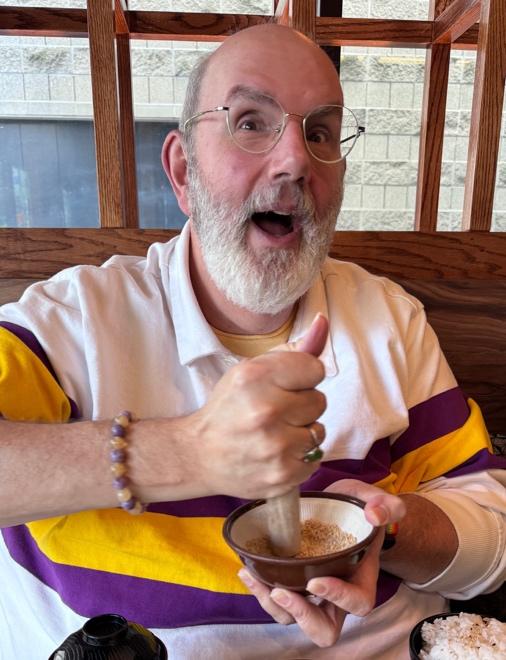 Brian Watson’s essays on queerness and Japan have been published in The Audacity’s Emerging Writer series and TriQuarterly, among other places. An excerpt from Crying in Foreign Language, their memoir’s manuscript, was recently accepted by Stone Canoe for the September 2025 issue. They were named a finalist in the 2025 Pacific Northwest Writer’s Association’s Unpublished Book contest, and in the 2024 Iron Horse Literary Review long-form essay contest.
Brian also won an honorable mention in the 2024 Writer’s Digest Annual Writing Competition. They share OUT OF JAPAN, their Substack newsletter, with more than 600 subscribers. In 2011, their published translation of a Japanese short story, MIDNIGHT ENCOUNTERS, by Tei’ichi Hirai, was nominated for a Science Fiction and Translation Fantasy Award.