Reviewed by Marissa Gallerani

 When Mallary Tenore Tarpley was 11, her mother died of breast cancer. While it was not the sole factor, this loss was a major contributor to the development of an eating disorder that ultimately required in patient treatment and hospitalization.
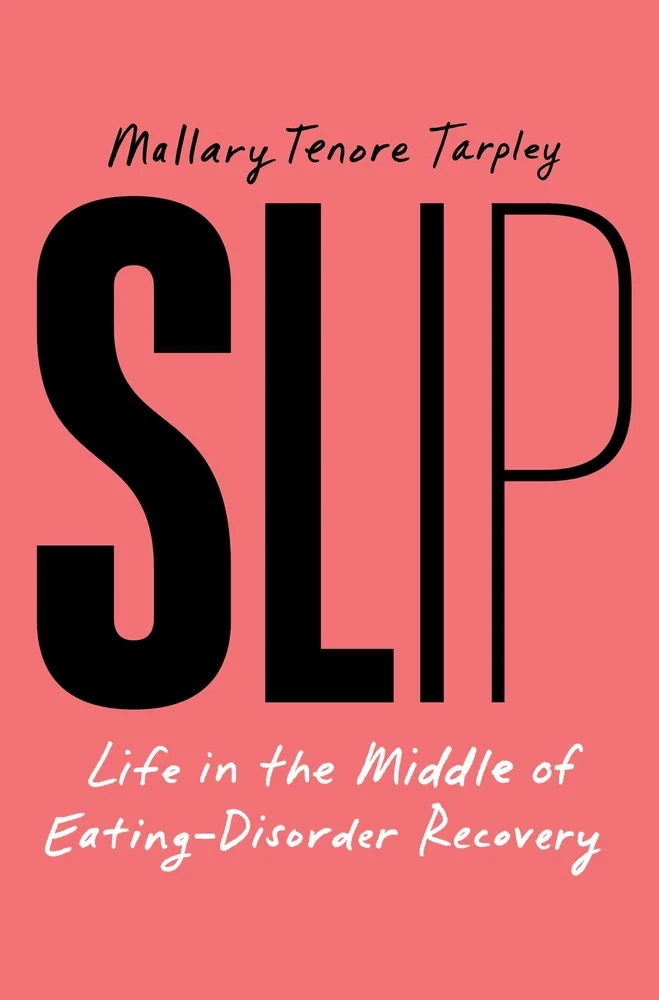
Slip: Life in the Middle of Eating Disorder Recovery (Simon Element; August 2025) is Tarpley’s memoir of those experiences, as well as an insight into the complex and contradictory nature of eating disorders.
Though the book is extensively researched (with more than 40 pages of sources and endnotes), Slip includes both memoir and journalism. Also included are excerpts of the many journals she kept as a child. Each chapter is structured similarly: Tarpley details her anecdotal experiences of living with and recovering from anorexia, and then after a break she weaves in the relevant research with each stage of her journey.
While it sounds it would be jarring to read, it’s not, and Tarpley seamlessly connects her lived experience to past and present scientific research. Her extensive journals allow her to compare her treatment with current standards, and, more importantly, what has and has not changed. She acknowledges in the book’s introduction that some of the entries she references can be triggering. If you are actively suffering from an eating disorder, I would skip this one.
After her successful recovery at age 16, Tarpley continues to detail the various ‘relapses’ throughout her adult life, including how anorexia has influenced sex, romantic relationships, and motherhood for her. As she notes in the text, we often have a limited and binary view of sickness narratives: we are sick, then we are well. There is no intermediary stage, and narratives that do include it often gloss over it for a tidy resolution. This all or nothing reasoning oversimplifies the true nature of eating disorders. Many of the subjects interviewed for this book do not consider themselves in full recovery from an eating disorder; just as many do.
Slip’s most important contribution is putting a name to a phenomenon that many sufferers of chronic illness will know intimately: the middle place. Tarpley argues for a more nuanced understanding of what recovery looks like, especially as recovery from an eating disorder looks markedly different than recovery from drug or alcohol abuse. Someone with an eating disorder will ultimately need to eat again; meaning the possibility for disordered behaviors always lurks. “I’m further along than I ever thought I would be,” she writes in the introduction. “But my disorder isn’t gone.” The middle place is neither active addiction or disorder, nor is it full recovery. It is not perfectionism but acceptance, and for a disorder that relies so heavily on the idea of perfection, this mental shift is critical to ongoing maintenance.
Ultimately, the ‘middle place’ that Tarpley describes can be applied to any illness or addiction. I have an anxiety disorder and Ehler-Danlos Syndrome, neither of which will ever be cured. Like many of the interview subjects in Slip, I cannot put my life on hold to wait until they resolve themselves. They won’t. The only way forward is to make peace with their existence and create a life that’s both livable and enjoyable, despite the illnesses in its midst. That’s ultimately the greatest lesson from Slip: that the middle place is attainable, and preferable, to active illness, and that there’s no shame in living there.
 Marissa Gallerani is a queer and disabled writer and teacher living in Providence, Rhode Island. She received her MFA from The Newport MFA at Salve Regina and has taught at multiple institutions of higher education including the New England Institute of Technology, Salve Regina University, and Write or Die. She has been published in The Harvard Review Online, the public’s radio, and The Financial Diet, among others. Marissa’s Substack, The Chaotic Reader, details her wide-ranging reading adventures. A life-long SFF fan, Marissa is currently at work on a science fantasy novel.