
Reviewed by Elizabeth Austin

Bailey Gaylin Moore’s essay collection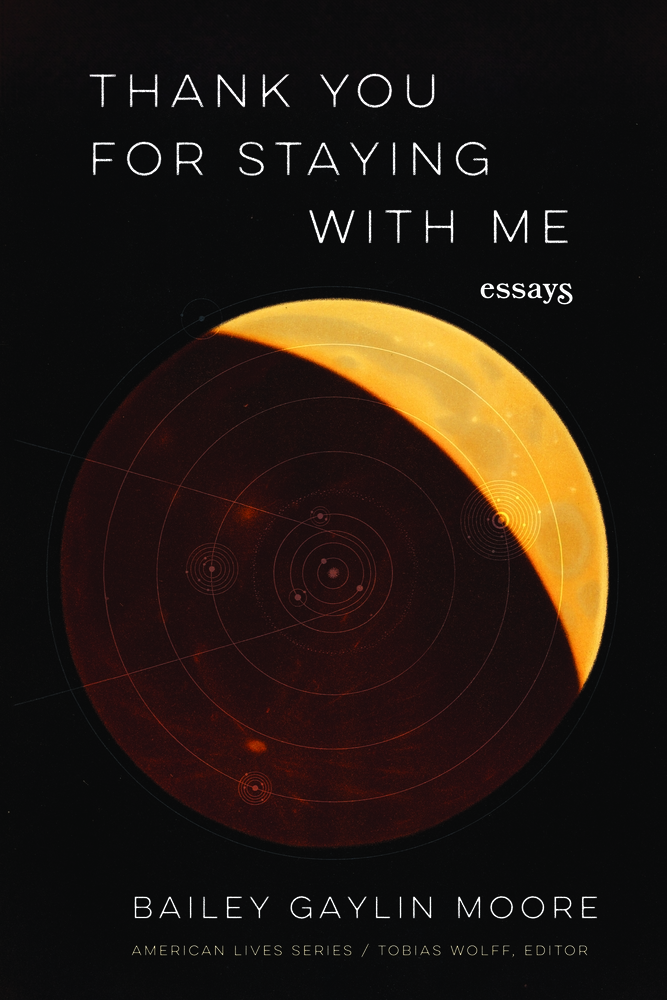 , Thank You for Staying with Me (University of Nebraska Press; 2025), reads like a friend who walks you back to yourself after you’ve been lost in the woods. It’s full of wonder and sharp observations, rooted in the red clay and complicated heritage of the Missouri Ozarks.
From the first essay, Moore invites us into a life lived on the edge of invisibility — young, poor, a mother before she was ready, thinking deeply in a place that doesn’t always welcome thoughtfulness, especially from women. And yet, she stays, looks closer, and makes art out of it.
Moore’s voice is intimate and smart, shifting effortlessly from memoir to philosophy, from motherhood to metaphysics. She draws constellations out of everyday experiences: a moment with her son, a teenage pregnancy, the ache of estrangement, the gravitational pull of a place that has shaped her and tried to unmake her. Throughout the book, the stars — literally and metaphorically — serve as quiet companions. She looks up often, asking the sky questions we’ve all asked in the dark: What does it mean to be seen? To stay? To leave?
These essays are not tidy– that’s part of their power. Moore plays with form in ways that feel earned, never gimmicky. She uses a braided structure in several pieces, pulling together scientific facts, myth, history, and deeply personal memory. In one standout essay, she weaves her experience of young motherhood with an examination of vagina dentata and Heidegger’s theories of choice. In her hands, it works beautifully. The tension between intellect and embodiment, between knowing and feeling, is what gives these essays their emotional voltage.
Moore’s narrative bravery allows her to write candidly about trauma, depression, and the shame that clings to girlhood like humidity in the South. She doesn’t flinch, but neither does she wallow. Her essays demand presence. Moore asks us to stay with her — through fear, through heartbreak, through the long, slow work of becoming.
The Ozarks are a character in their own right: beautiful, fraught, often misunderstood. Moore doesn’t romanticize them, but she also resists the easy caricatures of the region. She’s honest about its violence, its religiosity, and its contradictions. There’s a complicated, hard-earned love in this collection for a place that shaped her even as it tried to silence her. That push and pull is familiar to anyone who’s ever had to wrestle with the idea of “home.”
Another thread running through the book is motherhood, especially the kind that resists a traditional narrative. Moore became a mother in her teens in a place and time that offered little support and even less understanding. Her reflections on early motherhood are some of the most moving parts of the collection. She writes not only about raising her son, but about growing up alongside him.
There’s also a political undercurrent to these essays. Moore doesn’t write policy think pieces, but her lived experience speaks volumes about reproductive rights, the cost of invisibility, and the way systems fail women — especially poor, rural ones. She writes with compassion and clarity, never didactic, always grounded in the body and the land.
Reading this collection, a phrase someone said to me in a workshop kept coming to mind: “the most radical thing we can do is stay.” They meant stay with our work as writers, but the phrase has broader applications. In this collection, Moore invites us to stay— to bear witness not just to her story, but to the stories we’ve buried in ourselves. The title stands as both a request and a promise and reminds us that staying — with our pain, our questions, and each other — is a deeply courageous act.
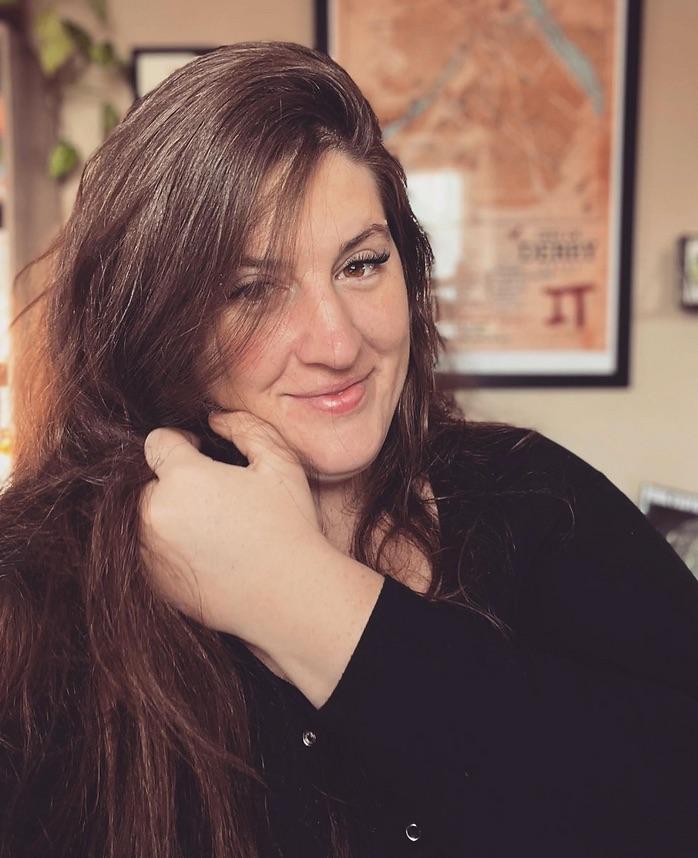 Elizabeth Austin’s writing has appeared in Time, Harper’s Bazaar, McSweeney’s, Narratively and others. She is working on a memoir about being a bad cancer mom. She lives outside of Philly with her two children and their many pets. Find her at writingelizabeth.com and on Instagram at @writingelizabeth