Reviewed by Angela L. Eckhart

 What was supposed to be a normal relaxing summer Sunday afternoon at a friends’ pool turned out to become a major defining moment for Mary Alice Stephens.
After several glasses of wine poolside, Stephens observed her toddler in the pool hugging a floating noodle and “motoring around in the deep end,” and it occurred to her that he could easily slip beneath the water.
When she heard herself proclaim (to be witty for her friends as Fun Mary), “Jake, don’t you slip off that noodle and make Mama have to put her wine down to save you!,” she instantly realized it was inappropriate, thinking, “What kind of mom says that to her kid?” But, that didn’t stop her from chugging a final glass of wine before leaving and then blacking out while her husband drove them home.
Even while inebriated, Stephens was aware of her husband’s disgust, and she had to face him and a wicked hangover the next morning. However, this time was different when she realized he’d slept in the guest room…for the very first time: “No matter how badly we’d argued before or how many times I’d gone to bed drunk, he was always by my side the next morning.” Images of him leaving her and custody battles flashed through her mind, punctuating the seriousness of her intoxication.
Her child at risk of drowning and her marriage at risk for ending, Stephens faced the fact that she had to make a drastic change: “I couldn’t believe what I was considering: I was going to have to quit drinking…forever.”
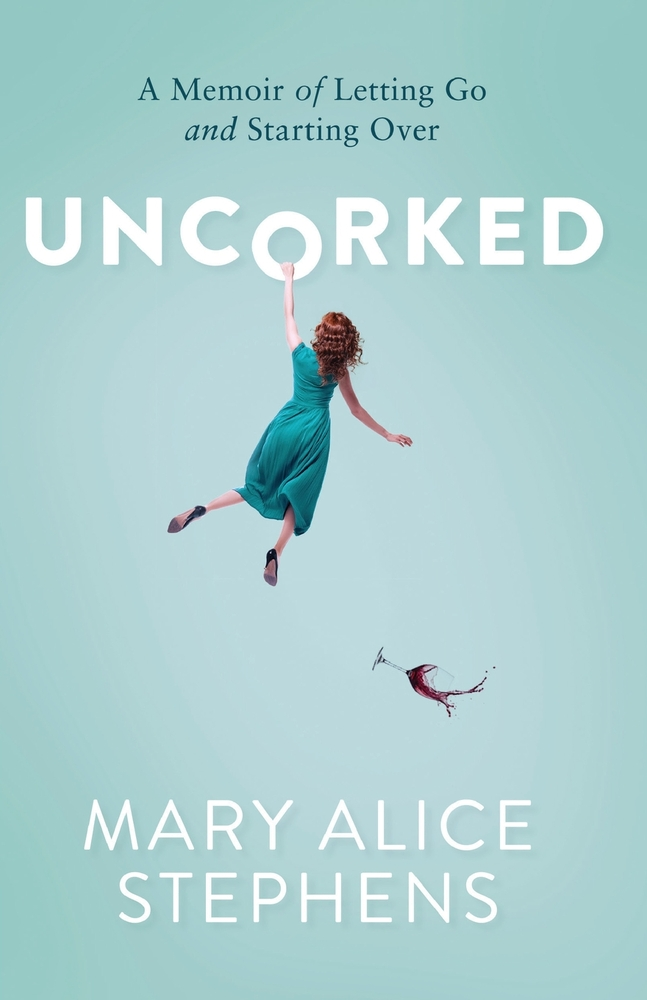
In her debut memoir, Uncorked: A Memoir of Letting Go and Starting Over (Sibylline Press; Aug 2025), Stephens, a television writer-producer and MFA in creative writing recipient, shares her deeply personal story of embarking on the path to sobriety, transitioning from Fun Mary to Sober Mary.
The narrative begins with a prologue taking readers to a hospital in Dublin, Ireland in 1988, when Stephens is 23 years old. She is studying abroad, and one night she endures a frightening and debilitating accident landing her in the ER for months. This scene is significant, because it permanently alters the course — and quality — of her life, and possibly becomes the catalyst to her decades-long alcoholism.
Following the prologue, the book is organized chronologically with chapters aptly titled by the content, and ending with the epilogue, which is “present-day” in 2022. In the first chapter, “My Last Drink(s),” we are propelled to that day in 2011 (when Stephens is 45 years old) when she consumes her last alcoholic beverages (mentioned in the opening scene above). This is where we first encounter Fun Mary, the life of the party, free of inhibitions and responsibility, and in subsequent chapters we eventually meet Sober Mary, the self-respecting and sensible wife and mother. The two often collide, as Stephens writes, “Sober Mary sat like an angel on one shoulder, while Fun Mary perched like the devil on the other.”
Stephens’ memoir discloses her experiences in Alcoholics Anonymous and her encounters with numerous, perpetual triggers challenging her goal of sobriety. In a world that reveres alcohol, the temptations were everywhere. She writes, “How was Sober Mary supposed to forget about booze when it was literally in my face all the time?” She likens the exposure to an ex. “Like after a breakup, I saw my ex everywhere. At the entrance to the grocery store, there were floor-to-ceiling shelves of wine, Gloria Ferrer’s Champagne billboard sparkled enticingly, and the restaurant wine menus were so extensive that they needed binding, yet not a single non-alcoholic drink was listed.”
Her voice shines in her cleverly crafted sentences interspersed throughout, such as describing a cherished moment with close friends, “The last time we saw them, we spent a liquid afternoon in our hot tub, drinking Champagne and laughing over parenting stories. By the time we got out, I was pickled (in more ways than one).” Her use of imagery and description is vivid, and it’s easy to imagine pictures in our minds. Of her mother, she writes, “She stood only five feet tall; I bent slightly to kiss her downy cheek. Everything physical about her was soft—her sweater, her posture, her gaze—but inside, she was tough Iowa farm stock.”
There are startling moments, too, such as the time her depressed, teenage self goes to confession to ask the Father about suicide (his answer was astounding), as well as the devastating way in which her older brother died at 32. The astute moments are many, and when Stephens proclaims, “I didn’t want to be on that merry-go-round again, drinking, blacking out, apologizing. I liked waking up clear-headed, proud, and energized,” I was rooting for her success. Facing obstacles in her path, most readers will be cheering her along, too, hoping that she doesn’t stumble off the trail.
Stephens writes with honesty and candor, allowing her readers to witness her vulnerability while she moves through the twelve steps of sobriety. She digs deep into her psyche, sharing the most intimate details of her life, and she does this to heal. Her self-reflection leads to insightful revelations. Even non-drinkers will be able to identify with parts of her life, such as those awkward teen years trying to fit in or encountering similar family situations and relationships.
On her writing style, I particularly admire how Stephens crafted and organized the chapter, “This I Like.” She frames the chapter about an upcoming meeting with her friend Cara around the full story of how she met and became friends with Cara. This chapter reads as if it could stand alone in a magazine or newspaper; the content is full-circle, with a beginning, middle, and end. It’s refreshing when writers write well!
Uncorked is entertaining and enlightening; it’s not just another memoir about an alcoholic. While it’s no secret she made it 365 days sober, the story leading up to that, combined with the morsels of wisdom and advice contained within, make it a worthwhile read. My copy is filled with highlighted passages and quotes; my highlighter ran out of ink.
As an occasional social drinker, I appreciated learning about the AA steps in detail and realizing that I can apply many of the teachings to my own life. Stephens gifted many gems, including those from her therapist Helen, who said, “You need to stop judging yourself…acknowledging the truth of how you feel will set you free…celebrate your uniqueness….” and from her sponsor Lena, who suggested that “flaws that bother you most in others are often those you share,” and “I want you to pray for calm and contentment….” Valuable lessons and advice for all. This is a memoir that will be shared amongst my literary acquaintances.
 Angela earned her MA in creative writing from Wilkes University. She’s edited two books for local authors and worked as an adjunct writing professor at her local community college for two semesters. She has completed a novel, is currently working on a memoir, and has been reviewing books for Hippocampus magazine since 2011, where she previously served as book reviews editor for several years.