
Reviewed by Marjorie Maddox

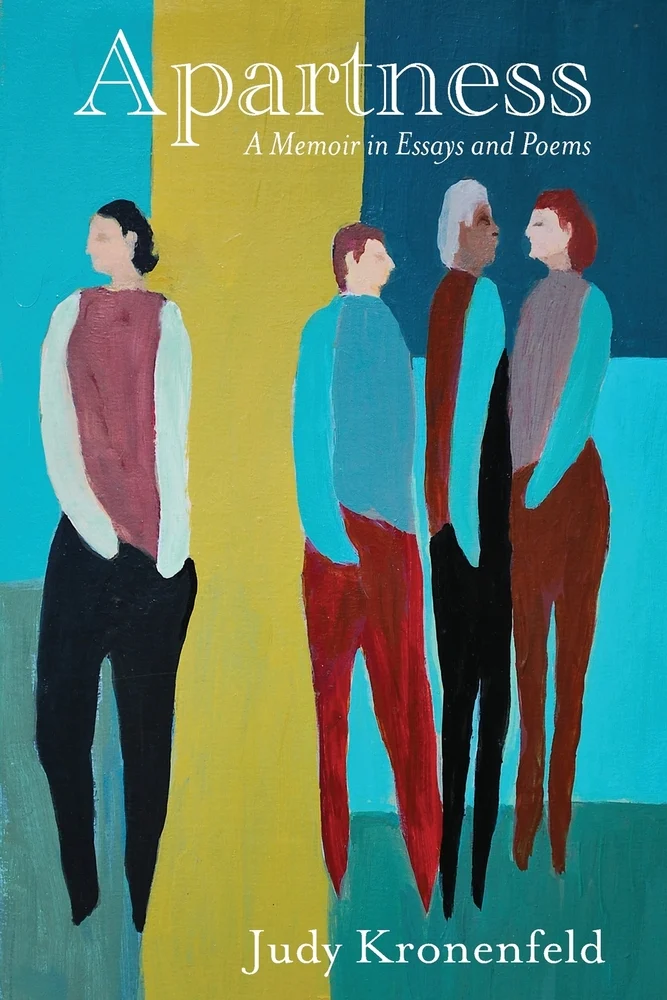
Apartness: A Memoir in Essays and Poems by Judy Kronenfeld, is a cultural, intellectual, historical and, at times, emotional ride through the author’s life in the U.S., France, Ghana, and elsewhere, beginning in the 1940s and continuing through 2017. Despite its title, this collection emphasizes perspective and connections: what draws us together, pushes us apart, or leaves us in the limbo of “between.” With its poetic road markers and satisfying twists and turns, Apartness keeps us looking out this window, then this one, then straight ahead, then directly into the rearview mirror of the past.
 Often, Kronenfeld’s family takes center view: a father’s near escape from Nazi Germany, a mother’s emphasis on decorum and the division between home and “street” life, the author’s childhood “in a lower-class immigrant neighborhood in the Bronx,” next to an Orthodox synagogue attended only once. Kronenfeld also wrestles with the parental, societal, and religious decisions that fill her marriage, while also modeling choice for her children.
At times, though, choice seems an illusion, complicating the question of identity for one who describes her Jewishness as “weak as a fifth cup of tea brewed with the same tea bag.” A scholar of 17th century Metaphysical Poetry, dripping with Christianity; a lover of the Jesuit poet Gerard Manley Hopkins; and the author of King Lear and the Naked Truth: Rethinking the Language of Religion and Resistance, Kronenfeld examines what it’s like to be part of and separate from various faith, academic, and cultural communities, as well as those separated by language and comprehension.
She does so by expertly immersing us in experience: shopping jaunts with her mother, a trip to France where she breaks her wrist but successfully engages with the people and language, the process of being interviewed for an academic teaching job while very pregnant during the women’s rights movement of the 1970s, a conversation with a stranger at a noisy conference banquet while deaf in one ear, a late-life synagogue membership prompted by social ties and the friendship of a progressive female rabbi.
In two of her most moving chapters, “Woosh!” and “Brief Dip into Ethnicity,” Kronenfeld focuses on her father. In the former, she accompanies him to his urologist appointment, during which, due to dementia, he forgets about his prostate cancer and repeats the same queries and responses. “Oh, I didn’t know,” “And how are the children?” and “woosh!” become a powerful litany of the lost when what Kronenfeld really “want[s] to know is how exactly he left Germany in 1934.”
In “Brief Dip into Ethnicity,” Kronenfeld joins forces with her daughter to fulfill her father’s wish to be buried in a casket affixed with the Jewish star—the casket they actually chose, “realiz[ing] even if I would never wear the star—how important it had been and was that my parents wore it for me, even in their deaths.” Despite her best efforts, once again she is made painfully aware of her “apartness”; the funeral home fails in its task. Nevertheless, her vocalization of the error leads to some sense of recognition (though still misunderstood), which allows her to own her grief. “My claim on the star had been registered. I could let it go. I heard the silence then, and moved into it: the long silence of my father’s death.”
By the end of the memoir, Kronenfeld reiterates the importance of landscape, gifting us snapshots of both US coasts, several countries, and time-stamped memories connecting moments from throughout the collection. At each juncture, she’s posted her all-important road markers, poems that complement versus summarize the prose, leading us to both question and embrace identity in the circuitous route between “apartness,” choice, acceptance, and community. A smart, honest, and perceptively written collection, Apartness is a hybrid memoir that questions and sometimes finds—in its various forms and definitions—this place called “home.”
 Commonwealth University professor emerita of English, Presence assistant editor, and WPSU-FM Poetry Moment host, Marjorie Maddox has published 17 collections of poetry—most recently Small Earthly Space and Seeing Things—as well as a story collection, 4 children’s books, and the anthologies Common Wealth and Keystone Poetry (co-editor with Jerry Wemple). www.marjoriemaddox.com