
Reviewed by Sara Pisak

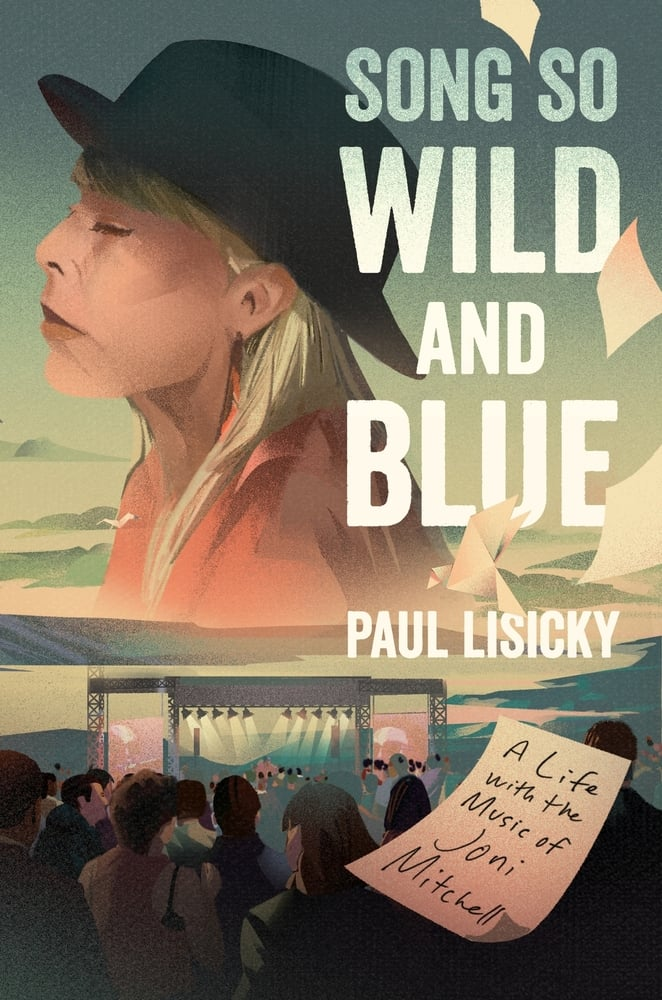 Paul Lisicky’s Song So Wild and Blue: A Life with the Music of Joni Mitchell allows his life and the music, life, and writing of Joni Mitchell sing in harmony. Equal parts memoir and Mitchell biography, Lisicky uses the folk legend’s song writing and personal struggles to help himself and the reader better understand significant moments in his life.
One of the most noteworthy moments Lisicky discusses is his transition from songwriter to prose writer. As a songwriter himself, he finds solace and clarity in both his own writings and in Mitchell’s. Together Lisicky and Mitchell forge a life engulfed in appreciation for the power of language that aids in his newfound love of prose.
Regarding his transition from songwriting to fiction, Lisicky writes, “[…] Deep down under my skin, I knew it wasn’t as far as it seemed. Novels and short stories lived on the other side of the room, though some would say, Oh no, and offer their pronouncements.” Lisicky’s transition to fiction writing mirrors Micthell’s other artistic pursuits like painting. To overcome his doubts as a writer, Lisicky uses this parallel of being songwriters who share other artistic outlets to help him find the musicality, fluidity, and freedom in language’s many forms.
Music as its own language is a clear thread throughout Song So Wild and Blue. Lisicky observes:
Music is water: I understand it to be so in that it breaks down levels; it equalizes. Once anyone is inside music, there isn’t a boss of it; the listener means as much as the players. And we aren’t ourselves anymore, not quite, with our usual heaviness and dashed hopes. If anything, it makes us lighter, buoyant. We float.
Music as an equalizer that ebbs and flows, forming a bond with the listener has as much to do with the melody and instruments as it has to do with the written notes and words. The poetics and storytelling that lift listeners in music and form metaphors, themes, and imagery equally hold their weight and importance in other written forms such as prose. Floating on the musicality of songwriting starts as a way for Lisicky to analyze, understand, and appreciate Mitchell’s greatest hits and deep cuts, but it quickly evolves into a life raft, guiding his understanding of his own writings and journey as a writer, musician, educator, and editor.
On the subject of music and language Lisicky continues, “Music offered polarity. Music made sure the song wouldn’t be received in one direction but several.” The freedom music offers is freedom that reverberates in language. Music’s polarity is an echo of the novel’s choose your own adventure; it is an echo of the personal experience in reader response; it is an echo of the author’s lived experience; it is an echo in the stark contrast of a soliloquy; it is an echo of the polarity of poetic form and content; and foremost it is an echo of language’s contractions.
Music’s polarity reaffirms language’s polarity and contractions and vice versa. Lisicky discusses language’s polarity:
Language is unruly; language wants to mean ten things at once. That’s exactly what I found compelling about it. By contending with the process that unnerved me, I was making sure it didn’t dominate the person I tried to be. It was always steaming ahead of me, and it was my job to catch up.
Like music, language is compelling because of its contradictions and juxtapositions. For a writer of any genre or form, language’s rowdiness can either steamroll you or you can use it to create and think innovatively.
Song So Wild and Blue is innovative because of its ability to see Mitchell’s unique and juxtaposing key changes and chord progressions, as well as her unique imagery and diction in some of her biggest hits like “The Circle Game,” “A Case of You,” “Free Man in Paris,” and “Both Sides Now” as a reflection of the Lisicky’s own unique relationship to the written word and his life.
After reading Song So Wild and Blue, it confirms language is the main tool readers, writers, musicians, and listeners have to create uniquely, personal meaning and understanding in the polarity of their lives. Perhaps, Joni Mitchell sung it best in “Both Sides Now,” “It’s life’s illusions that I recall. I really don’t know life at all.” Language takes our illusions and creates concrete meaning; language takes our concrete meanings and makes them illusions.

Sara Pisak
Community Content EditorSara Pisak is a reviewer, essayist, and poet. Sara participates in the Poetry in Transit Program and has work in The Rumpus, The Fourth River, LandLocked, Hippocampus, the Deaf Poets Society, Door is a Jar, and Appalachian Journal, among others. In total, she has published over 130 pieces. When not writing, Sara can be found spending time with her family and friends.
Role: As community content editor, Sara creates written and visual content for Hippocampus social channels and website, helping promote our magazine and uplift our contributors.