Reviewed by Carolyn Roy-Bornstein

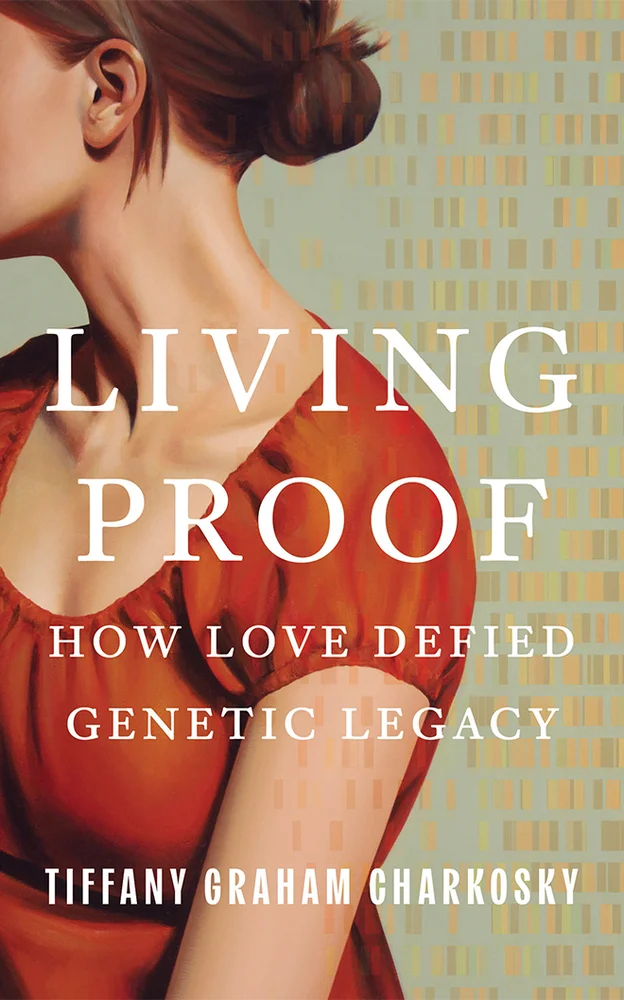 Tiffany Graham Charkosky calls her book Living Proof: How Love Defied a Genetic Legacy (Little A; October 2025) “a love letter.” It is a love letter to her mom who died of cancer at the age of thirty when Tiffany was just 11 years old. To her children, who may carry the same gene mutation that set her on a roller coaster of lifelong screenings, tests, and surgeries, and to her husband, her stalwart mate who always steadies her sometimes shaky ship.
But it is also a love letter to us, her readers, offering us a glimpse into a world of uncertainty and ambiguity. A world where each of her family members must decide for themselves how to use the information her father shares one day: that her uncle had testing during his cancer treatment that revealed a gene mutation that potentially places the entire family at risk for certain cancer diagnoses.
Tiffany may or may not have the same gene.
This information isn’t known or suspected when the author is 11 years old and loses her mother to colon cancer. All she knows at that point, with searing certainty and wobbly per-adolescent wisdom, is that her mother is gone forever. (“So keen was my need for a silver lining, I made this loss into my superpower…the notion that I was operating on a different level carried me through the chaos of my grief.”)
While this new information goes a long way toward explaining a family whose members have died at remarkably young ages, it also sends the author on a journey of uncertainty and impossible choices: whether or not to get tested for the gene that caused her mother’s cancer death, whether to try to have a second child and when, and should certain at-risk organs be removed and at what age. Her siblings have the same decisions to make; each tries to respect the others’ choices.
The book is structured in alternating timelines. We see the younger Charkosky struggling to make sense of her cataclysmic loss, throwing herself into her studies, trying to fit in at a new school while being the girl with no mom. Alongside this storyline, we also follow the adult Charkosky as she weighs her options, waits for nail-biting days and weeks for answers, and tries to shield her husband from what she can while he supports her as much as he is able.
The book is strongest when the clear-eyed, wise-minded author reflects upon the journey her mom must have made: on the milestones she survives to see: when she reaches the age her mother passed. When her oldest turns the age she was when she lost her mom. Going through her own cancer-centric journey informs, and in some ways creates, a new relationship with her mother: one where she sees her mother not as an abandoner of family, but a multi-faceted woman struggling with loss, present and future.
Tiffany pours her energy into creating as happy and normal a life for her family as possible, despite her own anxieties, procedures, surgeries, and daunting family history. “I didn’t realize how much of my adulthood would be spent nurturing the child I used to be… If I could give my own children a solid, peaceful childhood — the life I wished I’d had — then maybe I would make up for everything that had broken down in mine.”
In the writing of memoir, there are three selves. The experiencing self is the person going through the ordeal or on the journey, the protagonist of the story. Then there is the remembering self or the narrator, the one who is sharing her story with us, the readers. There is also the author herself. In Charkosky’s book, this is the self who steps out from behind the curtain of words on the last few pages of Proof to share with us what the experience of writing this book has meant to her.
It is my favorite part of this reading experience.
She shares, “I feel the most alive, like the most authentic version of myself, when I’m writing. I’m the mother I wanted, the wife and life partner I aspire to be, the person I’ve always been when I gift myself this creative time… My best life requires finding words for the feelings agitating below my skin. It needs laughter and sunshine, movement and time outside, books, music, art, and the space to try these things myself.”
With these words, Charkosky articulates all that I feel as a writer of memoir living a creative life. She also conveys the power of narrative to build empathy, foster agency, deepen self-awareness, and cultivate our own practical wisdom. Writing also creates connected community, helps others feel seen and heard, and helps us all feel a little less alone in this world. In this regard, Charkosky and her book succeed immeasurably.
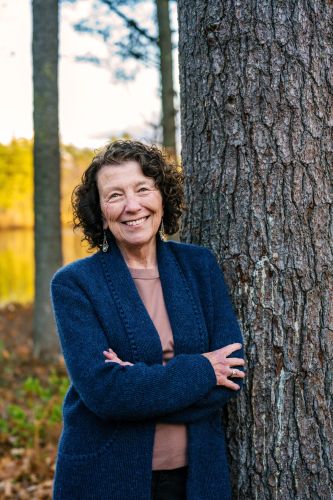
Carolyn Roy-Bornstein is a retired pediatrician and the writer-in-residence at a large family medicine residency program. Her work has appeared in The Washington Post, The New York Times, The Boston Globe, JAMA, Poets & Writers, The Writer magazine, and other venues. Her most recent book, A Prescription for Burnout: Restorative Writing forHealthcare Professionals is forthcoming with Johns Hopkins University Press in April 2026.