
Reviewed by Vicki Mayk

 I wouldn’t be honest if I didn’t admit that I’ve watched some of the true crime documentaries and series that are a significant part of the programming on most streaming services. While not exactly a fan of the genre, I’ve used these shows as a welcome distraction, a kind of junk food for my brain.
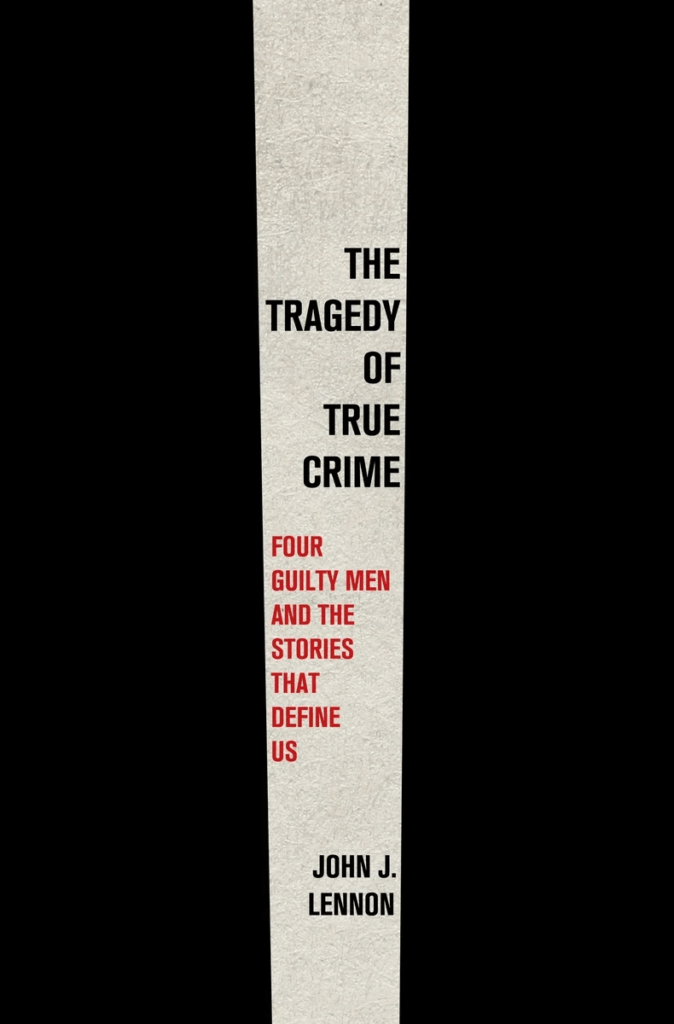
Now that I’ve read John J. Lennon’s The Tragedy of True Crime: Four Guilty Men and The Stories That Define Us (Celadon Books; September 2025), I’ll never think about true crime in the same way. Brilliantly blending reported nonfiction, immersive journalism, and memoir, Lennon — a convict who has so far served 24 years for murder — writes, “The stories we tell about the worst of humanity are a reflection on all of us. True crime is the antithesis to the notion that we are more than our crimes.” Then Lennon shows us how it should be done, as he tells the stories of four convicts – including himself.
The Tragedy of True Crime is hard to pigeonhole. It’s a book about four convicts — one of them the author. It’s a book about prison and prison culture. It’s a book about the evolving nature of the prison system and the laws governing how people are tried, convicted, and sentenced. And it’s a book about the true crime genre and how it has made horrible crimes a form of entertainment. That it can be all these things while holding readers’ attention in a meticulously researched and beautifully written narrative is a tribute to Lennon’s skill.
The book is organized into Acts, as if it is its own kind of true crime show. It opens with a prologue recounting Lennon’s experience being the subject of a true crime television show, HLN’s Inside Evil, hosted by Chris Cuomo. Lennon writes how he was duped by the show’s producers, who assured him that the word ‘evil’ was no longer in the show’s title. (“That was just the first season,” they say.) He learns that is not true, that the show embraces the sensationalism seen in other true crime shows.
Lennon also uses the prologue to give his own backstory. As a 24-year-old drug dealer in Brooklyn, he shot a man and was convicted and sentenced to 28 years to life in prison. He traces his early days in New York state prisons — first at the infamous Rikers Island, then Sing Sing, then on to the Clinton Correctional Facility, and eventually to Attica, the site of the legendary 1971 prison riot.
While at Attica, Lennon gets sober and takes a creative writing class. Falling in love with writing, he polishes his craft, landing his first published story in The Atlantic. Credits in The New York Times, The Marshall Project, The New York Review of Books, and Esquire followed, establishing him as a prison journalist.
Lennon refuses to embrace what he calls “the good versus evil binary,” as he tells his own story and that of three other convicts. In Act 1, “The Meet,” we meet Michael Shane Hale, serving 50 years to life for killing his 62-year-old male partner when he was 23 in 1995. He introduces us to Milton E. Jones, serving 50 years to life for killing two priests in 1987. Finally, we meet the one person in the book whose story has already been the subject of true crime shows: Robert Chambers, dubbed the “Preppy Killer” for strangling Jennifer Levin in 1986 while they were hooking up in Central Park. Chambers had served 15 years for manslaughter but returned to prison after being busted in a drug sting.
“When you learn about the crime before you meet the person, it makes you recoil; it colors everything about them,” Lennon writes. Although we know each man has committed murder, we first learn about them separate from their crimes. Lennon skillfully weaves his own story among the details of each man’s life, finding commonalities in their experience. For example, when he meets Milton Jones, the two bond over the memory of their mothers beating them when they were children.
In Act II, “The Killing,” Lennon writes a detailed account of each man’s crime. He makes no excuses for his own actions or that of his subjects. But as we learn about the murders committed by the men in horrific detail, we continue to see them as human — the antithesis of how they are presented in true crime shows. Lennon’s ability to create this balance is impressive.
“When I reported out the lives of Shane, Milton, and Rob, the experience became a foil for me to better understand the good-versus-evil binary is lazy storytelling. It’s also an inaccurate depiction of why violence occurs,” Lennon says. It struck me that this is a reminder for any of us writing nonfiction and memoir: no real-life character is ever one-dimensional.
Acts III, “The Time,” and Act IV, “The Reckoning,” trace the men’s many years in prison. In addition to following the lives of his subjects, Lennon explores aspects of prison culture: addiction and rampant drug use, fights and brutality among prisoners, the high incidence of mental health problems among the incarcerated. In some cases, these issues are considered in the stories of the men Lennon profiles. In other cases, he’s seamlessly woven them into the narrative.
Prison is the fifth character in the book. “Words build worlds,” Lennon writes, “and in this narrative nonfiction book written from prison, I’ve tried to use more authentic prose — convict, prisoner, the joint. I use terms like “CO” and “guard,” “tier” and “gallery,” interchangeably. These are terms I hear every day.” This is an insider’s account, layered with vivid details, and we see prison through the lens of a writer who lives there. As the four prisoners are transferred between prisons, Lennon deftly captures the unique cultures of each: Attica, renowned for its brutality, and Sing Sing, a jail with a legendary name and a more humane environment.
Lennon is friends with poet and MacArthur Fellow Reginald Dwayne Betts, a former convict who discovered poetry while incarcerated. Betts has been a supporter of Lennon and his work. Act IV’s epigraph quotes Betts: “So much of prison is trying to master the art of becoming. Who do you want to become?” Clearly John J. Lennon has answered that question: He became a writer. And a damn good one.

Vicki Mayk
ReviewerVicki Mayk is a memoirist, nonfiction writer and magazine editor who has enjoyed a 40-year career in journalism and public relations. Her nonfiction book, Growing Up On the Gridiron: Football, Friendship, and the Tragic Life of Owen Thomas (Beacon Press) was published in September 2020. Her creative nonfiction has been published in Hippocampus Magazine, Literary Mama, The Manifest-Station and in the anthology Air, published by Books by Hippocampus. She’s been the editor of three university magazines, most recently at Wilkes University in Wilkes-Barre, Pa., and now freelances and teaches adult writing workshops. Vicki previously served as reviews editor at Hippocampus Magazine. Connect with her at vickimayk.com.