Reviewed by Melissa Oliviera

 “When I make a quilt,” textile artist Gabriella D’Italia writes in her new memoir Getting Dressed in the Dark: An Artist’s Way Home (Unsolicited Press; October 2025), “I start with a fabric I love and I look for others. Sometimes it takes over a decade to find all the right ones. As they form a pile on the shelf, I keep a watchful eye on their conversation… Each piece changes the others, irrevocably.”
It’s the kind of statement that could just as easily apply to writing a book or developing a relationship as to quilting: we collect paragraphs or experiences and, over time, we see what happens when we place them beside each other. A memoir may start as a collection of unrelated scenes, scraps of memories and reflections. It’s through the act of putting the pieces into conversation with others that the wider tapestry of a story emerges.
In D’Italia’s case, this story has everything to do with the idea of home: the one she built — literally rebuilt, from the studs out, with her then-husband Rob — in rural Maine, how that home was later ripped apart, and finally how she pieced together another home from the scraps.
When Getting Dressed in the Dark opens, we find D’Italia in a period of deep emotional turmoil. She is recently divorced and back in her childhood house in New Jersey. This house is no home, however; here, she never stops feeling as though she and her four dogs are intruding on the life of her parents, even when they aren’t there, and there is no space for the messiness of her grief. The sterile, enameled perfection of her childhood house seems to be the opposite of the one she owned with her husband in rural Maine: an old schoolhouse on a wooded lot that she Rob lovingly renovated by hand into a warm, inviting living space with gardens, generously open to friends.
This home, The Bell School, evolved into a space for community, where loved ones could share their lives and art with each other. “Home,” she writes, “is deeply entangled with my sense of identity.” Thus, held and protected by this home, with Rob’s family and a growing community of artists nearby, D’Italia built her own practice making practical, beautiful quilts and transitioning, over years, into more conceptual textile art.
One day, D’Italia falls in love with Cameron, an artist she meets during a residency in coastal Maine. “Before polyamory became mainstream nomenclature,” and after much soul-searching, Cameron joins the relationship with D’Italia and Rob. Cameron lives in a different state, and the trio stays closeted in rural, deeply conservative Maine. The relationship lasts for over a decade until an affair between one of D’Italia’s friends and Rob brings everything crashing down: relationship, community belonging, The Bell School — all of it.
In D’Italia’s words, “Rob admitted his affair to his parents, but in the same breath, eclipsed the past decade by telling them about our relationship with Cameron, which now was cast as my relationship with Cameron.” The end is swift and harrowing, and she flees Maine with her dogs and with Cameron’s help. At 40, working as a waitress and with a baby on the way, she starts over again in New York City, wondering, “Was the creative life I’d chosen now responsible for all of this chaos and pain? Was this disaster in which I found myself a mirror for how ugly I had become?” The time after, and the space of this book, seek in some way to answer this.
Getting Dressed in the Dark is divided into three parts with 43 shorter chapters. The collection’s three parts each correspond to an animal with significance for D’Italia, providing a larger structure and overview of themes. So Part 1: The Turtle, an animal that carries its own home with it while “absorbing what is outside so that she requires this all-but-consuming carapace. She is hard because she is soft” grapples with vulnerability and defense, laying out the story of the Bell School remodel and her early career. Part 2: The Heron (which “hunts alone at the edge”) explores the violent end of that period and the rocky transition into the homes that followed. Part 3: The Monarch, takes a wider view, touching more on creative transformation and process. Here, old family stories converse with her present work as the holistic stylist behind Mirror & Lens. Like the nets she once learned to make, where “one must tie a series of knots and connect them”, sometimes, these feel more like standalone essays in which related elements, actions and themes loop and repeat, connecting loosely but remaining in conversation.
One of the striking things about this book is how much D’Italia seems to grapple with the conceptual and the physical: the world of ideas, and that of the body. Her art begins with quilting, a discipline that is so deeply engaged with the tactile, with bodies: requiring hours of work with the hands, joining together scraps of material to become an object to warm and protect other bodies. Yet she often expresses a strong dissociation from her senses, being “the person that used the mind to avoid, and even to negate, the body.” This gulf between the mind and the senses does sometimes sneak into her book. In terms of craft, I was hungry for more scenic storytelling, more of the senses brought into the writing. At times, I felt removed from the action, with some major events feeling more told than shown, but at its best Getting Dressed in the Dark is engaging and deals beautifully and precisely with themes of home (as a physical space, and in one’s body) and the challenges of making art when you spend limited creative energy on making a home instead.
Still, I most enjoyed the chapters that talk about process, whether that is the process of renovating a house or making a quilt. “In Between” was one of my favorites for that reason: “It needed the body and the mind.” She clearly has this incredible gift employing her senses as an artist and later a stylist, and in the strongest, most moving parts of the book D’Italia melds the physical and the conceptual.
Indeed, “Quilts embody ideas,” D’Italia wrote in 2008 about a piece of hers featured in a book about the best contemporary quilts. With quilts, you’re never far from the physical, the material, the body, home. Books by writers on writing are pretty common, but I don’t often find one that talks in the same way about making other kinds of art in the way that Getting Dressed in the Dark: An Artist’s Way Home by Gabriella D’Italia does. Here is a quiet, thoughtful memoir, and the tensions she discusses about art-making, relationships and home remain as relevant now as when she was trying to make her own home in the Maine woods.
Melissa Oliveira
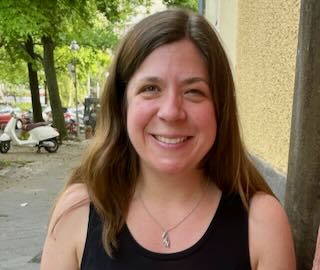
ReviewerMelissa Oliveira’s essays, poems and stories are published in Ploughshares Solos, AGNI, Post Road, BOAAT Journal, The Normal School and others. Her work was listed as a Best American Essays Notable, nominated for the Best of the Net Anthology and has received honorable mention in Glimmer Train’s Short Story Award for New Writers. She is a regular book reviewer for Hippocampus Magazine, and her reviews have also appeared in The Kenyon Review Online, Brevity, and more. She is a graduate of the University of Colorado (MA) and the University of Connecticut (BA). She lives in Berlin, Germany.