
Reviewed by Emily Webber

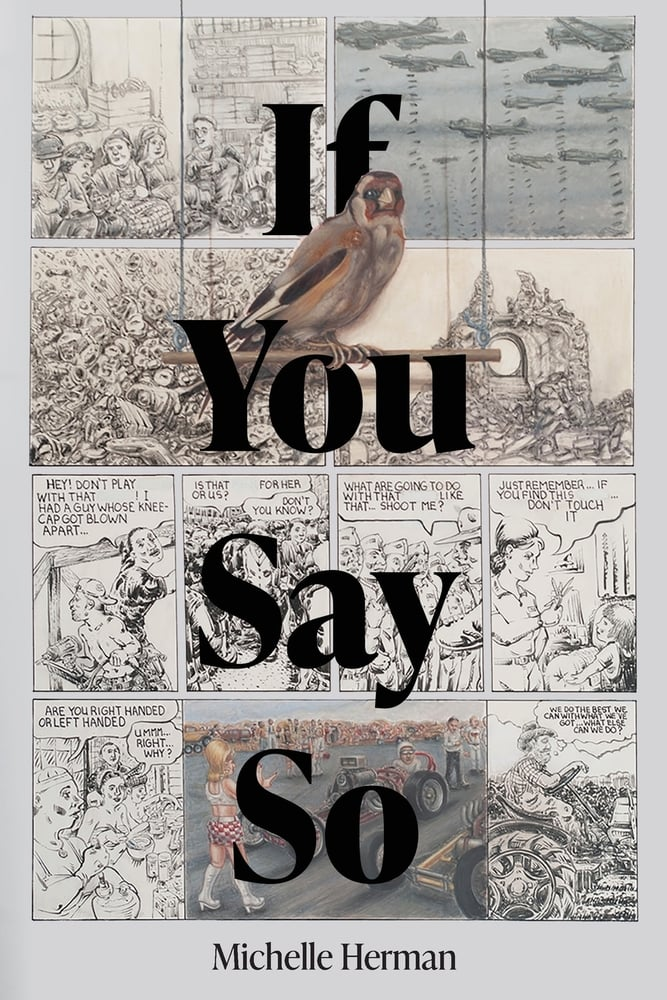 Michelle Herman’s memoir of personal essays, If You Say So (Galileo Press; 2025), offers an insightful reflection on aging, grief, and finding unexpected community later in life.
The opening essays in the collection focus on how Herman discovered a love of ballet in her sixties, how it transformed her relationship with her body and herself, and how it forged new friendships. In later sections, she writes about losing her father, buying her home in Columbus, Ohio, and the death of a beloved dog, followed by a challenging relationship with an adopted rescue dog.
In “On Balance,” Herman remembers a cherished childhood dance teacher who encouraged the children to be confident and expressive — “Telling us to take up space. To be joyful, to be bold.” That’s exactly what she does on the page in these essays.
In each of these essays, Herman fights against loneliness. Her daughter has moved away, she’s processing the death of her father, and living through the COVID pandemic. She writes about how dance gave her a purpose and a new place in the world:
“As the dance takes shape, it gives shape to our lives, too. Seeing one another twice a week, even as small squares on our computer screens, going through Russ’s familiar warmup, step-touch through shaking every part of ourselves, then settling in to review everything we have so far, then leaning in to the screen to watch as Russ shows us the new movement he has worked out since our last rehearsal, then trying it ourselves as he talks us through it—this is something we can count on when there is so little else that can be counted on. I feel anchored by this project. I feel as if, without it, I would float off into space.”
Aside from the strength and wisdom Herman discovers through dance, unexpected treasures emerge in these essays through the small details. Cooking with her daughter, an inside joke or special saying shared with a friend, the drawings her father makes on his deathbed:
“He had me write down the address of his elementary school, and then the names of his favorite teachers. There was one who had encouraged him to draw — he had loved drawing as a child. “Why did I give it up?” he wondered aloud. I asked him if he remembered teaching me to draw, and the drawings he had made, to demonstrate, then had me copy — a three-dimensional-looking box, a park bench, a road reaching to a vanishing point — and he did. He had me hand him a Sharpie and his yellow legal pad: he drew a box, a bench, a road. Then he drew some other things — a telephone, a table. “I used to draw airplanes all the time,” he said. He turned to a fresh page and drew some airplanes now. He filled a whole legal page with airplanes.”
I was surprised that in a collection focused on Herman’s experiences, the final essay in If You Say So is entirely about her friend Judith, whom she met at her dance classes. But this essay, meant to honor a cherished friend, ties together all the themes of the earlier essays. In particular, it emphasizes how, even as our relationships evolve over time or differ with age, and are interrupted by death, we remain intertwined with each other. We become as much the keepers of others’ stories as we are of our own.
“As I read through all of Judith’s papers, looked at all her photographs and scrapbooks and report cards — everything she had seen fit to save — I was thinking about how, once we are gone, our lives become stories, because that’s all that’s left. I was thinking about meaning, about meaningfulness, and how that doesn’t have to, shouldn’t, cease after a death. As long as there is someone left to contemplate and tell, to do their best to make sense of it, to carry it with them for the rest of their life. To pass it along, and along again.”
If You Say So includes moments of pure joy alongside deep grief, worry, and loneliness. Throughout, Herman’s strong, humorous, and distinctive voice serves as the reader’s guide, highlighting the importance of self-discovery, even if later in life, and appreciating the beauty found in the complexities of our relationships with others.
 Emily Webber is a reader of all the things hiding out in South Florida with her husband and son. A writer of criticism, fiction, and nonfiction, her work has appeared in the Ploughshares blog, The Writer, Five Points, The Rumpus, Necessary Fiction, and elsewhere. She’s the author of a chapbook of flash fiction, Macerated. Read more at emilyannwebber.com.