
Reviewed by Diane Gottlieb

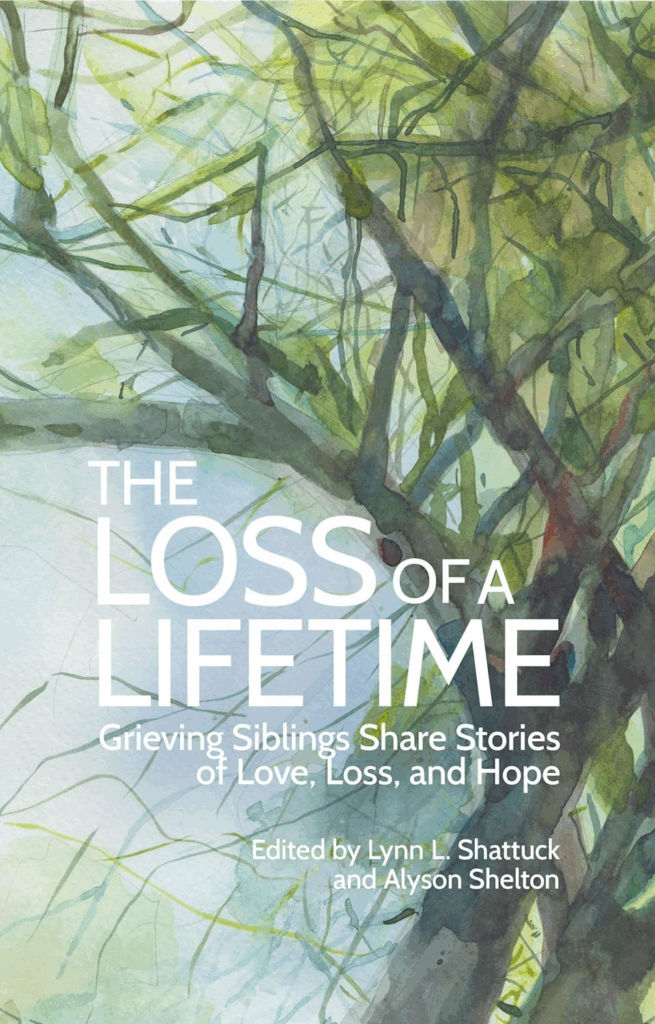 Thankfully, no one has to travel far to find books about grief, one of the most well-traversed topics in literature. There are countless poetry collections, fiction and memoirs that center grief, and self-help books about loss of loved ones—parents, spouses, children. Books about losing a pet may even be a genre unto itself. These works are all both welcomed and necessary. People in the throes of grief, and others who have gained some distance, benefit a great deal from their pages. I know I have.
But there is one group of bereaved that is all too often overlooked: people who’ve lost siblings. “Forgotten mourners,” they’re called, Jennie Burke tells us in “I Lost My Brother, I Recovered Myself,” just one of the 26 powerful essays featured in the beautiful, moving anthology The Loss of a Lifetime: Grieving Siblings Share Stories of Love, Loss, and Hope (Reburn Media, Inc., 2005), edited by Lynn L. Shattuck and Alyson Shelton.
Sibling loss is not only overlooked in literature but in the larger society as well: “If there’s a hierarchy of grief, we exist on low rungs, far below grieving children and spouses, and nowhere near grieving parents,” writes Burke. Gretchen Kelly, who lost her brother to cancer, concurs: “Culturally, sibling loss is the last sliver of pie, the one you forgot to include when you were allocating servings. Oops, here you are. That should be enough, right?” Kelly writes in “The Long Game of Loss and Life.”
It is difficult to make sense of this phenomenon, especially given the deep and unique connection siblings have to one another: “The narrow space given to losing a sibling is in direct contrast to the intense connection and bond of siblinghood,” Kelly explains. “There’s no one else who fully understands the experience of growing up in your family … like your sibling.” The Loss of a Lifetime gives voice to that singular relationship and to the depths and texture of sibling loss.
As the editor of two anthologies and the special projects editor at a small indie press, I have a deep interest in anthologies and an appreciation for what they can do. Anthologies present readers with variations on a theme, different angles, voices, and experiences. I love when anthologies teach me important lessons or offer points of view I never would have otherwise considered. I also love when anthology editors create an arc that takes readers from a starting point and leaves them changed, forever. The Loss of a Lifetime is one such anthology, thanks to the brave contributors and the knowing hands of Shattuck and Shelton.
The anthology is divided into three sections, mirroring broad stages of sibling grief: “Survival,” “The Messy Middle,” and “My Brother’s Keeper.” “Survival,” which chronicles the early period after the loss, begins with Annabel Chown’s “My Sister Died the Week Before I Gave Birth.” Chown lost her sister to suicide, and the juxtaposition of that loss against the birth of her son is haunting:
“The day after his birth, as he lies across my chest, sleeping … A strong desire to protect, to never let anything bad happen to him, rises up; the first seedling of love. Yet, as I hold him, it is my sister I long for. My son is gorgeous, perfect, but he is still a stranger. I crave the familiarity of her slender 5-foot 9-inch frame, long arms wrapped around me in a tight hug, her skin smelling of the rose moisturizer she loved.”
Chown’s imagery, lodged in her memory — the smell she can no longer smell, the hug she can no longer feel — brings home the loss in all its terrible power. Chown writes about storms of grief but also of glimmers of less difficult moments: “Sometimes a storm will last days—other times, only hours. Just as its arrival can be sudden, its temporary departure can be too, sparked perhaps by a bright and frosty morning walk along the boating lake in Regent Park, reminding me that the world is as magical as it is harsh.”
Alongside the pain in these essays, there are always those glimmers of beauty and hope. Kathryn Leehane writes about “reclaiming lost love” in her essay of the same title. She visits the apartment of her brother, from whom she had been estranged, shortly after receiving news of his death: “I haven’t seen him in 16 years. He left town without saying goodbye, never responded to my attempts at contact, and later hung himself in a city hundreds of miles away.” The ache Leehane feels when she enters his home is palpable: “Who was the man I am mourning? I need to reconnect with him and make up for the support I wasn’t able to give when he was alive.” Gratefully, Leehane is able to reconnect — in his closet. Beside “… a shorn necktie, dangling from a rack… I sit with my brother inside that closet and we pray the Our Father together … Despite our worlds being separated by distance and death, my brother no longer seems like a stranger.”
I was struck by the power small kindnesses hold for people in grief. I imagine these kindnesses are especially important for those experiencing sibling loss, as their grief is so often ignored. Meghan Britton-Gross, in “The Best Grief Gift Ever,” writes about a trip to the Hallmark store with her mother’s best friend: “When we walked into the store, she took me to the journals and diaries and told me to pick one … She told me to capture everything I experienced and everything I felt … It is the single, kindest thing someone did for me in the wake of Andrew’s death … I’ve kept some form of journal ever since.”
I was also struck by the lack of consideration another contributor received—this time at the hands of the justice system. In “Resentenced,” Ona Gritz writes about the long-ago murder of Angie, her pregnant 25-yr old sister; Ray, her brother-in-law; and Ray-Ray, their son. Gritz was notified of one of the murders’ release from prison just two days before the actual release, leaving Gritz and Ray’s brothers no opportunity to “oppose it, make her face us, speak on the behalf of those we lost.” This took Gritz back to the time of the murder—over forty years ago: “I’ve been resentenced to the beginning of my sorrow.”
While most siblings find ways to live meaningful lives after the loss of a sibling, the ripples of grief continue. At ten years old, Sarah Leibov learned her baby sister was going to die. Mindy died at three-and-a-half from Tay-Sachs, when Leibov was just thirteen. Yet grief traveled with her long after, as did its impact. She explains in “The Lion’s Way”:
“I went from being a straight-A student to a teen who could no longer focus in her honors classes. I numbed my feelings with drugs and bad relationships. I dropped out of college a few times and sought therapy before I was able to move forward with my life … I carried an irrational sense in my ten-year old body that I should have prevented Mindy’s pain, even though I was helpless to do so … There’s always been an undercurrent of failure and shame mixed in with my feelings of loss. It kept me from talking about my sister for years after her death.”
Leibov is not alone in her feelings of failure, guilt, and shame. There were many times, while reading, that I wanted to reach across the page and across time, to tell these siblings that I heard them, saw them, that the loss wasn’t their fault.
Most of the anthology’s essays are traditional in form, but Lia Woodall’s “The Scream” and Jennifer Hilbert Speak’s “Waves” take a more experimental approach. Woodall writes about the impact of her twin brother’s suicide in short, numbered sections, offering different perspectives on a scream. Speak writes tiny, sometimes one-sentence, paragraphs about how waves of grief at her brother’s loss have washed over her—and sometimes pulled her out to sea. Using fragments of memories is an incredibly effective way to write about loss and has resulted in two of the most powerful pieces in the book.
Lynn L. Shattuck in the “Editor’s Note” writes: “My hope for this collection of essays on sibling grief is that it allows other grieving siblings to see and feel the vastness of their own loss, and that it acknowledges sibling loss as the uniquely lengthy, painful, complicated, and so often, invisible brand of bereavement.” The anthology certainly does all that. But The Loss of a Lifetime is not just for “forgotten mourners.” It provides a balm for anyone who has lost a loved one and teaches every reader how to sit with those in grief, pay attention, and honor their loss.
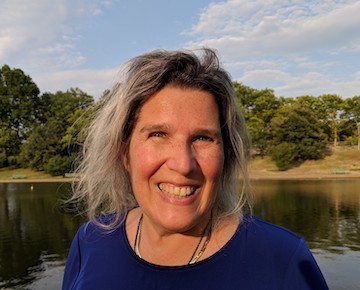 Diane Gottlieb received an MFA from Antioch University Los Angeles where she served as lead editor of creative nonfiction and as a member of the interview and blog teams for Lunch Ticket. Her work has appeared in the Brevity Blog, Entropy, Burningworld Literary Journal, Panoply, and Lunch Ticket. You can also find her weekly musings at her website.
Editor’s Note: We’re so excited to see many familiar names in this collection! Several of the contributors to Loss of a Lifetime are also past contributors to Hippocampus Magazine, including Katie Daley, Lisa Cooper Ellison, Ona Gritz, Kathryn Leehane, and Anne Pinkerton.
A wonderful review of a much-needed book.