Reviewed by Marissa Gallerani

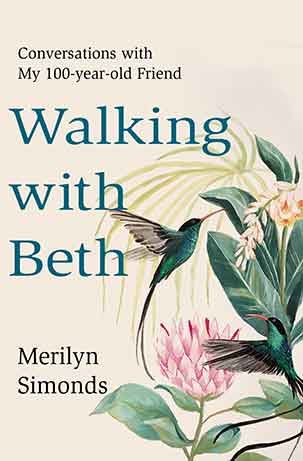 When Merilyn Simonds and Beth Robinson started taking weekly walks amidst the COVID-19 lockdowns, it was not with the intention of creating anything. They were simply looking to enjoy each other’s company safely during quarantine. The resulting memoir, Walking with Beth: Conversations with My 100 Year Old Friend, (Random House Canada; Sept. 2025) is the accidental product of their meetings.
Authored by Simonds, the book explains the nature of the collaboration and how Beth played an integral part in shaping the narrative.
Walking with Beth is divided into three sections, each representing a year and marked by their birthdays. These sections are then subdivided into smaller chapters. While most center around a walk and the resulting discussion between the two women, not all of them do.
Health issues and physical distance keep the women apart. Despite this, they maintain communication (through letters, emails, and phone calls) and their missives show their deepening relationship. Each finds the other woman enriching their lives. Simonds gives Beth some of her old stamps for an art project. Beth gives Simonds a huipil (a traditional Mexican tunic) that she got years ago. The point isn’t necessarily what they accomplish, but their mutual exchange and the joy they receive from it.
The book is unique for two reasons. First, for the fact that Simonds found a mentor and guide in her later years where she thought none existed. Already in her 70s, Simonds didn’t think she had much to look forward to, or anyone who could show her a roadmap for her elder years. She had already surpassed the ages both her parents and grandparents had lived to. That Beth was able to fill that role is the second reason for the book’s singularity: its detailed depiction of the inner lives and world of elderly women — an age group not often portrayed in literature. And when they are, they’re painted as the grandmotherly type: side characters, not the protagonists. Walking with Beth centers the lived experience of this often overlooked demographic and shows the reader that there is still much wisdom to be gained from them.
Given that Beth has lived through the Great Depression, World War II, and much of the 20th Century’s greatest upheavals, she is an ideal guide. Beth worked in some capacity until she was 99, and she works hard to keep both herself and her relationships healthy, and her conversations with Simonds reflect that. They discuss their past lives and relationships, their future hopes and fears, all interspersed with their artistic projects.
While centenarians’ longevity is often celebrated, Beth’s is not without heartache: She has outlived two of her three children and her husband. During the pandemic, preexisting health problems required her to observe strict quarantine measures, which severely isolated her. Simonds appreciated Beth for her wisdom, Beth appreciated Simonds for her company.
Ultimately, Walking with Beth complicates aging narratives. Even at 103, Beth looks ahead to the future and is not focused on her mortality. Further, it is not lost on Simonds that, for part of the book’s time frame, Beth is in better health than she is. While Simonds battles giant cell arthritis, she still worries about Beth’s health. “Ridiculous,” she notes at one point, that Beth “is waiting on me, a woman 30 years her junior, though today I feel twice her age.”
This book reflects the messy complexity of life: While there is some organization to the narrative, there is no tidy ending. Walking with Beth is a testament to the enduring nature of both female and intergenerational friendship.
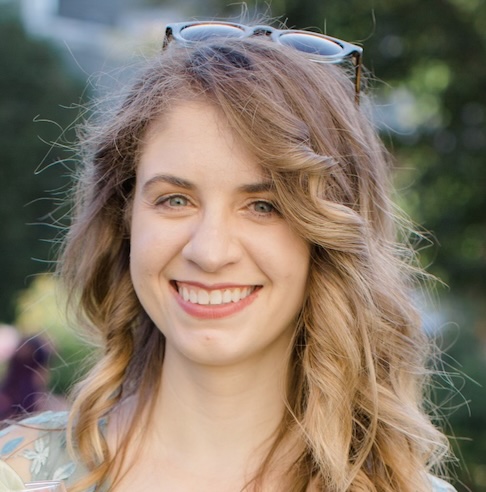 Marissa Gallerani is a queer and disabled writer and teacher living in Providence, Rhode Island. She received her MFA from The Newport MFA at Salve Regina, and has taught at multiple institutions of higher education including the New England Institute of Technology, Salve Regina University, and Write or Die. She has been published in The Harvard Review Online, the public’s radio, and The Financial Diet, among others. Marissa’s Substack, The Chaotic Reader, details her wide-ranging reading adventures. A life-long SFF fan, Marissa is currently at work on a science fantasy novel.