Reviewed by Amy Roost

 As the title of At the Corner of Past and Future: A Collection of Life Stories (Bison Books; October 2025) suggests, Pamela Joern’s three-part memoir in essays is concerned with intersections, specifically the intersections of time and place, memory and truth, and life and art.
The opening chapter, “Looking for Direction,” is cleverly divided into sections north, south, east, and west. It’s as if the reader is standing on a high point with a pair of binoculars as the author narrates the landmarks — Pumpkin Creek, Wildcat Hills, Courthouse, and Chimney rocks — that populate the North Platte Valley. I am reminded of Eudora Welty’s idea that “One place understood helps us understand all places better.”
In “Forest and Prairie,” coastal redwoods and midwestern prairies stand in for cozy confines and open space, respectively. Forests are foreign to her, Joern admits. “On the prairie, the eye is not drawn up as it is in the natural cathedrals of the redwood forest.”
In the titular chapter, Joern travels back to her starting place with her teenaged daughter to visit her mother and attend her thirtieth high school reunion. She is confronted with change. A boarded up Main Street, classmates who’ve aged beyond recognition and a mother who is now her responsibility, rather than the other way around.
Joern moves on to consider the elusiveness and instability of time in the context of mortality. In “Salvador Dali and Me,” Joern tells us how Dali’s painting The Persistence of Time was inspired by a wheel of camembert left out in the sun. It is one of the book’s many researched and associative passages, calling to mind another recent collection of essays, Bigger by Ren Cedar Fuller.
Dali’s vision of the melting-camembert-cum-pocket-watch was a metaphor for time slipping away. Joern’s own metaphor for time is a water pitcher: “Time, as we live with it, is more like a liquid than a solid. If you poured it from a pitcher, it might drip slowly or gush like a waterfall, dependent on many variables: the amount within the container, the angle of the tilt, the height from which it’s poured.” For the patient waiting for lab results, “time oozes from that pitcher like crystalized honey from a jar.” However, for the same patient, once diagnosed with cancer, time is short, uncertain, and wears down the desperate patient who tries to make every moment matter. Joern summarizes: “Moving in and out of the threat of death is a peculiar time-warping experience.”
Part Two of Joern’s memoir, “The Intersection of Memory and Truth,” is about how our memory plays tricks on us. Joern excavates memories of her father only to be confused by how gaps and time distort those memories. She writes:
My early memories of my father have fallen away from me like a distant echo. Later experiences, overheard snatches of conversation, impressions from other people, gleaned fragments of knowledge I have uncovered like a spy on a mission have given me a more complex picture of my father but have robbed me of my memories. I remember how I remembered him, but I am no longer sure if what I remember is fact or what I created.
Joern explores how we lie to our children about things like Santa, how her mother lied to her about Heaven. Joern herself misremembered her childhood dentist having a peg leg (he didn’t), and her husband misremembered his brother was a major league baseball player (he wasn’t). Joern thinks she knows her daughters, until she finds “shards” from their past that prove there was plenty she didn’t know about them. Like an archeologist, she must piece the shards together to create a nearer-to-the-truth approximation of the children she thought she knew completely. She asks, “How can we trust that we know what we know?”
No truth. Only memory with a porous filter. Only worry with a broken compass.
This book is a beautiful exploration of the intersections that exist between the things we understand and the things we never will, and if you find yourself wondering about the meaning of, well, everything, you’d do well to bring this book on your journey.
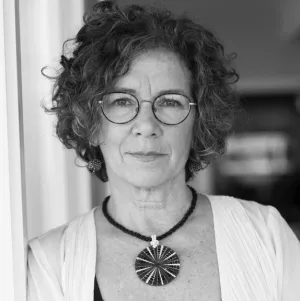 Amy Roost is a freelance writer residing in Bellingham, Washington currently working on a memoir entitled Replacement Child. She is the co-editor of two feminist anthologies and recently earned her MFA in creative nonfiction from Pacific University in Oregon.