
Reviewed by Amy Roost

 Nightbird by Shavaun Scott (Pierian Springs Press; 2025) is a coming-of-age memoir focusing on a psychotherapist’s own psychological development as well as her self-discovery, and adaptation to the world. It is a story full of heart and doesn’t require a degree in psychology to understand. Short chapters make for quick pacing. The linear structure beginning in her childhood and taking us through memories of her life, both personal and professional gives this memoir more the feel of an autobiography, however, the plentiful back story is not gratuitous. There is a point to it.
In order to escape her family, Scott took shelter in a marriage to an older man while in high school. She knew nothing about the rules of relationships such as they were in her patriarchal family and community where most women existed to serve their men, and the highest achievements were to finish high school, make babies and not rock the boat. These early years help the reader to understand the factors that can lead someone to stay in an abusive relationship. Scott’s distant and maudlin mother and misogynistic yet relatively attentive father, the strict religious education, and childhood abuse and bullying she suffered, and her desperation to feel as though she mattered to someone all contributed to the creation of a person easily manipulated by her desire to please others.
The middle section of Nightbird shines. Here, Scott describes the complexity that comes with loving someone who is abusive but also in dire need of help; also, someone smart enough to game the system. She tells the story of how she fell in love with her second husband whom she describes as sensitive, generous, and intelligent. Scott shares their times of laughter and their loyalty to one another all by way of revealing how her own feelings for him and her profession became the snare that prevented her from leaving him. She loved him and believed she could help him change. The reader travels with Scott through the relationship as her husband first begins to yell and intimidate, then throw things, and eventually resorts to intermittent physical violence leading her to constantly walk on eggshells. Eventually, her loving feelings are replaced with fear and a sense of being trapped.
Scott’s memoir addresses themes of unresolved childhood trauma, domestic violence, religious indoctrination, and mental illness, and calls to mind Kelly Sundberg’s excellent Goodbye, Sweet Girl and Carmen Marie Machado’s contemporary classic In the Dream House. Although both those books have a structure with a higher degree of difficulty than Scott’s six-part, linear memoir, her prose is no less shimmering and open-hearted. Like Sundberg and Machado, Scott is commendably honest and accountable. Lesser writers would demonize a man who deserves to be demonized, painting him as a one-dimensional monster. Not Scott. Her approach is more nuanced. She acknowledges her own mistakes and maladaptive behavior. By the end of the memoir we not only see the payoff of her having held her feet to the fire, but also the series of steps it took to free herself. While Scott takes responsibility for her choices, she does not apologize for them. Who better than a psychotherapist, after all, to illustrate that the point of human development is to learn from one’s mistakes and make forward progress — however non-linear that progress may be.
There are many vivid and emotional scenes in Nightbird. One that stood out for me was Scott’s description of a new workplace:
The Rape Crisis Center felt like a natural fit. I used to say that gang rape was the number one team sport in my high school.
In another passage I can’t get out of my mind, Scott describes how her thinking was warped by religion:
My mind became a labyrinth of incantations and prayers as I fought to avoid independent thinking.
Scott admits to frequently “sliding into unrealistic hope,” aka magical thinking, as portrayed in this passage:
Over time, I came to realize that his rage was familiar — like my mother’s. But this time, I thought I could change it. I had faith that I could stop the cycle and that things could get better. Even though I wasn’t religious anymore, I still believed in miracles.
And again here:
I believed that the real Robert was the one who loved me and nurtured me. The angry Robert was just a symptom that could be fixed with enough love and care. So, I held onto faith and clung to hope.
Filed under the cobbler’s children have no shoes is this passage:
I knew all too well how violence, coercive control, and verbal abuse could shape a person’s life. I had helped dozens of people leave toxic relationships. And yet, despite my expertise, I couldn’t seem to protect myself from the very thing I was so skilled at recognizing in others. Soothing Robert became part of the natural rhythm of my life. I was the personal fire extinguisher for his combustible moods.
Scott does a particularly good job grounding the reader in place. For instance, below she draws us a picture of her hometown:
The dark gray air burned my eyes, leaving them permanently shot with crimson. If you tried to run, your chest hurt when you inhaled. Breathing was dangerous. People spoke Spanglish or hillbilly pidgin. Mariachis blew trumpets at weddings and quinceañeras. Everybody got drunk at funerals and, on weekends, swilled Bacardi from the bottle in the back of cruising low riders. Girls who got raped after football games already knew how much money they would get from welfare if they decided to keep the baby. It was best not to cooperate with the DA since every criminal had at least one cousin who did hits; they’d get back at you if you snitched….
The air at the edge of the Mojave Desert was crackling and dry. As a child, I chased the tumbleweeds down wide, lonely streets into the nearby sandhills, imagining that one day, the wind would carry me away to a soft, green, forested place with clear blue skies. My hometown community was known as the Inland Empire, but no trace of magnificence could be found there.
At the conclusion of Nightbird, Scott writes lyrically about her journey:
I am never free of grief; there is always a shard of sorrow in my heart, but I have grown around it.
Nightbird is a thin quick-paced book that packs a powerful punch. The epigraphs at the head of each section are thoughtful, spot on, and should not be overlooked as so often is the case.
Few books I’ve read better explain the way one is slowly pulled into emotional abuse until trapped, and how hard it is to get out. Scott does not hide from the reader how difficult it was to leave her situation, and is not afraid to say the hard things most survivors of suicide think. The reader cannot help but cheer for her because her journey reminds us that grief is complicated, layered and utterly challenging but it’s possible to walk through it and come out on the other end with grace and dignity.
Nightbird is not for the faint of heart but a must-have in the tool chest of someone who is ready to pursue their healing as a survivor of suicide and/or domestic violence.
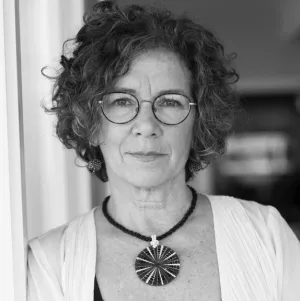 Amy Roost is a freelance writer residing in Bellingham, Washington working on a memoir entitled Replacement Child. She is the co-editor of two feminist anthologies and recently earned her MFA in creative nonfiction from Pacific University in Oregon.