

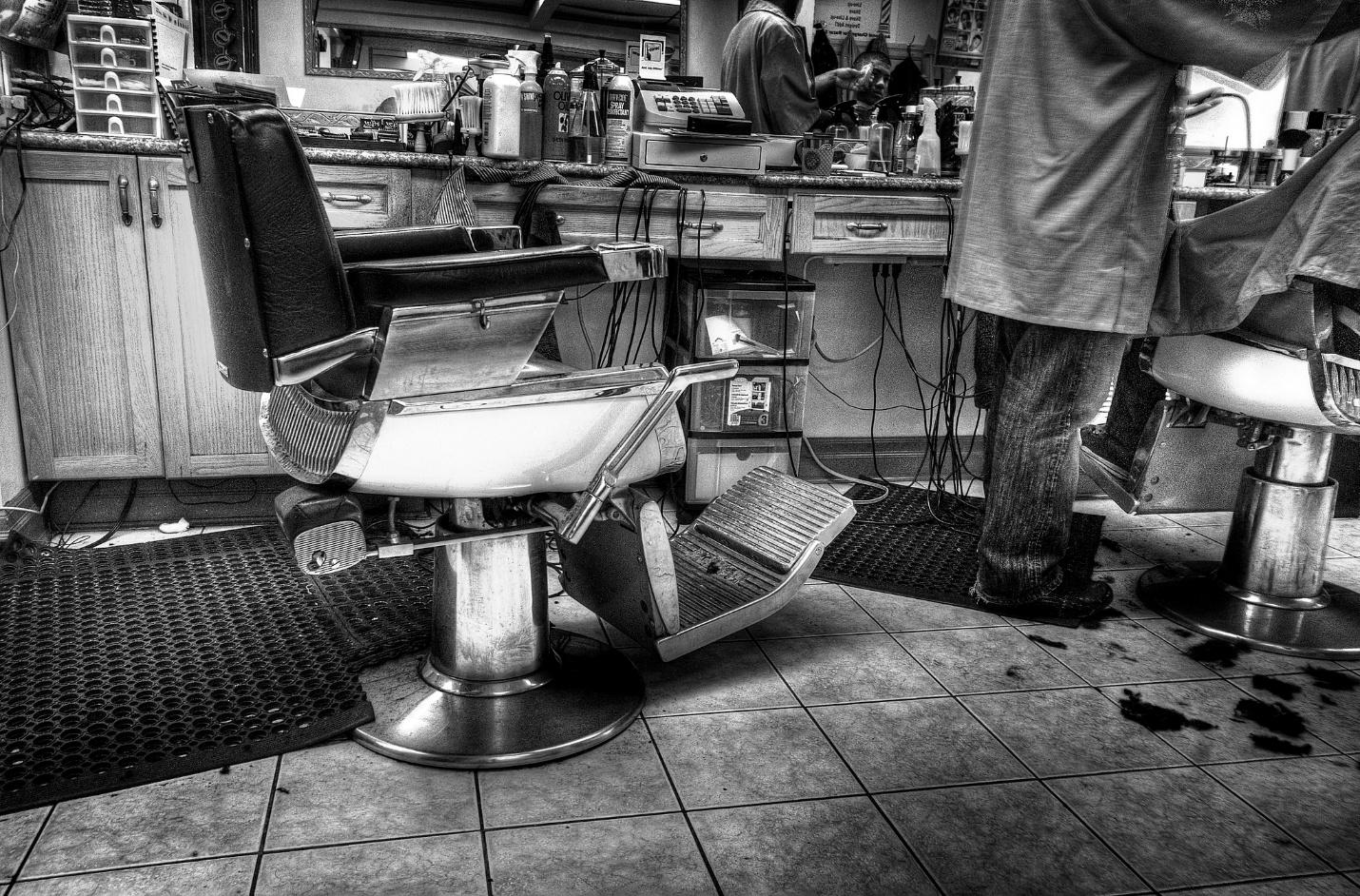
Paul Milligan was buried at the very hour he was supposed to be cutting my hair.
“Where’s Mr. Milligan?” I asked the stranger standing behind Milligan’s familiar barber chair.
“He died,” said the man, as if it had happened before to Milligan. “Sit down. I’ll take care of you.”
“But I just made this appointment with him a week ago,” I said. Somehow, I thought my appointment should have warded off this fate, preserved the barber at least another week.
“Well, he died,” the man said again. “’Fact is they’re burying him right this minute. Sit down. I’ll take care of you.” Obviously, this interloper hadn’t known Paul Milligan well or he would have been at his funeral instead of trying to appropriate his customers.
And perhaps I should have been there, too. After all, I had known Mr. Milligan for almost twenty years. My mother had first brought me to him when I was two or three years old. Someone had told her that there was a sweet, round-faced barber in the basement of Wilkinsburg, PA’s Penn Hotel who was good with children and her advisor had been right. Patient, jovial, gentle, Paul Milligan made haircuts fun for even the youngest child. Perhaps the fact that he had only a fringe of hair himself made him particularly appreciative of those customers guaranteed not yet to have lost theirs. Perhaps he wanted to instill in them an appreciation for its presence. He knew what trauma might lie ahead.
For almost twenty years I had liked everything about going to “Mr. Milligan’s,” as both my mother and I invariably called his shop. I liked the barber poll out front. I liked the descent into the basement of the old hotel. I liked finding Mr. Milligan, solitary and welcoming, just inside the door. I liked the booster chair contraption with its cracked red leather seat that he installed over the arms of the barber chair to make me more accessible to him. I liked the first time I didn’t need the booster anymore. I liked the smell of talcum, the cut hair scattered so daringly on the floor, the background sound of a Pittsburgh Pirates baseball game.
And most of all, I liked the proud array of bottles, each one containing a different color liquid, lined up along the shelf beneath the window. The end game of a haircut was my favorite part: “What color do you want today?” Mr. Milligan would say when he had brushed away the final hair and was prepared to shellac my head. And I would pick a color and he would laugh, stride over to the shelf and pull down the selected bottle, shake it briskly on his way back to the chair, pour a liberal amount into his hands and rub it on my head.
Only once do I remember that he turned down my recommendation of a color. “Oh, no,” he said almost sternly. “You don’t want that one” and I imagined that I had picked a tonic either too dangerous or too valuable to expend on little boys.
But apart from that, he granted my every wish and I came to imagine that I was his favorite customer and that he would cut my hair forever. I kept going back to him, even through the sullen early teenage years, even into high school on those rare occasions when I permitted my hair to be cut at all, and even after he had made some disparaging remark about the length of the younger generation’s locks. I went back to him even when I came to realize that he was what of course he was: an elderly man who had lived his life in a little town on the edge of Pittsburgh cutting people’s hair. A man for whom all those things that were beginning to excite me so much about the world—John Kennedy, civil rights, the Beatles—were utterly foreign and no doubt a little frightening to him.
But I went back out of nostalgia, yes, and gratitude for his kindness to a little boy—that deep, true, Midwestern kind of kindness that survives in Pittsburgh even though Pittsburgh wants to think of itself as East—and because, though I was closing in on twenty, he still asked, “What color tonic do you want today?” But now he was dead and being buried at the exact hour of my last appointment with him and I realized that I had assumed an intimacy that wasn’t really there, that I didn’t even know where I would go to attend his funeral, much less anything about his life beyond the barbershop. I wondered if he ever regretted having spent all his years there.
“Sit down. I’ll take care of you,” the stranger said. And I sat down and let him cut my hair and he poured liquid of his own choosing on it and I paid him and walked out and never went back.
Why is it that some men form such strong attachments to those who cut their hair? It is not just a matter of appearance, though how a haircut makes us look is far from unimportant. It is also a matter of protracted intimacy, the tight field of action between cutter and cut, and the fact that those who cut our hair are given free rein to inspect what not a one of us will ever directly see. Who else gets that “privilege” except a gastroenterologist?
Moreover, when carrying out that inspection, barbers may read in our pates the progress of our dying. Hairy or hairless, graying or Grecianed, our skull tops double as crystal balls of our decrepitude. Whoever gets the chance to discern that vision is thereby invested with the gift of prophecy and the Delphic are not supposed to die. Certainly not when you still have an appointment.
And so when Mr. Milligan died, I went to Nick. Nick was young, vital, bombastic, and he, unlike Milligan, had a full head of curly hair and, though he might be too inexperienced to read the crystals carefully, his good humor would provide ample distraction if what they foretold was cruel.
Nick had come to this country to work at Tony’s barbershop near the University of Pittsburgh, the shop where my father, a law professor, always went and to which I would occasionally accompany him. Tony’s barbershop, in contrast to Mr. Milligan’s, was clearly for adults. There were four barbers and four barber chairs, not one, and there were always crowds of people waiting for their turns. But most of all, there was the banter, the kind of sweet male banter that tells you everything and nothing—about cars and customers and sports—and the gentle teasing, often in Italian, usually of Nick, because he was the newest and the youngest and because at first he spoke no English.
By the time Mr. Milligan died, however, Tony had also died, and the shop had closed, and Nick, the only one left, had moved to a one-chair barbershop in the basement of the local Howard Johnson’s. My father had followed him there and because my father seemed content, and because I knew no other barbers, I went there, too.
Indeed, for the next ten years, despite having gone off to college in Ohio and later moved to Boston, I kept going back to Nick. Sometimes, my hair would grow very long between my visits home to Pittsburgh but I remained ever faithful and Nick reveled in my fidelity. “All the way from Boston!” he would cry to no one but himself and me whenever I would appear. “I got the only client come all the way from Boston to see me.”
The truth is he seemed so lonely in that one-chair basement shop after the camaraderie of Tony’s and so overjoyed to see me that I felt happy, too. I would ask him about his kids, which made him beam, and about his memories of Italy, which made him sparkle, and his enthusiasm about his native land made me want to see it too.
But finally the distance to get to Nick for haircuts became too much and I decided to find a barber in the Boston area. That was not easy to do because by the 1980s, traditional barbers were scarcer than lava lamps and I ended up, on the recommendation of the husband of a friend of my wife’s, going to a “hair stylist” by the name of Jules.
Jules and his Salon Pigalle on St. Mary’s Street in Brookline were as different from Mr. Milligan’s and Nick’s as hairspray is from Brylcreem. Jules was a francophone from Quebec; Salon Pigalle catered to wealthy, middle aged Jewish women; and Jules himself was gay. Furthermore, Jules washed my hair before he cut it and cut it slightly damp. When he beckoned me over to the sink at the start of my first appointment with him, I thought he was going to insist I wash my face before getting a haircut. Neither Mr. Milligan nor Nick had ever washed my hair and I’m sure they both would have thought it strange as hell if anybody had asked them to.
But Jules washed it with delight and in fact did everything with delight. Inevitably, when I would ask him how he was, the answer was “Pahr-fect!” And Jules always looked “pahr-fect.” He was, I learned quite late in our relationship, over 60 but could easily have passed for 40. He loved theater and he and his colleague, Walter (his partner, I always presumed), went regularly to New York and sometimes to London for theater. Jules loved his apartment; he loved playing tennis; he loved his customers; he loved his nieces and nephews; and he loved clean but clever jokes which he would whisper in my ear as he straightened the neckline.
In fact, there were only two things he didn’t like: one was salesmen who interrupted his workday without appointments. That was no problem for me because the last product I had tried to sell was lemonade when I was six. But the other thing he didn’t like was clergy. Raised a Catholic in Quebec but rejected by the church for his sexuality, Jules despised priests and everything associated with them. This was a problem because, though I was no priest, I was a Unitarian Universalist minister and the distinction between the two was not easy for him to grasp.
At first, we danced cautiously around my ecclesiastical associations, I speaking vaguely of my profession and he trying to ignore it. But this was the era, the late 1970s and early ’80s, when Unitarian Universalists were taking the lead among religious communities in championing LGBT rights. So, occasionally, I would drop a reference to our AIDS ministry or the many services of union my colleagues were performing and, gradually, Jules came to trust me. He still had no use for clergy but granted that there might be one or two who weren’t so bad.
For almost fifteen years, I went to Jules on an average of twice a month. We were not friends exactly, but as my hair got thinner and the first gray appeared, it was somehow easier to take because Jules pronounced my hair still “pahr-fect,” an inexpensive form of therapy.
Over the years, we developed a set of common understandings: Jules would fit me in, even at the last moment, and I would send him other customers. Two of these he always referred to as “Your Handsome Friend” and “Your Nervous Friend,” because he could never remember their names and, in fact, I don’t think he ever got clear on my own last name and I certainly never knew his. It was enough that he was Jules and he was “pahr-fect.”
And then one day, shortly after I had moved to New York City but only two or three weeks since I had last seen Jules for a haircut, I called the Salon to say I was returning to Boston on business the following week and I’d like to get an appointment. “I’m sorry,” Walter said. “Jules won’t be here that day.” “What about Friday then?” I asked. “No, not Friday either.” “Well, when will he be back?” I wondered. “Jules won’t be back, I’m afraid. He died last week.”
I wanted to say, “But I just saw him and he was ‘pahr-fect.’” But all I said was, “Was it sudden?” And all Walter said was, “No, it had been coming on for a long time.” And all I could say was “Oh, Walter, I’m so sorry.” And then, stupidly: “Will you keep the shop?” And Walter said, “It’s too early to decide.” And because Walter and I didn’t know each other well and there seemed nothing more to say, we said goodbye. But at that moment all the pathos of more than forty years of circumscribed familiarity came clear to me, of how we allow people to get close to us, so close that their breaths trail down our necks, but look at them mostly through a mirror. I missed Jules not because he was the best hair stylist in the world but because he was a constant presence in my life who kept it ordered and kept me clean. We could rely on one another to always be there—he with his bonhomie; I with an endless supply of new customers for him. Our bonds were tenuous, it’s true, but then most bonds are and their tenuousness makes them no less precious for it. I could always find someone else to cut my hair, but I had invested years in building a compact of trust and intimacy that would be hard to duplicate and painful to forego.
I felt bereft and I was tired of barbers dying on me so when Jules died, I started going to women stylists for my haircuts. It’s not that women can’t die of course, but these women were young and far from finished with their lives. For the past twenty years, for example, Meghan has cut my hair and she is young and healthy and strong and highly unlikely to die on me. The odds are pretty good that at 75, I’ll be gone long before she is and then she can be the one to reflect on the profundity of certain ephemeral connections. Just like Nick did the last time I ever saw him.
Shortly before my father died of cancer, I was back in Pittsburgh for a few days to take care of him. By this time, his always-robust frame had shrunk, and his cheeks had shriveled, but his beautiful hair was just as straight and blonde as ever and, though he could no longer walk without assistance, he wanted to get a haircut. Somehow, that routine gave him reassurance. “Of course,” I said to him. “We’ll go to Nick’s.”
I hadn’t seen Nick in more than a decade and his curly black hair was largely gray, his firm belly a paunch, but he was still the Nick I had always known—warm and brash and welcoming—and he could not have been kinder to my now fragile father whose hair he had cut at that point for going on twenty years. As he and I helped Dad into the barber chair, I saw Nick pass his big fingers through my father’s hair, help him straighten himself in the seat; I saw him cut the hair slowly, carefully, talking quietly, comfortingly. I saw him smile and pass on a joke or two as he had always done, as he had learned to do so many years before with Tony. And when the haircut was finished and Nick had brushed away the final strays, he and I lifted Dad out of the chair and Nick put his arm around him to steady him as I went to get his cane and all of us said goodbye, Nick standing beside the chair smiling, smiling. I helped Dad out of the barbershop and through the door and I turned back to wave. Nick was still standing beside the chair but he was no longer smiling. He waved back at me but his face was full of tears.
William F. Schulz, a Unitarian Universalist minister, served as executive director of Amnesty International USA from 1994 to 2006. He has written or edited eleven books and more than 150 articles in publications such as The New York Review of Books and The Nation. He is a graduate of Oberlin College and the University of Chicago and has been awarded eight honorary degrees. A native of Pittsburgh, he now lives in happy retirement on the North Shore of Massachusetts.

I loved how the stab of doubt at your connection you felt at the loss of each barber was validated so poignantly at the end with how Nick looked at your father. Filtering the phases of your life through the barbershops is really fascinating and speaks to the surface level, yet consistent and meaningful, bonds that all of us form in some way.
I love this! Made me so sad at the end. But I live the ways our lives cross paths. The woman who cut my hair retired and I didn’t have a chance to say goodbye. I teach and when a semester ends I say goodbye and off the students go.
Thank you for this piece. I also live outside of Boston.