
Reviewed by Brian Watson

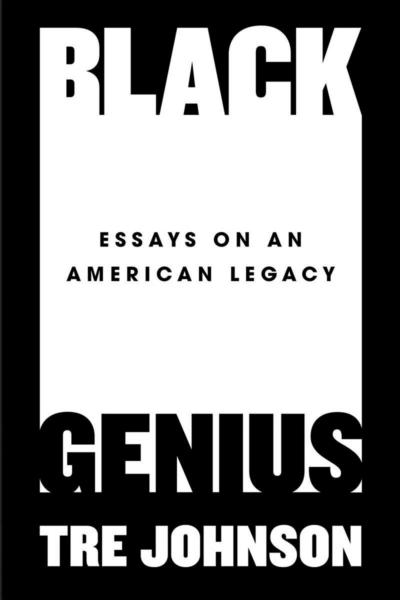 I’m leaving the writing of this review to the last minute because I instinctively worry I’m going to get something wrong. How can I, a white person, speak with a reviewer’s authority on a collection of essays that speak to the experience of being Black in America? Tre Johnson’s Black Genius: Essays on an American Legacy brought me both profound epiphanies and a better awareness of the systemic racism that pervades America, however. It also taught me, a queer person, valuable lessons in community and uplift.
In reading Black Genius, I underwent a war with myself. On one side is a very queer me whose queerness draws inspiration from and owes gratitude to Black American queer culture. On the other side is white me, still breathing the air of white supremacy, of colonialism. A me that I hate, a me that I react to, and run from, but also a me that I have to acknowledge.
And so when Tre Johnson writes about Black genius, he writes about the ways his families and communities have created joy despite everything in America that works to tamp that joy down, that internal war went into overdrive. The poison of systemic racism is both insidious and everywhere. Non-white people suffer its murderous effects, while white people are led into compliance with the demands of supremacy. White people not only police others, but we also police ourselves. We internalize what is acceptable, both in self-expression and in the expression of others, and that self-censorship separates us from joy within ourselves and the joy that others experience around us.
The essays in Black Genius are sectioned together in threes. The first section, Part 1, brings the reader closer to the author, to who he is and how he views the genius identity. The essays fill the reader in on Tre’s family, as well, and are written with a profound love.
Part 2 zooms out and turns the reader’s attention to the broader social milieu within which Black genius constructs itself. The first of those three essays, The Fifth Dimension, reviews ways in which Black people find genius (and joy) within city streets. Tre’s enunciation midway through, rang loudest for me.
“The world is still set up for us to navigate and celebrate Blackness through a series of red lights and green lights, and those permissions and denials are the reason we need to consider about why we sometimes do things like become flash mobs and urban ATV roadies. There is an inability in society at large to give space to all the ways that we want to be able to express ourselves, love ourselves, hear ourselves, celebrate ourselves and understand the types of freedoms we want.”
Tre is not asking me to accept blame for those red lights, but I am still aware of how whiteness demands those arbitrary stops and gos, yeses and nos. And at the same time, I know that what Tre describes for Blackness, that wanting to express, love, hear, and celebrate ourselves, also holds true for women, for queerness, and for transness. And although I will come back to this, this paragraph started me thinking about ways to construct a new world without those red lights.
Tre comes back to the (this time, corporate, Capitalistic) evils of this world in the next essay, What Doesn’t Kill You Only Mutates and Tries Again. As he discusses what rap music does and fails to do, and about the violence often present within rap lyrics, he rightfully enlarges the focus to more American realities.
“After all, it’s the corporate world’s own violent language of ‘layoffs,’ ‘downsizing,’ ‘recalibrating,’ ‘right-sizing’ that has the sort of real-world implications that not only allow but arguably produce the cauldron that rap’s created in. Through their mergers, takeovers, efficiencies, pivots and strategic rollouts, American corporations and banks routinely create the cooking pot where Americans are boiled alive, and then shake down and crush them to find the best sediments that will maximize profits and company value for executives, stakeholders and board members.”
But the ultimate redemption that Tre envisions and places on the page for us in Part 3 is the knowledge, as I alluded to earlier, that a better world is within our grasp, if only we can imagine it. Yes, Tre posits, it is on Black Americans to do that imagining, to realize, as Tre learns from a looping series of images curated and scored by Terence Nance called White People Won’t Save You. And those of us who are white need to know we, in our book clubs and social media activism, won’t be saving anyone else, either (least of all ourselves).
“I know there’s a better world somewhere out there, even if it’s only imagined. One that doesn’t require so many of us to think we have to go it alone, where every existing system doesn’t seem like it’s working around the clock to destroy us. I’m trying to think of a world where our story isn’t about bootstrapping it or shaming other folks because they aren’t bootstrapping it like we did or have to, a world where collaboration and not competition is the first vibe we respond with.”
I want to live in that world, and I won’t pretend, in my imagining, that I can save anyone else in the process. I also want to believe, however, that a collaborative, community-centered world is within reach, despite, or perhaps because of everything we’ve all been asked to live through (and contribute to) in the past year. Thank you, Tre Johnson. Thank you.
 Brian Watson’s essays on queerness and Japan have been published in The Queer Love Project, The Audacity’s Emerging Writer series and TriQuarterly, among other places. An excerpt from CRYING IN A FOREIGN LANGUAGE, their memoir’s manuscript, was recently accepted by Stone Canoe for the 2025 issue. They were named a winner in the 2025 Pacific Northwest Writers Association’s Unpublished Book. They share OUT OF JAPAN, their Substack newsletter, with more than 600 subscribers.