
Reviewed by Dorothy Rowena Rice

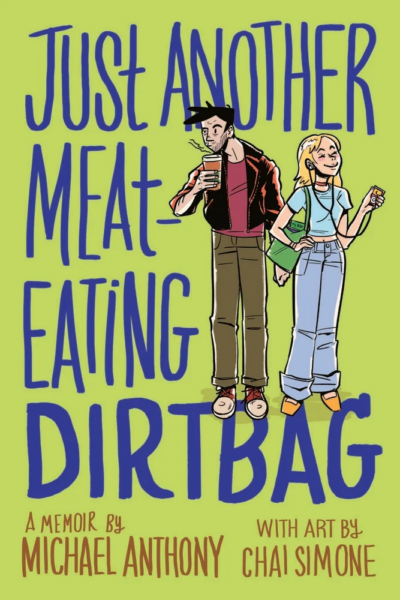 How to review a graphic memoir? The artwork — the cartoon panels — are as intrinsic to the storytelling as the words. Describing visual art is a different kettle of fish than writing about the written word (think apples-to-pomegranates or asparagus versus apples-to-apples).
Yet in some ways, it’s not so different than a collection of flash or stories where the author plays with form and the placement of words on the page, with each story or segment surprising the reader with a new experience, a new way of considering the art of story-telling. Michael Anthony and Chai Simone do the same in this graphic memoir; for while the thought and speech balloons, narration boxes and art panels will be stylistically familiar to any comic book reader, there is substantial and intentional variation in the number, placement and purpose of both art and text.
I cracked the cover of Just Another Meat-Eating Dirtbag (Street Noise Books; November 2022) without preconceived notions of what a graphic memoir could or should be. It proved to be an engrossing, relatable, page-turner. And, given the ratio of words to art within its approximately 170 pages, a relatively quick read. Though you will likely find yourself, as I did, reading it more than once.
This is a sweet, relatable, poignant and often-funny love story from the perspective of Michael (the self-proclaimed dirtbag), beginning with finding his perfect girl (nickname Coconut) and the high of complete and utter infatuation. True to the tropes of romantic tales, his giddy, all-consuming new love is inevitably threatened by conflict and struggle. Yet Michael is determined to be with his Coconut. On page one he makes this clear, stating: “Because when you love someone, like really love someone, then you’re liable to do anything to keep them in your life — anything.”
What conflicts and barriers to love does Michael face? Not a persistent ex, the logistics of a long-distance romance, or religious differences. No, his is a philosophical conundrum of meaty proportions. Coconut is a committed vegetarian. Michael enjoys his hamburgers. This isn’t a problem until she becomes an animal rights activist, in a serious way. Her initial laissez-faire perspective regarding their differences (“I don’t eat meat, but I respect you enough to make your own decision”) is no longer tenable.
Michael notes, “Coconut’s podcast playlist had gone from being about serial killers to animal abusers.” This struck me as both hilarious and, as a true crime podcast junkie, I got what a huge, defining shift that was! With details like this and myriad others (we learn that Coconut can perfectly mimic a seagull squawking and that Michael has had the same best friend since second grade), they feel alive and real on the page, like that memorable college roommate or old friend. The panels that accompany the story are cartoonish and, at times, outlandish, yet throughout, there’s affection for these two. I was laughing and commiserating with them.
A trigger warning of sorts is in order. There’s no denying that meat production as it’s practiced in this country is inhumane at best. A number of panels graphically depict this reality. The same is true of Michael’s backstory thread. He was an operating room technician during the Iraq war. In words and accompanying gory pictures, he explains, “By the end of my first month in the war, I’d learned what it was like to amputate limbs with three different types of saws. By the end of my second month, I had a preference of which saw.”
The brutality of war and the pain suffered by animals destined to become food are both juxtaposed and graphically depicted. Not to equate or compare them but as one explanation for why Michael’s response to the terrifying videos of meat and poultry production that Coconut insists they watch (multiple times) is different than hers; it’s as if his “horror response” has been muted by the wartime operating theater.
As noted in the first paragraph, the artwork and formatting of this graphic memoir are inventive and varied. The variety is used to good effect in highlighting different aspects of the story while keeping the reader entertained and engaged. Some pages contain multiple panels and are loaded with forward-moving action. Full page panels highlight key moments or background (used to introduce the two main characters, for example). Other full- or half-page panels are primarily comprised of text and serve an educational or information-sharing purpose, often in list form: such as, “Why People Become Vegetarians and Animal Activists,” “How to Convert a Meat Eater,” “Vegetarian Chocolate Chip Cookies — a recipe” (yum), and “Vegetarian Sources of Protein.” And, at the end, two pages are devoted to additional recommended books on vegetarianism, veganism, and animal activism.
Three of my five children became vegetarian or vegan as pre-teens (now, in their twenties, thirties and forties, they still are). As a result, I’m a decent plant-based chef. And I ate what I cooked for my kids, rather than prepare something different for my husband and myself. Which, I suppose, meant I was a vegetarian in practice without having gone through the philosophical shift my kids had. For them, similar to Coconut, their commitment to not eating animals was reinforced or born after watching horrific videos and reading about food production practices. After reading and reflecting on Just Another Meat-Eating Dirtbag, I realize I don’t want to just be a practicing or habitual vegetarian; I’m motivated to own it as a conscious choice and to expand my knowledge of the reasons why it matters.
Reading this graphic memoir convinced me of something else. I love this genre and want to read more. This memoir’s blend of cartooning, story-telling and powerful, emotion-packed content works. As a bonus, reading it evoked a comforting sense of nostalgia, taking me back to sunny afternoons, reading and sharing Archie and Richie Rich comic books with my friends while sucking on tootsie pops from the five and dime. I hope you enjoy it as much as I did.
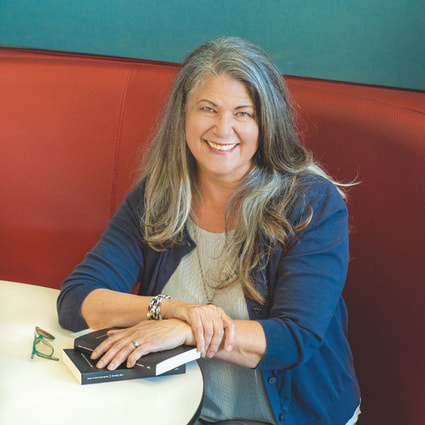 Dorothy Rowena Rice is a writer, freelance editor, managing editor of the nonfiction and arts journal Under the Gum Tree and a board member with the Sacramento area youth literacy nonprofit, 916 Ink. Her published books are The Reluctant Artist (Shanti Arts, 2015) and Gray Is the New Black (Otis Books, 2019). She is the editor of the anthology TWENTY TWENTY: 43 stories from a year like no other (2021, A Stories on Stage Sacramento Anthology).
At age sixty, after retiring from a thirty-five-year career in environmental protection and raising five children, Dorothy earned an MFA in creative writing, from UC Riverside, Palm Desert. Learn more and find links to many of her published stories, essays, reviews and interviews at www.dorothyriceauthor.com.
Hi Dorothy,
I’m a huge fan of your riding, especially The Reluctant Artist. It is serendipitous that I saw this review since I am completing a manuscript of a graphic memoir based on my dad’s book about his childhood. I’m collaborating with a talented NYC artist. We have been working on this book for six years, finally found a publisher, and it may even see the light of day! I have read lots of graphic memoirs in preparation for my book. My intro to the genre was Allison Bechdel’s books and I’ve read most of the ones that have been published lately (and Maus, of course) and was surprised how much I enjoyed them. Thank you for this review. I’m going to add this book to my collection.
Cathy Cassady
Of course, I’m a huge fan of your writing, not your riding
🙄
Michael and I were in the same cohort for our MFAs at Lesley University, which sadly (side note), seems not to offer that anymore. I remember reading parts of this as a work in progress, ages before the graphics. The graphic novel/memoir is a great way to tell certain stories and particularly gory or horrific ones seem to lend itself to that format: Maus, Persepolis, as well as the humor of often painful things like in Hyperbole and a Half and Roz Chast’s Can’t We Talk About Something More Pleasant. I’ll add this one to my bookshelves next to those.
Thanks for posting! I remember reading Maus and Persepolis years ago, but need to revisit. I will be on the lookout for others.
Hi Dorothy…
I wrote a comment but I don’t know if it went through.
Cathy Cassady