Reviewed by Emily Webber

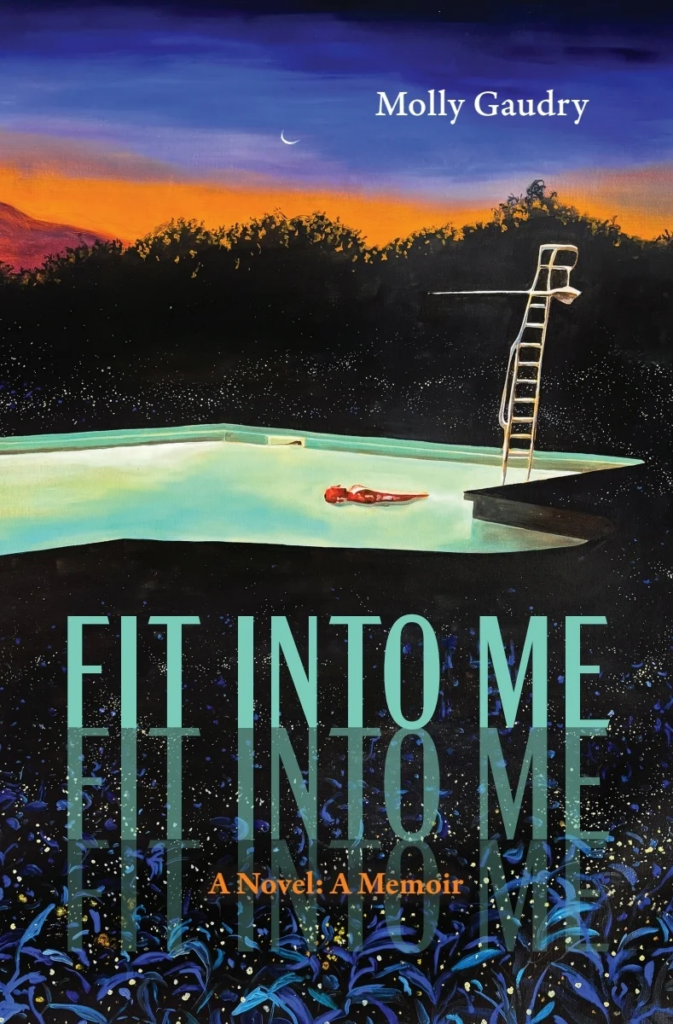 When you pick up Molly Gaudry’s Fit Into Me, A Novel: A Memoir (and you most definitely should), you’ll have certain expectations going in just like I did. Prepare for them to be smashed in the best way possible.
I expected it to be like Erika Stern’s genre-blending book, Frontier, which I read and loved last year. In that book, Stern shares her experience of giving birth and, in alternating chapters, tells a fictional ghost story about a woman who dies during childbirth in the Wild West.
But Fit Into Me (Rose Metal Press; Dec. 2025), instead of presenting two separate narratives — one memoir and one novel — seamlessly merges fiction and nonfiction, as well as a look into Gaudry’s writing process. The result is a unique blend: it’s part memoir about a writer coping with a mild traumatic brain injury, part about the process of writing a novel, and part how a writer is influenced by other literary works. All this while incorporating the fictional story of the tea house woman, a character who appeared in Gaudry’s previous books, Desire and We Take Me Apart.
The tea house woman inherits the family tea house when her mother dies, sooner than expected, before she’s even had the chance to explore other desires. The tea house woman’s story unfolds over Christmas and into New Year’s as she works, takes care of her elderly father, and navigates a volatile relationship with her lover. Gaudry shows how she uses word lists from other literary works as prompts, as she has done with her other books. For Fit Into Me she cut up and selected words from Anne Carson’s translation of Sappho, If Not, Winter. Gaudry presents the word list on the page, followed by the piece of fiction with the words used identified in all caps.
It didn’t matter how many times her father told her she didn’t have to continue her mother’s (and grandmother’s and GREAT-grandmother’s and great-great grandmother’s) WORK if she didn’t want to, that it was okay to forge her own path in life. And yet, guilt, duty, obligation—these always took over. Perhaps it had been ingrained in her too early that she would inherit the tea house, that it was hers, that all of it was for her and her own CHILDREN, all of it would one day be theirs.
Gaudry’s own story explores similar themes of identity and desire, especially coming to terms with how her mind and body have changed after her head injury. On the page, she shows how the injury changes both her reading and writing process. She’s also dealing with a dismal job market, complicated relationships, and exploring her identity as an adoptee from Korea. Towards the end of Fit Into Me fiction bleeds into her own story with an entire section where she imagines her brother from Korea coming to tell her that her biological dad is dead. In the end, we know this doesn’t happen, and we are left to wonder if her biological dad is even who her family says he is. With fiction and nonfiction interwoven on the page, it becomes clear how certain topics are easier to explore through fiction—especially those that carry significant emotional weight or involve questions the writer cannot answer directly about themselves.
There’s another layer to this book with footnotes on many pages and surprisingly they were a favorite part of my reading of Fit Into Me. Gaudry merges passages from literary works into her text, drawing on writers such as Marguerite Duras, Roberto Bolaño, Weike Wang, and Margaret Atwood. She does not use quotation marks to avoid taking the reader out of the text, instead using footnotes as citation. To do this over 100 times, and the sentences fit so perfectly, is an amazing effort. Any reader and writer will understand the effect—what we read, the works we love, become one with our voice and shape how we tell our stories.
Gaudry also uses the footnotes for lengthy asides that become entire stories in their own right. One footnote tells the backstory of a minor character, Nell, a friend of the tea house woman, and how Gaudry created the character partly based on a woman who lived upstairs from her. It is a total offshoot from the main text and full of particular details on Gaudry’s characters and real acquaintances, which could weigh everything down, but instead becomes a beautiful meditation on character, memory, and personal stories.
All over Molly Gaudry’s Fit Into Me are the holes in our lives made by grief, changing self, fear, and the unknown. Also, what we fill them with—the truth, stories made up, stories given to us, or even the blank space on the page. Often, when reading experimental work, I can appreciate what the writer is doing to push beyond the norms of traditional genres and the use of unique technical construction, but the result can be confusing or lack emotional connection. Gaudry avoids both pitfalls. Fit Into Me demands the reader’s close attention, with over 170 footnotes, shifting styles, and complex layers. In return, you’ll experience an intellectual and emotional journey unlike anything else.
 Emily Webber is a reader of all the things hiding out in South Florida with her husband and son. A writer of criticism, fiction, and nonfiction, her work has appeared in the Ploughshares blog, The Writer, Five Points, The Rumpus, Necessary Fiction, and elsewhere. She’s the author of a chapbook of flash fiction, Macerated.