Reviewed by Melissa Oliveira

 Early in Lights In Cold Rooms: A Psychologist Reflects on Family, Aging, Love & Loss (CavanKerry Press; 2025), Joan Cusack Handler writes, “Incidents of depression quadrupled among aging women during the COVID pandemic and quarantine isolation… Those who were suffering were left to face their demons alone.”
Handler, a psychologist with about forty years of practice under her belt, also knows personally what she’s talking about. Most of the short essays and reflections contained in Lights In Cold Rooms were written with Handler nearing eighty years of age and the COVID pandemic gaining momentum. With the world in various levels of quarantine, the area around Handler’s New York apartment loud with sirens, and family and friends self-isolating, Handler finds herself slipping into depression.
In perhaps the best description I’ve read of what depression actually feels like, she writes, “I understood what was happening to me, and I was terrified… But in these textbook descriptions lies an unrelenting weight that can’t be so easily described. A silent thief, stealing what makes you you.” She knows she needs help, but previous therapists have predeceased her and, despite her best efforts, Handler is unable to find a therapist willing to treat a nearly eighty-year-old therapist. Handler, though, is also a writer and a poet, so she pivots to what’s left to her to process some of what’s going on in her mind: she turns to the page.
Lights In Cold Rooms is the end result of that period of pain and isolation: a series of memories, reflections and anecdotes ranging through time from the pandemic and back through to Handler’s childhood and everything since. Over the course of these short essays, we are invited into the very process of her mind, as the writing literally serves as her therapy. In this way, we explore, with Handler, what depression might steal — impressions, memories, and ruminations that make her her.
In a manner similar to talk therapy, topics tend to jump around rather than stick to strict chronology, so there are stories from childhood as well as her seventh decade: stories about being the tallest child in her class whose mother’s style and sewing skills helped her feel beautiful in her tall frame, and stories about that same tall frame falling, breaking bones, experiencing pain. There are short essays about discovering her scoliosis by chance in college, and needing several surgeries to resolve the back pain. Sometimes, she grapples with her own aging; other times, she observes the aging of her older sister with a mix of compassion, resentment and fear.
There are also pieces about Handler’s ambition, motherhood, family and faith, but it is these discussions about aging – its vulnerability, its uninvited changes – that somehow stayed with me after I put down her book. She writes, “In aging we have the capacity to resurrect emotions, events, people — study them, turn them around. It’s the mental reverse of falling.”
What’s interesting about the book is that these do feel like discussions, like there are multiple people in dialogue on a given topic. Sometimes there’s a literal polyphony of Joans on the page: alongside the narrative voice, there’s the voice Handler calls “Therapist Joan” providing wise insight and cool observations as well as a ‘poet Joan’ reciting lines of verse. For example, Handler writes, “Sometimes I think that my longing for isolation is rooted in my feeling like an outsider all my young life. I belonged nowhere.” A few lines later, Handler’s poet-voice interjects, “One’s center / must really be / home.”
Like the many facets of identity that make up all of us, this collection of voices, all belonging to the same person, felt true and added so much depth to her writing. These quiet conversations with herself were some of my favorite parts of this book, maybe because that “homework of therapy — watching and catching myself as I keep walking into the same wall” is typically such a private process. Here, it’s all laid out. Handler’s relationship to aging, to her own body, to the Catholic church and to pain are all covered in detail. While I wished for more scenic storytelling, I also enjoyed how Handler relates and processes these experiences — as a woman, as a psychologist and as a poet — that is really unique to this book.
“To know what lurks inside us,” Handler writes, “is to gain the ammunition to face it — and the spark to ignite change.” In reading this, it struck me that the process of the poet and the therapist aren’t far off from each other: both involve looking hard at yourself and trying to make something emotionally useful of the pain you find. Compare this with her childhood Catholicism, which she says she misses for the feeling of “being loved unconditionally. Of being held closely and reassured that life does not end. That I’m safe.” This works well for Handler’s older sister, but its simplicity no longer fits Handler (no matter how much she misses parts of it).
There’s so much to value in Lights In Cold Rooms. Six years after the start of the pandemic in which she wrote her first draft, but with a world that seems no less complicated or horrifying, I appreciate Handler’s willingness to examine life without shying away from complexity. If she’s willing to let us also observe her process here, maybe those of us reading can learn how as well. I also enjoyed being able to peek behind the therapeutic mask to the mind working behind it, which seems just as crowded as anyone’s despite all the years, the knowledge, the experience providing therapy to others. Maybe more than that, I valued Handler’s perspectives on aging and vulnerability, especially in the context of world events, and I can’t say I’ve read a similar book in recent memory.
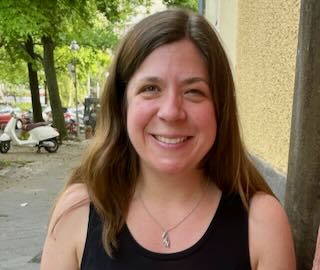 Melissa Oliveira’s essays, poems and stories are published in Ploughshares Solos, AGNI, Post Road, BOAAT Journal, The Normal School and others. Her work was listed as a Best American Essays Notable, nominated for the Best of the Net Anthology and has received honorable mention in Glimmer Train’s Short Story Award for New Writers.
She is a regular book reviewer for Hippocampus Magazine, and her reviews have also appeared in The Kenyon Review Online, Brevity, and more. She is a graduate of the University of Colorado (MA) and the University of Connecticut (BA). She lives in Berlin, Germany.