
Reviewed by Carolyn Roy-Bornstein

 Essayists contain multitudes, to paraphrase Walt Whitman. The writer may be the child or at least the younger version of themselves, living an experience on the page as the protagonist with little insight.
Then there is the older, wiser self as well: the one who has extracted some lesson, some practical wisdom from having lived through that encounter and is now sharing it with their readers.
Then there is the author themself, who developed the idea, who sat at their computer or writing table and penned their thoughts, erased and deleted, added and modified. In many perfectly good essay collections, we see only the first two “I’s”, or sometimes only the second.
In Ravelings: Essays on Love, Loss, and Wonder (University of Nebraska Press; 2026), we see all three, often in the same essay, communicating not just with us, her readers, but with each other.
A quick note before I begin: When I finished this book, I just wanted to write as my book review, “Buy this book. Read it.” 1,200 times on the page. But I thought again.
This collection consists of 17 essays, arranged roughly chronologically, written over a 16-year period, mostly from Knopp’s perspective as an older adult: from her father’s death, through her bouts with an eating disorder, to her efforts to reverse osteoporosis. All are free-standing and meaningful on their own, but connect with each other around the themes of love, loss, and wonder. I see the connections as ties between stories. The author sees them as vital to her process of untangling an experience in search of its deeper meaning.
This style of essay-writing creates a fascinating pulling back of the author’s curtain that makes it accessible and authentic. In the essay “After Dover”, Knopp describes eloquently the tiny lighthouses topping each breakwater, the soft and powdery limestone chalk, and the slow queues of lorries in the harbor below. She injects mystery and tension as the author and her daughter are offered a ride back to their quarters by the shopkeeper they’d just met back up the road a way. Then there is the visit with her daughter itself and the “wonderstruck moments” they’d shared with deep gratitude. All that would have been enough. But when Knopp awakens the next morning, she learns that a migrant from an encampment in Calais, the French village opposite the white cliffs of Dover where the two had sat, had leapt to his demise trying to jump onto a moving train headed for England.
Now, another writer may have just woven this detail into the story from the beginning, or centered it differently. But Knopp chooses to tell us how and when she became aware of this news, and about her decision to include it in the essay. This compassionate transparency illuminates both her humanitarian bent but also reveals a human foible. Not only is she “intrigued by the extent to which the addition of one new detail can change the story we tell about ourselves and our experiences, reminding us that the first version we tell about any encounter might not be the truest”, but she is also shamefully cognizant of the “unexpected twist, complexity, and balancing ballast that he brings to what otherwise would have been a pleasant, uncomplicated narrative.” Her self-revelatory way of weaving process into her work exposes a vulnerability and a refreshing truth.
Underlying many of the essays in this collection is the subject of aging. And Knopp considers aging the same way she approaches all her essays, and life in general… with an abundance of curiosity. In “Leaving the Body”, Knopp stays in the hospital room as the aide washes her mother’s body in preparation for the funeral home. She remembers the sponge baths her mother gave her when she was sick as a child. She studies the details of her mother’s form, telling us “I want to savor and memorize the details. Her nipples are a lovely light pink and pegged; a puckery white surgical scar on her left outer breast is smaller than I expect it to be and matches one that I have on my right breast.” She is not one to shy away from discomfort, shame; our bodies all tell a story.
Throughout the book, Knopp is braiding, raveling. She braids past with present and future. The washing of her mother’s body is braided with memories of childhood, but also imagining her motherless life ahead; “I’ll want to assure her that in spite of the pain, I don’t want this grief that mingles with my joy at the arrival of the mourning doves and daffodils she loved, and I don’t want the buds on the pear trees to end because it keeps her near and present.” She also weaves certain motifs, thoughts, and observations throughout the different essays, pulling strands from one story, weaving them into another. The chartreuse vines of a sweet potato in “Kadish” recalls the chartreuse jacket of the oarsmen in “The Renoir.” The naming of plants and trees in “Name-staker” blends into the “emotional granularity” of naming very specific feelings or processes. And her own aging is woven throughout, there on every page. We see it. From child to young mother to craving lover, to aging writer questioning her relevance. Then, there is the ultimate raveling as she plaits her mother’s hair, then cuts it from her dead body.
One of my favorite essays is “Giving Form to Feeling” in which Knopp goes to an art exhibit of the Austrian artist Maria Lassnig who is most known for her self portraits. But Lassig doesn’t merely paint what she sees in the mirror. She portrays her “internal world” according to the curator’s plaque. Garish faces — pained, monstrous, perplexed—paired with guns, graters, a slab of red meat. All to share her inner life. Her angst, her anger.
Knopp’s initial revulsion at the exhibit gives way to her signature curiosity, wondering what events in Lassnig’s life inspired this brazen art. Was it a reaction to the male-dominated art world of Vienna in 1960? A response to the Nazi occupation where she was studying as a young woman? Of the piece where Lassnig’s face is covered in plastic wrap Knopp wonders, “Was it cultural forces or the effects of trauma that so enshrouded her?” As I read this essay, I began to wonder how this art would influence Knopp’s own writing.
Towards the end I had my answer. “…this woman who speaks to me about matters close to my heart: how to represent myself in my art; how I, who find it easier and more natural to think rather than feel, can become more attuned to what my body knows.” And there it was. Knopp’s writing will become more embodied, less concerned with thoughts and ideas about getting old, instead focused on what that marcescence feels like.
In her preface, Knopp considers the title of her book, the word Raveling:
“A contranym—a word with a pair of contradictory meanings—is a curiosity. The verb ‘ravel,’ for instance, means ‘to disentangle’ threads or strands. But an older, less common meaning is ‘to entangle’ them. One must consider the entire sentence in which the word appears to determine if ‘raveling’ means ‘to make’ or ‘unmake,’ ‘to complicate’ or ‘simplify.’”
When I read this introduction, I wished she had held back her ideas about the word. I wanted to figure it out myself. To ruminate and reflect. Research perhaps for this piece. But by the end of this book, I realized it just isn’t in her nature to hold back. And that’s a blessing for all of us.
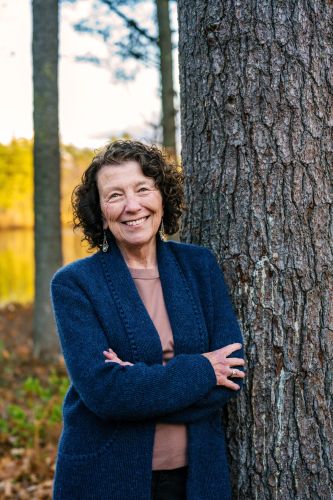 Carolyn Roy-Bornstein is a retired pediatrician and the writer-in-residence at a large family medicine residency program. Her work has appeared in The Washington Post, The New York Times, The Boston Globe, JAMA, Poets & Writers, The Writer magazine, and other venues. Her most recent book, A Prescription for Burnout: Restorative Writing forHealthcare Professionals is forthcoming with Johns Hopkins University Press in April 2026.