
Reviewed by Kirtan Nautiyal

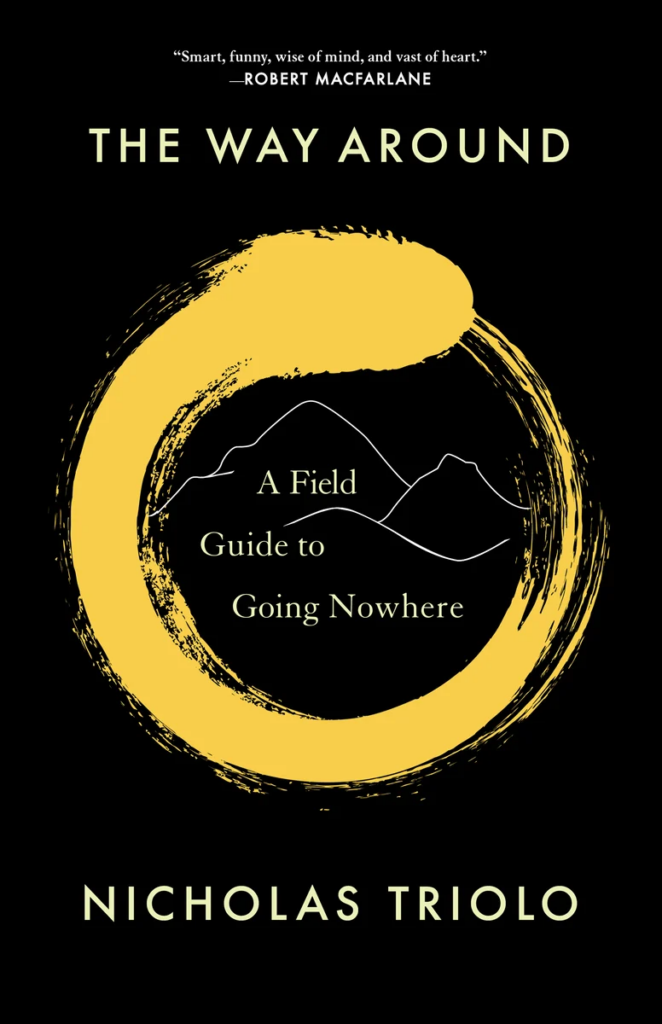 In the opening pages of his debut book The Way Around: A Field Guide to Going Nowhere (Milkweed Editions; June 2025), Nicholas Triolo describes the scene of his collapse at the finish line of the Western States 100, the world’s most competitive one hundred-mile footrace.
He’d begun running recreationally as a simple counterbalance to a corporate day job, but slowly, swept up in the culture’s dictum to grind harder and achieve more, he’d pushed himself further and further over the years; so far, in fact, that when he blacked out at the end of the Western States, regaining consciousness an hour later submerged in an ice-filled Motel 6 bathtub, it felt less like an achievement than the end of another day spent digging his own grave.
The book chronicles his efforts to find another way to be in the world, one less consumed with winning races and conquering summits. It’s a challenge that will feel relevant to many readers with overstuffed lives of their own.
“What if,” he asks, “surviving the perilous times ahead requires us to identify with a different trajectory, one that relies on questing and returning, achieving and relinquishing, one that centers mystery and humility as a way home?” He’d encountered the Buddhist practice of kora years before when backpacking in Nepal, and now, attempting to answer his own questions, he found new inspiration in that ancient ritual of circumambulation.
“How are the shapes we follow in life also shaping us?” Triolo asks as he begins circular walks around sites of pilgrimage in Mt. Kailash in the Tibetan Himalaya, Mt. Tamalpais near San Francisco, and the site of a former open-pit copper mine in Butte, Montana. In each case, the roundabout path taken helps turn his gaze from a particular destination to what is encountered along the way. He writes in a meditative, allusive style, quoting liberally from literary fellow travelers like Nan Shepherd, William DeBuys, and Ralph Waldo Emerson, and referring frequently to indigenous practices that run counter to prevailing Western norms of acquisitiveness, linearity, and speed. And yet his writing isn’t pedantic, frequently returning to a probing self-reflection that helps work against any developing sense of self-satisfaction.
It’s with this turning inward that Triolo begins to question the assumptions that undergird his travels. I appreciated his willingness to complicate the cliched narratives of spiritual tourism, in which a faraway culture is treated as a mere backdrop for a Westerner’s self-transformation. In Tibet, he comes to understand how his passport and bank account allow him to travel freely over sacred land denied to hundreds of thousands of exiles. And he sees something of his prior adventure-obsessed self in his decision to seek self-actualization in a remote, exoticized location thousands of miles away from home. Tibet, in some ways, still feels like an attempt to escape the self.
So he returns home, where his mother is undergoing treatment for breast cancer. As he hikes around Mt. Tamalpais in the North Bay, retracing a route originally walked by the beat poet Gary Snyder, he connects his circular movement with how he now orbits his mother as her caregiver, and how his mother once orbited him. By decentering ourselves, he contends, we begin to see how we’re merely one node among many centers of gravity.
That sense of interconnectedness is a necessary counterbalance to individualistic striving, a way to widen a “circumference of compassion.” Even in Tibet, where his companions are a motley crew of influencers, yoga teachers, and the vaguely spiritual, he listens when the leader of the trip tells him, “It’s important to join others in kora, because we all slip into a…movement with shared intentionality…everyone is going around the mountain with the same aim — to reflect and transform their lives, overcoming something that limits us, something that holds us back.” Community is our most important source of strength.
He brings the threads of his developing understanding together in Butte, Montana, where a local environmental consultant and conservationist named Joe Griffin invites him along on a twenty mile circumambulation around the Berkeley Pit, the location of an abandoned copper mine flooded with toxic water, now designated the largest Superfund cleanup site in the country. Here, rather than following well-trodden routes as he had in Tibet and California, he aims to co-create his own pilgrimage with Joe. Contending with the ecological destruction wrought by unchecked capitalism, the walk around the Berkeley Pit is a final test of all he has learned up to this point.
Readers who’ve traveled this far with Triolo will, I think, begin to see how they too can rethink their own relationship to place and how they move through and by and past it. The ways that such a reorientation could ripple outwards to benefit those around us — not just people, but all living creatures – also become clear. Those willing to slow down to the book’s beautifully contemplative pace will reap the most rewards from their reading experience. I, for one, hope to hold on to just a little bit of the shift in consciousness I experienced while working my way through this impressive debut, especially when faced with the buzzing demands of a life that regularly pushes me in a very different direction.
Though there remains, in this work of memoir, an ongoing tension between its overarching project of ego dissolution and the necessity of personal revelation in driving the narrative forward and deeper, it’s a tension Triolo deftly navigates. The Way Around: A Field Guide to Going Nowhere is a lyrical invitation to slow down and participate in its redirection of attention, a simultaneous radical and vital proposition in this world seemingly spinning out of control.
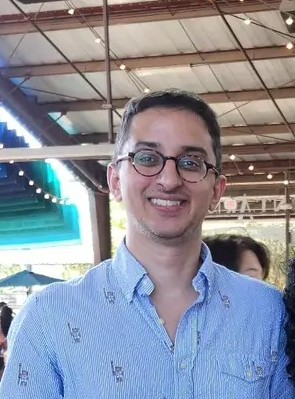 Born in small town Oklahoma, Indian-American writer Kirtan Nautiyal is now a practicing hematologist and oncologist near Houston, Texas. His debut memoir-in-essays, An End is A Beginning, will be published in early 2027 with the University of North Carolina Press. His work has also appeared in The Guardian, Aeon, Electric Literature, Longreads and elsewhere. Visit his website at www.kirtannautiyal.com or find him on Instagram @pizzachampion to learn more about his upcoming work.