

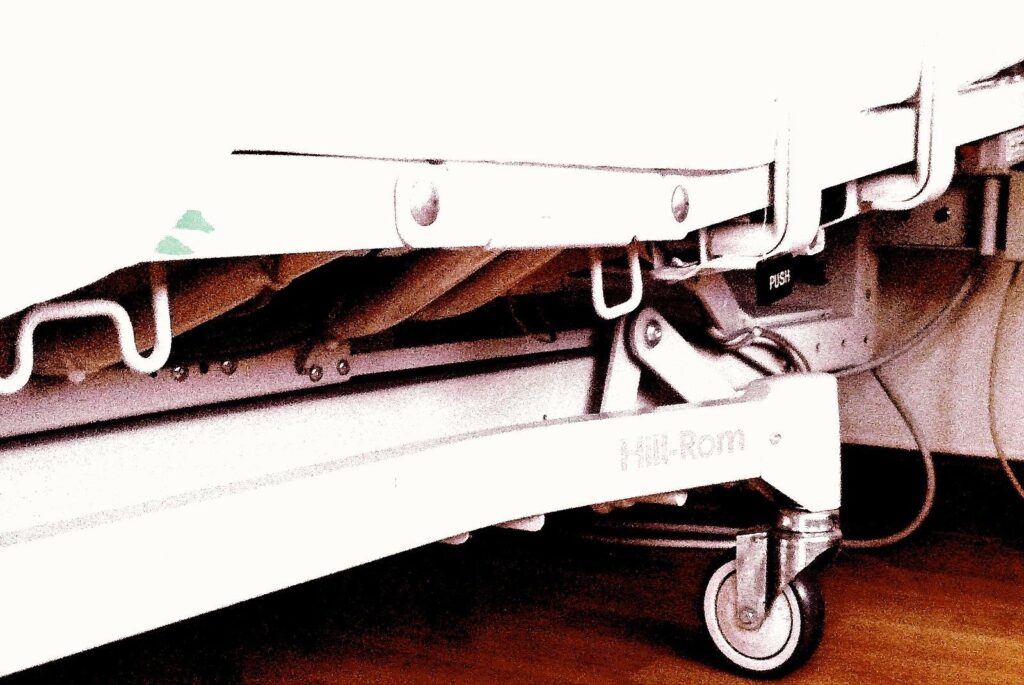
Visible through the window:
light sun, little squirrels scurrying down cement steps, empty-handed.
In front of me:
Jonathan lying down in a hospital bed, mouth agape, eyes closed, neck torqued back, his face reaching toward the ceiling.
“Good morning,” I say. “It’s Michael with the caregiving service.”
“Good morning,” he says, disoriented, still waking up.
I grab his arthritic hand and shake it gently.
A puddle of piss near my foot; the container overflowed while I was gone. On the end table: dentures soaking in their solution.
I’m not the most knowledgeable caretaker, but I make him laugh. I get him talking. I’m curious. His diaper’s soiled — I can smell it.
We get through this part quickly: the wiping, the changing. I’m learning how he likes it done and expediting the process each day.
Nobody wants to have their ass wiped any more than somebody else wants to be wiping it.
I grab his breakfast. We fall into more conversation than the first day.
Jonathan spent two decades traveling as a civil engineer, working off the coasts of different countries. His family joined him if he felt they were safe. They spent a lot of time living in the U.K. near the North Sea.
When they sent him to Japan, he preferred staying at a hotel in Tokyo an hour away from everybody else and figuring out how to use the train like a local commuter — even though he didn’t understand the language.
“Eventually, you’d just know how many stops until it reached yours,” he says.
“Muscle memory,” I say.
“Right.”
He loved an annual deer hunt out in West Texas, even though it wasn’t every year that he caught one.
I ask about the photos on his wall. He never says he loved his late wife, but I can tell they were everything to him. His smile is different when he talks about her.
“What was she like?” I ask.
“Real bubbly,” he says, smiling like a knucklehead.
She painted and pressed brass. They built a two-story house together with their own hands outside of Houston where he lived until he lost functionality in his legs.
Our first day together, we watched eight straight hours of NCIS, so I brought books the second day.
The commercials haunted me:
“Having troubles with your hand? Call the hand doctor!” An arthritic hand, contorting, struggling, unable to press flat against a table.
“Keep your teeth white!” A performative veneer smile, being whitened under bright lights.
Another, promising medicine to keep our elders running, laughing, and swimming in lakes.
A hundred years ago, would they all have been dead ten years earlier?
Is most of the time we’ve gained just devoted to acquiring more time?
Death, death, death, looming around the corner anyway.
I won’t stay able forever.
After breakfast, he naps. I read Plutarch and write about how I’m there, reading Plutarch in the meantime.
Lunch is left on a quarantined oak bench in the hallway. The grandkids are my age. They don’t knock to let me know. I grab the matte blue canteen, clean it when he’s done, and return to the room.
They don’t say hi as I pass. They avoid me, stare at the floor, pet the dog. Do they think I’m going to rob their house? Probably. Maybe. The grandson’s mouth has consistently hung open in this confused and fearful way no matter what direction he’s focused his gaze on. Whenever his anxious and beady eyes dart away from me, I can’t help but wonder if he’s mistaking my dark olive complexion for being one that’s of Mexican descent.
I go to drop one in the bathroom designated for me and think about how creepy they are — but don’t really blame them for it too much. I don’t know why. Maybe I just don’t want to focus my energy on judging them when I’m there to help Jonathan. I’ve heard that they treat all “the help” this way and “the help” is all Jonathan has. When I leave the bathroom, I notice the grandson looking at me from the living room. He quickly looks away.
Do they hang out with Jonathan when I leave, or are they always in the next room, bringing cups to the door when it’s time?
I’ve stopped asking as many questions. He doesn’t want to watch TV. Silence sits between us.
Should I fill it?
He takes a beer every day with lunch. I pop the tab on his Coors, place a plastic straw in the hole, and hold it to his lips until he drinks it down low enough to take the rest himself.
I ask more. He’s easy to talk to. Sometimes, he gets easily angered and calls me “boy.” I wonder what that’s about — maybe dementia, maybe my demeanor, maybe the situation at large or something else entirely. But mostly, he’s sharp and I heard from my supervisor I was the only man he’d allow to take care of him.
“When you lost your legs and had to leave the house you built, how’d you take it?” I ask.
“Part of living,” he says, pulling a sip through the straw.
Sometimes, while sitting bedside in the wheelchair he can’t use anymore, I feel tears welling up in my chest. Sometimes I cry, though I don’t know if they’re for him or me.
When I feel them coming, I look out the window into the backyard, so he won’t see my face.
In the backyard, all by itself, is a square enclosure of worn-down white picket fence. Two tall posts and an overhead arch at the entry. High grass around it. The white paint fading.
His son built the enclosure years ago to grow a garden and keep the deer out.
“It didn’t work out too well for him, did it?” I ask.
“No, no it didn’t,” he says, laughing. “He gave up on it a while ago.”
“You think it ever stood a chance?”
“No, I don’t think so,” he says. “You can’t stop what’s meant to come through.”
Before my shift ends, I see four deer grazing on the grass by the enclosure.
“There’s a bunch in your backyard right now,” I say. “They’re real comfortable—some are coming super close to the window.”
“Yeah,” he says. “The deer out here have a darker color of hair on their backs than most deer.”
“Interesting,” I say.
“At least the adults do.”
I grab the trash from the day and bring it to the kitchen on the way out. The grandson’s holding the front door open and waiting for me to leave.
I step past him and nod. He doesn’t nod back.
Behind me, the door clicks shut.
Visible in front of me: the sun getting ready for bed, giving amber kisses to the hills on its way toward night, while a ready-to-go car with a full tank of gas waits by the curb.
The air is stale and stuffy and so hard to breathe, staleness akin to lying in a bed day after day, waiting to die, with nowhere to go.
The staleness sticks and despite it, I go dutifully. As I still have more than just one room to go.
 Writing, being of service to others, and connecting deeply with people have consistently given Michael’s days meaning and purpose. Whether composing poems to his cousin’s guitar in New York, or navigating the smoke-filled pits of South Korean army bases, his notes app and word have always been a home for his stories and poems.
Michael’s currently pursuing an MFA in creative writing at Texas State University. He was accepted into the program in January 2025.