Interviewed by Morgan Baker

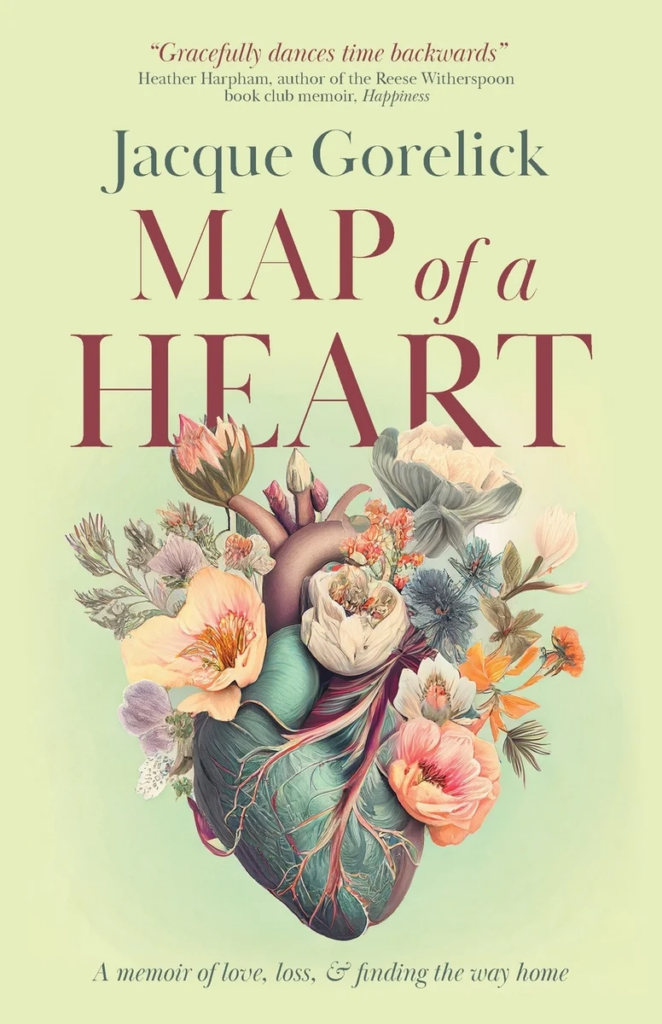 I didn’t expect Map of a Heart: A Memoir of Love, Loss, and Finding the Way Home (Vine Leaves Press; February 2026) to be a page turner, like a mystery, but it is.
In the book, Jacque Gorelick and her young husband, Ed, go for a hike with their two-month old newborn son. Ed takes off for a run, leaving Jacque and the baby. When he returns, he looks at Jacque and says, “I don’t feel well,” and then collapses on the ground.
Bystanders come, but no one wants to help with CPR without a face mask. An off-duty firefighter appears on the scene, and gives Ed the compressions he needs for his heart to get going again. At the hospital, a nurse hands Jacque a plastic bag with Ed’s belongings: watch, wallet, and keys. She says “Be prepared for a different life.”
Please enjoy my conversation with Jacque.
Morgan Baker: First of all, congratulations. It’s so exciting. The book is about to drop. You must be in the midst of launch stuff.
Jacque Gorelick: I am doing a zoom launch on the day of, and then I’m doing a small launch party at a local independent bookstore that weekend.
MB: Thank you for talking with me today. First of all, I thought it was a real page turner, and that surprised me. I didn’t know what was going to happen. Does he die? Does he not die? Does he live with complications? At the end, it’s 13 years later. What propelled you to write the book to begin with?
JG: Honestly, I left teaching and it was time to think about segueing into something else. I was being pulled in all sorts of directions, and teaching requires your full focus. Early education was changing so much, it was just time for me to move on. The long answer to your question is I started taking some writing classes — something I’d always wanted to do. I took a memoir class because I liked reading memoir. I really hadn’t intended to write one.
MB: I thought the pacing was really good — which is part of the page turning aspect, but I was also really fascinated by the structure and how you came to it. It’s not a linear story. It’s present, past, present, past and then you have the letters to Ed woven throughout. It all worked beautifully. You get us interested in the couple and their baby, and then it’s “oh my god.” The reader wants to know who these characters are. And you go back and tell us. It worked really well. How did you come to play with structure?
JG: I’m glad it worked well and the pacing, too. That was something I didn’t know tons about. I didn’t have that background, but from a reader perspective, I just knew what would pull me in. I didn’t know how I would do it as I wrote, but the first chapter came out as an epistolary. I think because at the time it was still really hard for me to write because it was still traumatizing. How do I get the reader to care at all about this man who we haven’t met? I knew I wanted to start with an inciting incident. Obviously having that happen in anyone’s life as a new mother is horrifying but I wanted to show how much it meant to me to have the stability in this family and then to feel like it was going to all go away again.
MB: Your structure reminds me of the TV series The Pitt. Each episode is one hour of a shift. Your structure when Ed was in the ICU was similar—every other section was an hour of the time you were in the waiting room. It moved the story along at a fast pace. It felt like you were there forever, but really it just seemed that way. Maybe also because of what you were going through.
JG: I agree with that. To your point, it did feel like a year and you know, you blink your eye and it’s over. Then it’s like, “Whoa, did that even happen?” I wasn’t sleeping. Truly. I had a newborn. He was nursing every two hours. It was all hands on deck with him. I was adjusting to motherhood. That whole thing is hard and a little bit surreal and knocks you off your balance. None of it felt stable.
MB: My 4-month-old granddaughter and her parents live with us. Having a newborn is labor intensive and exhausting. It must have been weird, and like you said, surreal. You have a new life, moving forward. Looking at this like, who is he and who is going to be? And the possibility that you’re also looking at death. How do you do joy and not joy?
JG: It was joyful being a mother, and I knew I loved him immensely, and I wanted nothing but the best for the future. I look back and I’m impressed with how I did it, and I’m kind of not surprised because that’s the nurturer, the teacher I am by nature. But it became a little bit perfunctory because, obviously, the massive focus was on Ed. I was divided between the two people I loved most.
MB: That’s life. You can’t plan for your husband to fall down in front of you. Life happens. So tell me a little bit about Steve, the off-duty firefighter.
JG: Steve and I are friends now. We’ve stayed close over the years. I didn’t meet him in the hospital. I didn’t know as much about him in the hospital as I knew afterward. He did call the hospital to see how things were going, but to your point, I think he gets it more as a medical worker. He didn’t want to flood me with too much information. To hear him tell it, he gave me the responsibility of doing breaths. He didn’t need me to do that, but he said, “You needed a job.” He’s right.
That was a good way to give me a closed end task. I was probably panicking and spiraling. But I can do this. He could have easily done the whole thing. He wasn’t worried about giving Ed breaths. The guidelines [of CPR] have changed to hands only. You just get down and start pumping, and that’s enough to keep blood flowing through to save organs until someone can get there to do more intensive intervention.
MB: What was it like writing about the people in your life who have let you down? First your mother dies when you’re young. Later you become estranged from your dad and brother, and then your stepmom. All of this contributes to your need for a home and a family.
JG: It was sad. It was heartbreaking. It was one of the first times I let myself feel it. I was a product of my upbringing and probably also partially because I was a firstborn daughter, and my personality, I was trained to bounce back and see the positive of everything and that’s probably why I’m resilient. It was really sad. It was hard. I had to do it in slow bits, and take breaks. On the flip side, I tried to really see them whole… as a product of their upbringing. We all have so many layers to us.
MB: Can you talk about burning your journals? Did that feel good? Do you regret it? It was a scene I didn’t expect, not that I expected anything really, but I just thought, wow. I was impressed. Some people say burn everything before you die so the kids don’t have to find it.
JG: As a writer, I regret it. I wish I had access to all of that, but then there’s a part of me that wonders if I’d actually read it, because it might just be too much. I need to really feel like I was done with it.
MB: Tell me about your publishing process.
JG: My publishing journey had some stops and starts. It had the pandemic, which was a big hurdle and slowed me down, and then the day my kids went back to school in 2021, I was diagnosed with breast cancer, so that really derailed me for about a year. Once I got over the chemo and radiation, I started looking at small presses because it was another wake-up call about time. I submitted to Vine Leaves Press when they opened for submissions in September. They’re great. I’ve had a good experience. My developmental editor was so good. Our back and forth has been great. I would definitely recommend putting them on a list.
MB: One of the things I thought of looking at my notes, is that a lot of the book is about loss and fear, but when I finished it, I felt joy and hope. It’s a reminder that happiness can be born out of difficulty.
JG: I definitely feel that way. I feel like there was no other way for me to find the life I’m living or the stability I have, other than the path I had to get here. It does feel hopeful. I am really grateful for the simple things in life. It doesn’t mean I never want the things that aren’t simple. I just have a lot of gratitude for my family, for their health, and that my dogs are sleeping at my feet right now.
MB: I have a different story, but with a lot of similarities, so I get it. I think having kids after you’ve had an unstable or challenging childhood, is a chance to do it over, not just for the kids, but you’re doing it over for yourself too.
JG: That’s true. That’s really true.
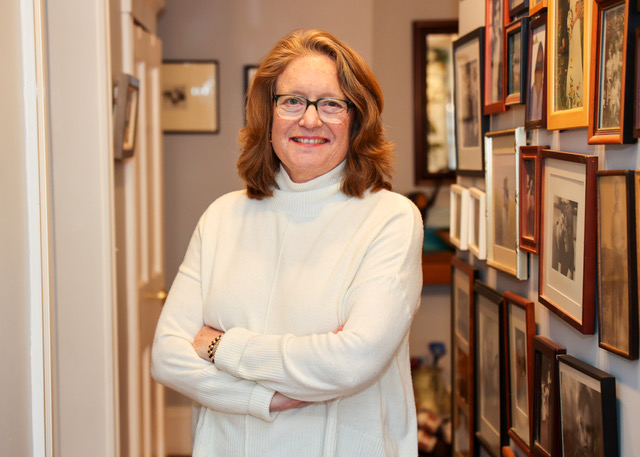 Morgan Baker writes about reinventing yourself, learning how to handle loss, and emerging from depression in her award-winning memoir Emptying the Nest: Getting Better at Good-byes (Ten16 Press). Other work can be found in the Boston Globe Magazine, The New York Times Magazine, The Martha’s Vineyard Times, Dorothy Parker’s Ashes, Grown & Flown, Motherwell and the Brevity Blog, among others. She teaches at Emerson College and is managing editor of The Bucket. She is the mother of two adult daughters and lives with her husband and two Portuguese water dogs in Cambridge, Mass. She is an avid quilter and baker.