

Blood on the table, drops on the floor. I watched from the kitchen doorway as my aunt Marge taught my mother how to carve the moose my father brought home into cuts of meat. At six years old, I learned that the dark, hulking animals that suddenly appeared along the highway or chewing on the mountain ash tree in our yard could become food for our family. Beneath the animal’s brown hairy skin lay deep red flesh and bones much bigger than my own or any I had ever seen. The heavy, sweet smell of the meat filled the room and set my stomach twisting.
Aprons over their clothes, sleeves rolled up, blood to their elbows, the two women wielded the knives my aunt brought from the butcher shop where she worked. Periodically, with an explosive “whack,” Aunt Marge would slam her cleaver down on a joint or bone, gradually severing the animal into recognizable chunks. Steaks, roasts, ribs, stews were wrapped in thick white paper, taped and labeled to be stacked in the chest freezer in our garage. Scraps were set aside to be mixed with beef suet and ground into hamburger. A leg bone was tossed into a bucket for the dog, enough to keep our cocker spaniel happy for a year.
My family moved from Buffalo, New York, to Alaska when I was five. Dad was a city boy from Scranton, Pennsylvania, who adjusted quickly to life in Alaska. He learned how to hunt from the other men at the power plant where he worked. Having served in the Army, he was already skilled with a rifle. I don’t know if my mother ever imagined that moving to Alaska would mean carving up a thousand-pound animal at her kitchen table. Having been raised on beef, pork, and chicken my first five years of life, I never grew to like the stringy meat or strong taste of moose or caribou steaks and ribs, but roasts, stews, or hamburger with plenty of onions, garlic, or tomato sauce tasted good enough. It was what we had to eat.
I was probably seven the first time I came face-to-face with the reality that an animal we ate for dinner could kill me. On a morning in early fall, our family of four camped at Kenai Lake about a hundred miles south of Anchorage. My father, younger sister Patty, and I meandered along the rocky shoreline of the blue-green glacier-fed lake while my mother read a book by the fire. Dad showed us the right kind of rocks to skim across the surface of the water. Patty and I were practicing our technique when the brush behind us began to quiver and crack. We froze. A moose stepped out of the willows, twigs and leaves dangling from his massive antlers. Towering above my father, bigger than a horse, the animal’s legs were twice as long as my body. I had never been so close to a creature that big.
“Ooh,” said Patty. Dad put a finger to his lips. The animal ripped out willows on the shore and crunched them with big yellow teeth. Snap, chew, snap, chew, lips and long nose wriggling with each bite. I would have laughed if the animal wasn’t so huge and scary. Dad grabbed our hands and slowly backed us away from the moose. The bull turned his enormous head toward us and stared, ears cocked forward in our direction.
“If he charges,” Dad whispered, “we’ll run behind that tree.” He pointed to a scrawny spruce a few yards away. The moose lowered his head and continued with the business of bulking up for the rut. When we backed far enough to reach a thicket of spruce, we sprinted for camp, blurting our story to Mom over and over when we arrived. After my sister and I calmed down, Dad reminded us, “When a bear charges, stand your ground. When a moose charges, run behind the nearest tree.” I didn’t want to be afraid, but I couldn’t stop thinking of how easily that moose could stomp my small body into a pile of meat and bones with his sharp hooves and gigantic legs.
***
Then, as now, along with moose, we shared the Alaskan landscape with bears, porcupine, lynx, snowshoe hare, and other mammals as well as the ducks, geese, swallows, and other birds that migrated with the seasons or survived through the winter. “Watch out for those bears,” my New York grandma warned us in her letters. But when Anchorage was a town of less than 40,000 people, bears had plenty of food and room to roam in the forests and mountains. As a child, I don’t remember ever seeing a bear in the city, though grown-ups said they sometimes followed the cow moose down from the mountains in the spring as they moved to the lowlands to birth their calves.
Decades passed. The Anchorage population grew to nearly 300,000, expanding to overrun wildlife corridors, making encounters between people and animals more frequent and sometimes deadly. In a 2021 report, the Alaska Department of Fish and Game estimated that there were around 350 moose living in the city year-round, but between 700 and 1,000 migrating seasonally between the mountains and population centers, particularly during deep winter snows when they sought out easier access to food in the city. Moose even triggered automatic doors to enter grocery stores and hospitals in pursuit of produce and greenery. Every year, a handful of moose/human attacks occur, some of them fatal. A moose harassed by an unleashed dog tramples the owner. A cow moose crushes a man’s skull when he tries to take a picture of her calf. A man exiting a building on a dark morning is stomped by a moose stressed by a crowd of people in the parking lot.
Periodically, in letters to the editor or topics of conversation at gatherings, people call for the culling of moose from the city. Some suggest offering pricey bowhunting permits to allow hunters to kill them quietly as they browse in streets and neighborhoods. Yet on the other side, people are fond of “our” moose — protective, and proud to show the big animals off to outside visitors. For me, I accept the dangers of living in moose country while watching for animals that could kill me without any warning. I no longer eat moose meat but know people who feed their families for a year on one of these powerful animals.
***
Dad had passed away in his early sixties, his hunting days long over by then due to heart and back problems. I left Alaska for college, traveled, returned, got married, divorced, and married again. When my second husband and I bought our house, we chose the neighborhood because it was near state and city park land and a network of biking, hiking, and skiing trails. For the first few years we lived there, fireweed bloomed in late summer among the charred stumps, twisted trees, and furrowed fire lines scraped into the land. The forest was just beginning to heal. No one knows how the fire started. Maybe kids smoking behind the high school or making mischief with a campfire. Grass and alder slowly overtook the fireweed, then birch began to sprout, then spruce seedlings appeared. Moose converged on the regenerating birch and willow, feasting on the tender young tips and creating a bonsai forest until the spruce could gain enough light and height to reclaim their share of the forest.
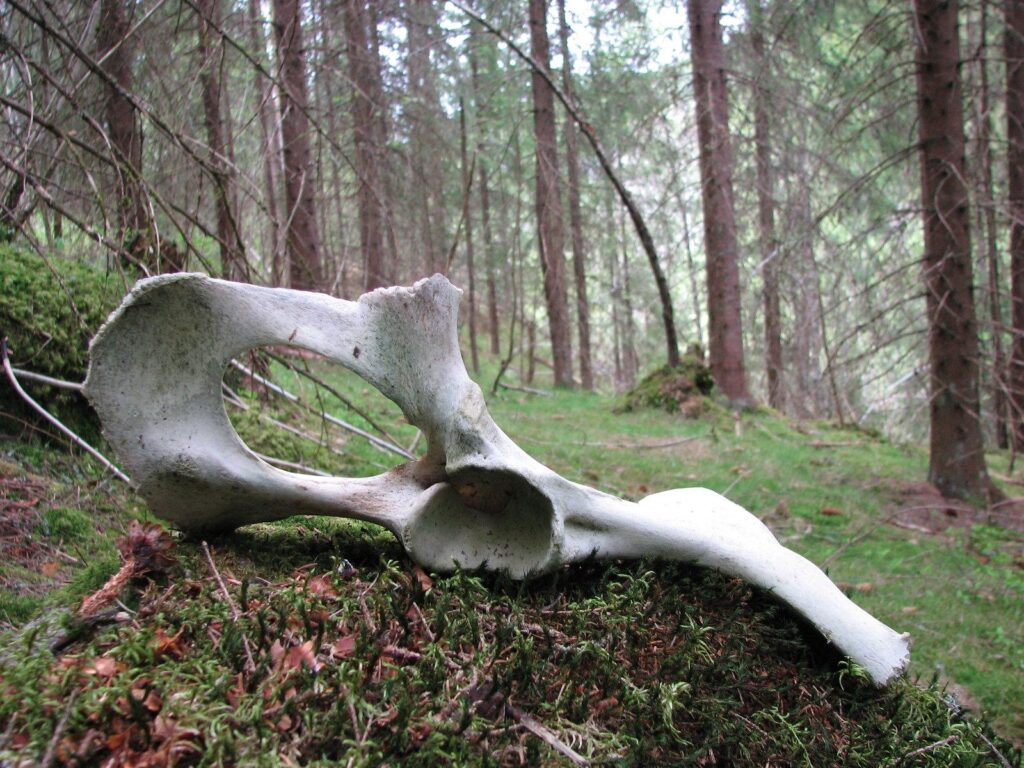
Over a few years, the forest floor began to diversify with low bush cranberries, dwarf dogwood, labrador tea, and mosses. My husband Jim and I found the bones one early spring day when the snow had just melted. A lower leg with hoof, ribs, and vertebrae scattered among the moss, crowberries, and unfurling ferns. A shoulder blade poked out from a pile of soggy leaves. Judging by the size of the skull and antlers, a large bull moose fell here, a half mile from our house.
How did the animal die? Was he wounded fighting another bull and stumbled here to fall just feet from where skiers breezed by all winter? Or was he hit by a car? Moose sometimes wander across the highway at the exact time someone is on their way home, or off to school, work, or a quick trip to the grocery store. This intersection of animal and human often proves fatal for one or both. Sometimes, though, the moose rises from the wreck, limps away, and dies hours or days later in the woods, unseen. One dark winter morning, roads greased with black ice, my husband Jim was driving our daughter to school when a young moose dashed across the road. Car and moose skittered into an inevitable collision. The car slowed just enough and the moose gained just enough traction so that the two intersected at rump and rear-view mirror. Deadly calamity apparently averted, but did the moose die a slow, agonizing death from internal injuries later? Bears, wolves, dogs, cars. Moose have a lot working against them.
We walked around the antlers, studying them, running our fingers over the tines, feeling the smooth curve of the bone. I wondered what it would be like to carry such an immense weight on your neck and shoulders for several months of the year, then feel the relief of finally shedding it in early winter. I pictured the bull we encountered at Kenai Lake so long ago. Had this animal been that big?
Jim lifted one side of the antler, then the other.
“I’d like to have this rack,” he said.
Though I was fascinated by the remains of the animal, I had no need to claim the antlers.
Better to let the creature lie where it fell to feed the soil, the plants, the insects, and other creatures still making use of small bits of attached flesh.
Alaska Native people believe that animals must be treated with respect in life and death. When the appropriate rituals of respect are performed, the animals will deem humans worthy of receiving their bodies as food. Non-indigenous Alaskan hunters often display hides and antlers of the animals they kill just to show off their hunting prowess. Even though my father was a hunter and wild game sustained us throughout the winter, he never felt the need to put the animals on display. Jim is not a hunter, nor the kind of man who needs to show dominance over animals, so I didn’t take his comment seriously.
***
A week later, the skull and antlers appeared in our driveway. Jim had returned to the bones and, with great effort, retrieved the entire head and carried it home.
“No!” I yelled over the deck. “I don’t want them.”
The antlers were objects of beauty, Jim explained, nature’s art. No, I argued. It was disrespectful to cut off the animal’s head just for our own amusement. Plus, though I wouldn’t admit it to him, I was a bit superstitious. I didn’t want to offend whatever spirit of the moose might reside in its bones.
But he would not back down. He placed the skull in the flower bed beside the front walkway and hung the antlers on the woodshed facing the street, death greeting all who passed by or stopped to visit.
Years passed, and I quit worrying about how we had desecrated the moose’s resting place.
It was a cool, overcast June morning. Jim and I snagged some time for a walk with our 20-year-old grandson Cason. Home from college for the summer, Cason spent his time biking when he was not working. We were on our way to get a glimpse of the starting line for the race he was to enter in a few days. No need to worry about which trail to take; we knew them by memory.
We passed the cut-off to the trail where we found the moose skeleton so many years ago. It was well-worn, a thrilling shortcut for bikers like Cason. I relished our unhurried pace and conversation without the distraction of the usual large family gatherings.
Jim and I each carried bear deterrents. He preferred a flare. I relied on the standard easy-to-unlatch-and-aim bear spray sold at Costco. Bears were on our minds. We had seen their scat on the trails, and neighbors reported them prowling decks and upending unsecured trash. Since we were three people on the trail making noise, we were confident that any nearby bears would know we were passing through and leave us alone.
Cason explained the features of his new bike, designed for downhill trail riding and jumping. The suspension would carry him forward as he leaped over a jump, then absorb the shock as he hit the ground again, hopefully still attached to his bike. I tried not to say what I was thinking — be careful, don’t do it, you’ll be sorry, find a safer hobby. He had already taken two spectacular falls that landed him in the emergency room and was recovering from a broken wrist. But isn’t that the role of the older generation, to protect the young from what they can’t foresee?
Without warning, a flash of gray crashed toward us. Thud of hooves, crack of branches. A moose.
Get behind a tree. We scattered, each plowing our own way through the jumble of spindly trees, fallen branches, and elderberry bushes. Don’t fall. Don’t fall, a voice inside my head screamed. I spotted the calf, in deep vegetation to the right of the trail. The cow was so close I could hear her breathe. Eyes wide, snout flat, ears pressed back, legs flailing, it was the slicing of brush beneath her hooves that chilled me. She was going to kill me.
With a split-second turn, she headed toward Jim, somewhere in the shrubs to my right.
“Hey, get out of here,” he yelled.
“Don’t make her angrier,” I said.
I was no longer an elder protecting her grandson, but that frightened little girl standing with her dad in the presence of a big scary animal.
The animal pivoted away from Jim and came back at me. I plunged deeper into the tangle of scrubby spruce. Another pivot and she was off in Cason’s direction. Then, back to me. She swirled from one to another, driving us away from each other and farther from the trail.
On one of her charges — the third or fourth — I managed to unlatch the safety lever on my bear spray but realized that to hit her with the spray she would already be upon me, hooves splintering my ribs and crushing my skull. In my panic, a strange thought drifted across my brain: what a soft cinnamon color was the calf and how dull, gray, and scarred the cow. What a hard winter it must have been for her, pregnant, with so much deep snow late in the season.
Then, it was over. She’d done her job. We were no longer a threat, so she slipped back through the understory to her calf. We called out to each other. Cason, deeper into the woods, was a blue shadow in the distance, Jim somewhere closer to the trail. I realized that if we had not all scattered in different directions, she might have trampled one of us, most probably me, the slowest and most clumsy. Her confusion saved us. We staggered closer to each other and assessed our damage. No one had suffered more than scrapes and cuts and the mental trauma of realizing how puny and vulnerable we were next to a thousand-pound angry mother. Dazed, we wandered through the brush for a few minutes, wondering which way to go. Not back the way we came. She was still there. The woods we thought we knew so well now seemed foreign.
“I thought you were going to protect your elders,” Jim told Cason.
“You were just too slow,” he countered.
As we joked and teased each other, the adrenaline slowly drained from our bodies. We tried to make sense of what happened, how we missed such a big creature beside the trail, how we came so close — though no one says it — to death. Jim handed me the water bottle that dropped from my pack as I foundered through the brush. Finally, we stumbled upon what must have been a moose trail, which led us to the winter ski trail through the bog.
With trembling legs, I wobbled back to the house with the men I love, all of us intact. Not so for the moose whose skeleton had been desecrated so many years ago. One night, about a year after Jim hauled the moose antlers home and proudly shared their beauty with the neighborhood, they disappeared. Someone stole them for a high school scavenger hunt, my daughter said. Too much trouble, I thought. Someone must have snatched them to sell to an antler collector to resell to bone carvers. Jim mourned their loss but admired the determination of whoever was able to wrest the rack from the three-inch spikes he used to attach them to the shed.
The skull and jawbone remained as they do today, nestled between the birch and the forty-foot larch we planted as a six-inch sapling. A soft carpet of green moss grows over the nose and forehead of the skull and last fall’s dried birch leaves peek through the eye holes. The jawbone, teeth intact, is still smooth, now with a slight green tint to it. I wonder if the soft young calf so fiercely protected by the cow who charged us survived the winter.
I think about our own demise, how we’re two of a handful of old timers left in the neighborhood, and how, like the old bull moose, we’ll be reclaimed by the earth in a few years, the bones that held us together for a lifetime surrendered to the ages.
 Susan Pope’s life has been shaped by growing up among the mountains, rivers, and tundra of Alaska. Throughout her careers in counseling, education, consulting, and social work, she has continued to pursue her love of writing. Her work has appeared in Creative Nonfiction, Short Reads, Alaska Magazine, River Teeth Beautiful Things, Hippocampus Magazine, Deep Wild Journal, and Burningword Literary Journal, among others. Her memoir Rivers and Ice: A Woman’s Journey Toward Family and Forgiveness follows five generations of one Alaskan family evolving with the rapidly changing landscape of the North. She lives with her husband in Anchorage, Alaska.