Reviewed by Lindsay Bennett

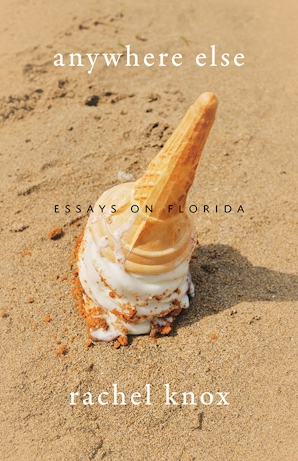 Anywhere Else: Essays on Florida by Rachel Knox is part love letter to the author’s home state and part reckoning. In what can, at times, feel like an interrogation (even if it is an interrogation of self), Knox wrestles with other people’s misconceptions, and with her own complicated love for Florida, which she notes sometimes includes hating it.
Early on, Knox makes a plea to the readers, declaring: “I hope that by reading this book, in seeing Florida through my eyes and the art that tries (and sometimes fails!) to tell a more nuanced story about this place, you might think more deeply about your perception of this place.” She goes on to say, “[l]isten to our stories, take us seriously, afford us the same agency and dignity as anyone else, and please, stop feeding the goddamn seagulls.”
As someone who has spent considerable time in and around Florida, but is not of Florida, I respect what Knox is trying to do here. Some of Knox’s stories could well have occurred elsewhere. The things that happened to her, and around her, or otherwise shaped her lived experience, are the kinds of things that happen all over—to many of us. Still, the particularity of place, culture and, occasionally kitsch (which, the author notes, makes her happy), animates the prose on the page.
The essays toggle between Knox growing up in St. Pete and being a grown-up who left the state (to New York, no less!) as soon as she could, and her present-day self—a woman who has come home. This book feels like something of a meditation on Knox’s connection to a place, its people, and herself.
At times, Knox addresses readers, with an eye towards those who may misconceive her home state but who, nonetheless write the headlines. She knows Florida is, for many people, a punchline. She wonders how that happened. In her book, she explores this central question, along with myriad others big and small.
Knox sets about her mission by coupling selected cultural or historical pieces with her lived experiences. There’s the juxtaposition between the trajectory of teenage girls in the movie “Wild Things” with Knox’s own, and that of the young women she knew who, like “Wild Things” protagonist, Suzie, died young. In “wild things”—the essay—Knox conjures messy memories that are no doubt relatable to so many of us women. In doing so, she reveals something of herself to her readers and invites us to reflect on our own messy memories. Knox admits a resistance to writing about her own trauma. “But,” she explains, “Everything makes me think about it all the time, even if I don’t recognize it for what it is.”
I found myself particularly moved by the essay “the last resort,” in which Knox reflects on the life and death of Aileen Wuornos, who spent her last free night drinking beer at the Daytona area bar “The Last Resort” after which the essay is named. After her arrest, Wuornos confessed to killing several men, was later convicted, and ultimately executed by the state of Florida. In her essay, Knox considers things she and Wuornos have in common, from the trivial (a “fondness for Miller Lite”), to the deep (they are both rape survivors). She acknowledges that her pursuit of finding parallels between her and Wuornos might seem odd, but the comparisons serve a purpose. Knox knows the temptation to cast Wuornos as “other,” to conclude that, because she murdered men, she is – like the title of the movie made about her—a “monster.” But Knox does not let herself or her readers off so easily. In detailing some of Aileen Wuornos’s backstory, Knox writes:
“Do you feel differently about her crimes when you know that she was drinking by the age of twelve, that she started having sex with boys from her neighborhood in exchange for food? These same boys once threw her out of a moving van, badly injuring her head.
Very often, I envy Aileen. I wonder what it would feel like to kill the men who hurt me. Maybe that sounds extreme, but consider for a moment the fact that I have to use the plural there—men, not man. To be a woman who has been assaulted is to learn how to live with constant, indescribable, near-overwhelming rage.”
Knox observes that the work of writing about oneself involves looking for patterns, along with the “subtext underneath [our] choices” to “contextualize who [we] were and who [we] might have been.” What feels important here is Knox’s acknowledgment of the potential for her own life to have taken a different direction. One in which her rage overtook her, too, making her a “monster.” It feels relatable, this contemplation of a different, worse outcome, when Knox admits, “I feel pretty confident that the chances of my mugshot making the nightly news were always slim, but they were never zero.”
Throughout Anywhere Else, the reader is invited to consider Florida from different angles, at different periods in time. The lens though, is decidedly that of the author. By peering into the windows Knox provides, we, as readers, recognize familiar scenes unfolding within the rooms, like the need to bury past hurts or the desire to reinvent ourselves. We spot the sentimental, too, when it shows up in scenes like that of young Rachel Knox dressing up for Easter Sunday services with her mom and big sister (in “motel art”) or spending summers with her grandparents in and around their double-wide in Jacksonville (in “my god, rachel, how can you live here?”).
What Knox wants, is what we probably all want: that her stories are enough. Whether it prompted me to reconsider something familiar in the new light Knox presented, or it taught me something previously unknown, or it helped me reconnect to something within myself, Knox’s stories contain plenty of eating and drinking (as a Southern friend of mine used to say), for readers with an appetite.
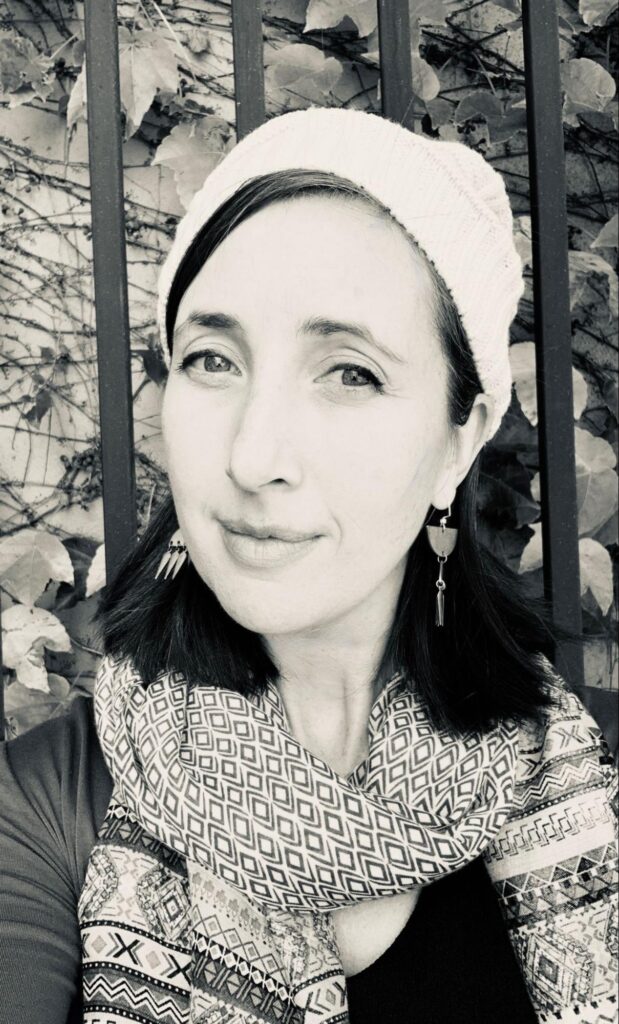 Lindsay Bennett has always been moved by people’s stories. For many years, in her capacity as a death penalty lawyer, Lindsay worked to tell her clients’ stories. Fueled by her love of great storytelling, Lindsay went back to school in her 40s, obtaining her master’s in creative writing and literature from Harvard Extension School, where she was awarded the Dean’s Prize for Outstanding Capstone Project.
Lindsay’s work has been featured in Ms. Magazine, Herstry, and The Memoirist, among other publications. In all endeavors, Lindsay is guided by her belief in the transformative power of stories well told. She is currently working on her first book, a work of narrative nonfiction. You can read more about Lindsay’s work here. She lives in Northern California.