
Reviewed by Sara Pisak

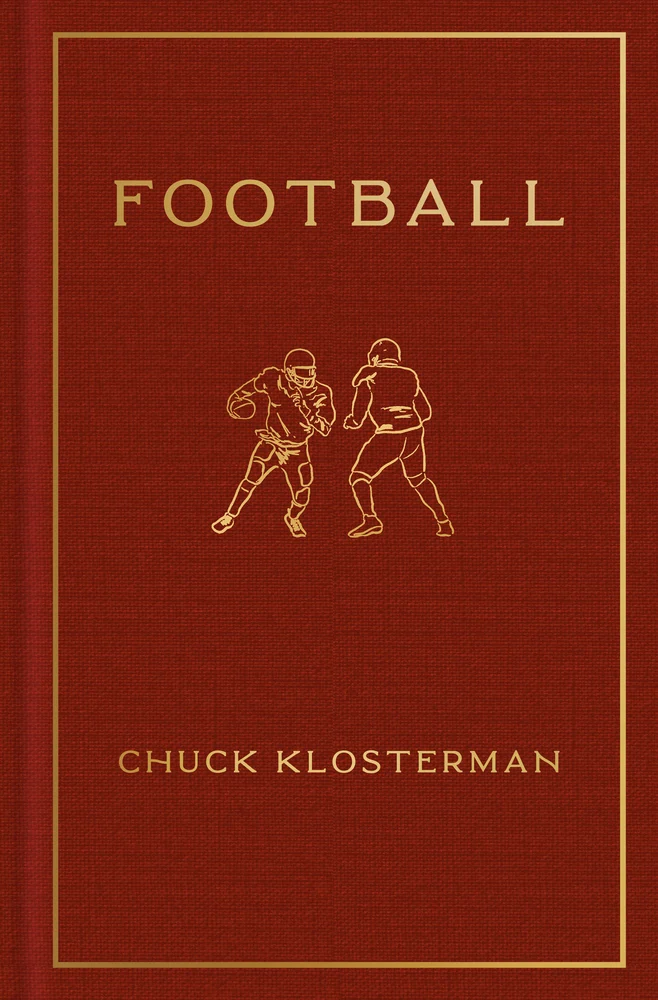 At the time of writing (not publishing) this review, it’s officially 206 days until Thursday, August 27, 2026, week zero of the college football season. If that day isn’t circled on your calendar, then maybe Football by Chuck Klosterman (Penguin Press; January 2026) isn’t for you. Or maybe it is? Let me explain.
Chuck Klosterman’s discussion of football stirred ideas of what audience means to a written work, but also how an audience affects a visual medium like watching a sporting event, in this case a football game. As someone who has previously worked in sports writing and editing, I was drawn to Football on the list of available books to review. As a student of football and of writing about it, I was first drawn to the simplicity of the title. Football is anything but simple. The same can be said for this book.
The opening sentence of Football reads, “This is a book about football, written for people who don’t exist.” A simply constructed sentence with a complex meaning. It is from this opening sentence that a reader begins to wonder how the intended audience will factor into the information they receive in the upcoming pages.
Klosterman goes on to explain:
Football is the clearest projection of how people of the United States think and of what those people value, even (and perhaps especially) when football is something they actively dislike. The role it plays in the shaping of our contemporary reality is both outsized and underrated. And this is going to pose a problem in the future, because football is doomed, and all those people who do not yet exist are going to misunderstand why it once mattered as much as it did.
It takes a talented writer to admit that your audience doesn’t exist yet. Further, it takes even more talent to declare that the subject of your book is doomed. Writing a book for an audience that doesn’t exist creates a literary chicken or an egg scenario. And readers are drawn into the idea that Klosterman is cutting the problem off before it starts. He is explaining to us, aka the current audience, who aren’t technically the intended audience, so we can cut off any future misunderstandings that the intended audience might have. Are you confused yet? Stay with me.
The audience and appetite for football is growing. Klosterman informs, “Of the hundred most watched U.S. television telecasts in 2023, ninety-three involved NFL football, and three of the remaining seven were college games.” It is truly outstanding to consider the breadth of football in television. It is even more interesting to contemplate how the intended audience of football changes when watched on television verses in person.
Discussing watching a televised broadcast Klosterman believes, “The televised experience is so superior to the in‐person experience that most people watching a football game live are mentally converting what they’re seeing into its TV equivalent, without even trying.” Upon reading this passage, I instantly asked myself if I convert the live sporting events I attend to a televised equivalent. And after much consideration, I am not sure. But here’s what Football helped me discover.
Whether you watch the game in person or on television, the audience dictates not how the game is played but how the game is enjoyed and its influence. Much of watching a game on TV revolves around recreating that stadium feeling. Gathering fans, preparing game day eats, dressing up in your best team apparel, cheering together, and arguing with the officials. Much of watching a game in person revolves around making sure you have comforts of home: the good seats and an unobstructed view of the action, even if that means paying all that money to still watch the game on a screen, albeit a much larger stadium screen.
Continuing the discussion of the impact of television on a football audience Klosterman muses, “The visual imprinting of television is more overpowering than the visual imprinting of life; a TV screen presents an enclosed reality inside the preexisting reality of your house, and that manufactured reality overwrites both your memory and your imagination.” Television as a type of supreme reality continues to speak to the idea of audience. Whether you watch the game on a screen or in person, the audience draws meaning from what they are watching.
The same can be said for any book, including Football. Whether the intended audience finds a book or not, those who read it make meaning for themselves. Keeping with the sports metaphors, they in turn share this meaning with the other fans around them. And that’s the best a writer can ask. These ideas associated with football audiences can be seen as an encompassing metaphor for a reading audience.
Some writers, like Klosterman, write with a particular audience in the forefront. Others write and let the audience come to them. Chuck Klosterman’s Football offers a range of football discussions and knowledge, all of which I enjoyed and shared with the football fans in my life. However, for me, Football drove home the ideas regarding intended audiences that are often discussed in writing craft books. And while that might have been one of the misunderstandings Klosterman was trying to avoid, it’s a misunderstanding I am glad I discovered. So whether you are a fan of football or not, pick up Chuck Klosterman’s Football, it will make you reconsider many ideas you assumed were true, even if you read it on a screen.

Sara Pisak
Community Content EditorSara Pisak is a reviewer, essayist, and poet. Sara participates in the Poetry in Transit Program and has work in The Rumpus, The Fourth River, LandLocked, Hippocampus, the Deaf Poets Society, Door is a Jar, and Appalachian Journal, among others. In total, she has published over 130 pieces. When not writing, Sara can be found spending time with her family and friends.
Role: As community content editor, Sara creates written and visual content for Hippocampus social channels and website, helping promote our magazine and uplift our contributors.