
Reviewed by Amy Roost

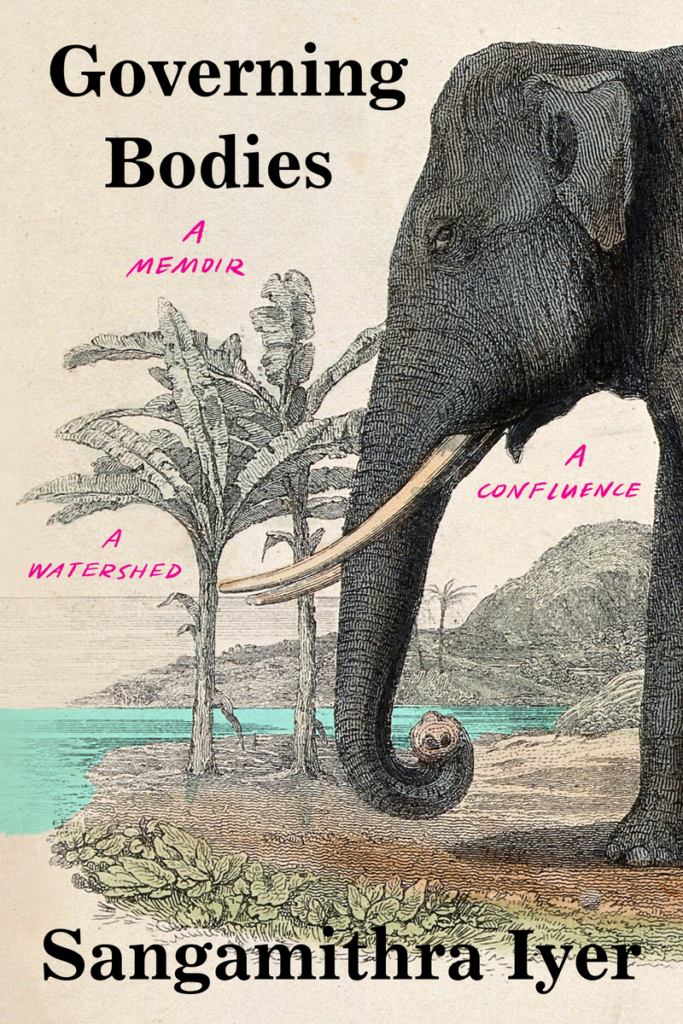 If I were to use one word to describe Governing Bodies: A Memoir, a Confluence, a Watershed (Milkweed Editions, November 2025), it would be tender. Tender as the eyes that witness suffering. Tender as the body that must bear the burden of suffering. Tender as the soul that attempts to alchemize what the eyes see and body know into a kindness we can live by.
Sandamithra Iyer’s memoir takes the reader on a meandering journey of self-discovery, not unlike a river’s journey—a body of water that is used as a metaphor again and again throughout the book. (Even the table of contents is laid out like a meandering river.) While reading, there is a palpable sense of flowing like water through and around the contours of Iyer’s family history. Water that seeks its own level much as Iyer seeks her own purpose in life.
The author, an hydro and soils engineer by training, salvages lost stories from the past, “panning for possibility, not criticism.” One need not be an engineer to appreciate her quest, but it helps to be a seeker like Iyer and someone who is willing to have their eyes opened and heart broken in order to understand our own personal call to action.
But don’t fret, Iyer’s gentle, probing, and luminous writing protects your exposed heart as you witness through her eyes seemingly irreconcilable and unconscionable truths. For it is truth that is the unifying tenant in Governing Bodies, just as it was an anchor for Mahatma Gandhi’s, from whom Iyer is separated by but a few small degrees.
Iyer’s memoir is structured in three epistolary parts. The first is a letter to her paternal Thatha, or grandfather, who was a disciple of Gandhi, and who quit his engineering career to become a diviner and activist in Kallakurichi, India. Just as Gandhi understood that spinning was closely linked to India’s independence movement to achieve economic self-reliance and promote social unity across class and caste lines, Iyer’s Thatha understood that water is closely linked to social justice. Or as Iyer quotes from an ancient text by Thiruvalluvar, “No being can be without water. Nothing can flow for anyone without rain.”
Iyer connects to her Thatha through their shared history of hydrology, geology, and math. Throughout her young adulthood she retraces her Thatha’s work in Burma where he was a Chief Engineer working for the British Raj, building the infrastructure that helped the British remove resources from Burma. Her search takes her to the India Office of Records at the British Library in London and to his many posts throughout Burma, including a lighthouse and a logging encampment where elephants were trained (read: mistreated) to roll logs.
Iyer is a writer who makes excellent use of associations and connections. For instance, when she learns about her Thatha’s work among beasts of burden, she is reminded of George Orwell and his protagonists in the essay “Shooting an Elephant,” and novel Burmese Days. Like those protagonists, her Thatha becomes disenchanted with the British and grapples with his identity, eventually leaving behind financial security to devote himself to activism.
Evaluating her Thatha’s life, Iyer finds parallels in her own journey. She, too left behind more lucrative offers to work for a chimpanzee sanctuary in Cameroon where she helped with water supply. There, she witnesses firsthand the effects of Big Oil extraction in the same manner her Thatha witnessed the British plundering. Iyer eventually leaves her engineering job to pursue activism full time, just as her Thatha had.
If there is an inciting incident for Governing Bodies, it is the death of Iyer’s father, Adi, in the early aughts. In Part II of Governing Bodies, Iyer is addressing Adi, her Thatha’s youngest child (just as she is her father’s youngest child). Adi came to America in the mid-70s with seventy-five cents in his pocket and eventually established himself as a social worker. He, like Iyer, is deeply sensitive and committed to ahimsa, or nonviolence. He also instills the author with a love of poetry, especially Tamil poetry which focuses in large part on love and war, or “inness and outness.”
Adi tells his daughter of King Ashoka, a great warrior. The name Ashoka means ‘without sorrow.’ However, after witnessing the destruction of the Kalinga War, Ashoka is asked by a monk, how can he be without sorrow when he has killed so many? Whenever Adi tells Iyer this story, his eyes fill with tears. Here, Iyer acknowledges her own “kinship with sorrow” and tells the reader how ahimsa is rooted in grief and reckoning, which is exactly what Governing Bodies is rooted in.
It is Iyer’s grief over losing her father that grants her the courage to pursue her junoon (or passion) which is ethics, justice, and activism. This trickle of influence, from her Thatha to her father to herself, is how Iyer eventually winds up writing for Satya, a New York City-based monthly magazine which covers vegetarianism, animal rights, environmentalism, and social justice issues.
While working for Satya, Iyer investigates the poultry and cattle industries both in the U.S. and India, and laments the “globalization of cruelty,” “economies of excess,” and “language stripped of moral content.” She makes a strong case for veganism and, in the process, ponders deep philosophical and ethical questions such as:
How do we live when there is willful forgetting and normalization of suffering?
How do we carry our burdens without collapse?
How do we show compassion and kindness to all living beings?
How do we find what was thought to have been erased?
How do we get to a place where kindness and regard are centered?
How can we be without sorrow?
How can we prepare for an uncertain future in ways that act tenderly with the present?
How much do we all suffer from the suffering of mothers?
How do we see the truth and protect our hearts?
In thinking about utopias, Iyer playfully defines her own: a “matriarchal, nonhierarchical, animal-friendly, vegan, love-not-war, bonobo ashram.” She identifies with a friend’s idea of what it means to be a vegan: “Not plant-based as in vegan chips, vegan as in overthrow the patriarchy.” In other words, being a vegan is a way of answering her questions. Her diet extends to politics and ethics in an attempt to reach a unified theory of living here on Earth.
Governing Bodies is rife with metaphor which aligns with the author’s passion for poetry. Water is a story about family. The body is a form of measurement. Responsibility is fractal (practice reform on a small scale). Obligation is tyrannical (once we care, how do we not care?). Ideas are a contour map that lead us to truth. Landscapes are emotional. Eyes are sympathetic. Anger is dirt. Soil is memory. Grief is subversive. Work is love.
Reading Governing Bodies will soften you. That is, after all, what tenderizers are meant to do. You will walk away seeing more of what’s right before your eyes. You will think more about how to alleviate suffering. You will understand how your life is linked to all other lives. You will lose cruelty and gain giving.
In the third and final section of Governing Bodies, Iyer, addressing the reader directly, quotes a Mary Oliver poem, expressing exactly what her book means to do, if you let it:
to break your heart,
by which I mean only
that it break open and never close again
to the rest of the world
 Amy Roost is a freelance writer residing in Bellingham, Washington currently working on a memoir entitled Replacement Child. She is the co-editor of two feminist anthologies and recently earned her MFA in creative nonfiction from Pacific University in Oregon.