
Reviewed by Brian Lee Knopp

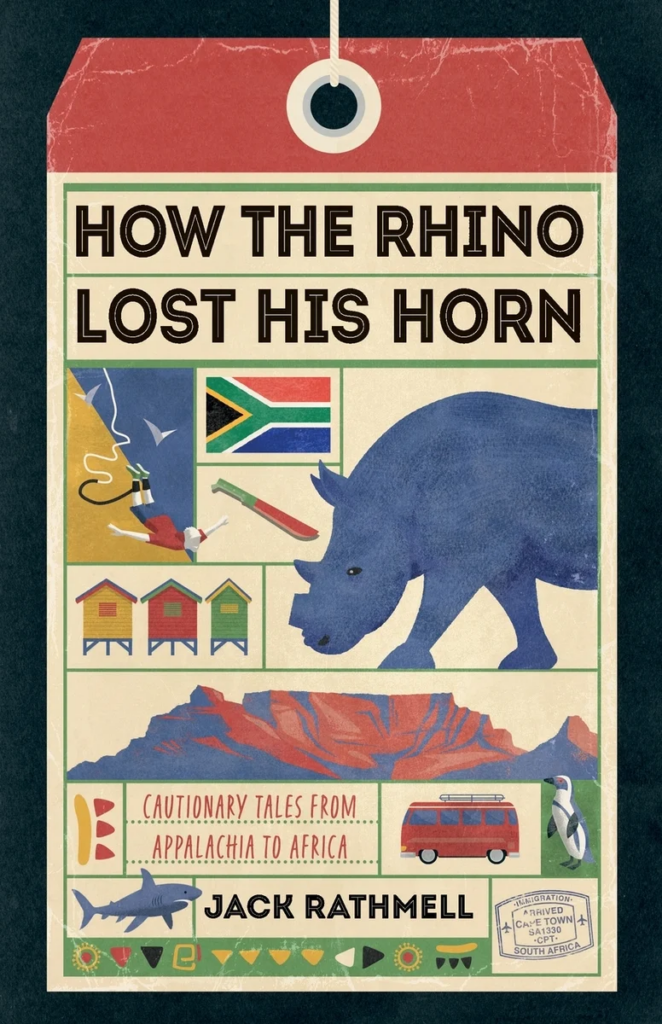 Even the very title of Jack Rathmell’s memoir, How the Rhino Lost His Horn: Cautionary Tales from Appalachia to Africa (Whitefox, January 2026), warns that this book might not be for the faint of heart.
Good on him. Because it isn’t.
How the Rhino Lost His Horn relates the author’s approximately five-year odyssey, which includes the two years and three months he spent living in South Africa. This timeframe spans from his first “Voluntourism” trip to Muizenberg in 2014 for his three-month assignment as an “unqualified, overwhelmed, and increasingly disillusioned gym teacher,” to the completion of his post-graduate studies in journalism and political science in 2019. The memoir’s structure is somewhat unconventional, with the narrative derived from travel journal entries but without their cumbersome, sequential date/time/location references. Most of the chapters read like stand-alone personal essays devoid of discernible transitions between them. Instead, the chapters are loosely connected topically, or by actions continuing across a given chronology.
For me, this unconventional narrative structure neither compromises the narrative’s integrity nor blunts its impact on the reader. Indeed, the narrative structure is not haphazard but organic, like a living creature; its digressions are cohesive, relatable, pleasingly elusive and serpentine in their movement, mimicking the way real life slips and slithers largely out of your control when you are in your twenties and living in a foreign country and when you are as honest about it all as Rathmell is. The lack of a traditional linear narrative arc does not automatically doom the reader to rummaging page after page through someone’s psychological junk drawer in search of meaning and overarching themes. Some diary or journal-driven memoirs impart that kind of misery. But not this memoir.
Rather, I find that Rathmell’s journal-derived episodic structure provides an almost palpable immediacy to his experiences, along with an unparallelled opportunity for recall accuracy and pitch-perfect dialogue. His approach is the perfect imaginative antidote to the growing trend of selfie stick memoirs. He even includes inspired doodles and whimsical drawings that underscore his efforts to creatively capture poignant moments as close to real time as possible. And the winding story itself includes no shortage of cliffhangers.
Take, for example, the little matter in the very first chapter with the author adrift in the Indian Ocean off South Africa’s Mossel Bay, submerged inside a battered cage held together with duct tape, suddenly coming face to face with a frenzied shark that didn’t get the memo about how sharks can’t penetrate shark cages and don’t eat ecotourists. Well, you won’t find out how that rendezvous concludes until Chapter 10.
And I won’t even start on the bungee jump, or the hallucinogenic mushroom trip, or the huge outdoor rave festival, or the obnoxiously exhibitionist roommate and his extortionist landlady mother, or any of the dozens of other superbly-crafted, laugh out loud cliffhanger episodes in this book.
Is this plot tease or delayed gratification a mere page-turning gimmick? Far from it. In the author’s own words:
As our world has become more interwoven and complex, so too have our stories. But that is exactly why it’s more important than ever to try and take stock; to figure out what got us here, and our role in it all. Why we believe, want, and do the things that we do. Not that we’ll always like what we find. Indeed, the question of how the fuck, exactly, I, a teenager from Amish country in the US, ended up in Africa in the first place — let alone submerged in rotten seal shit off its coast— is not one with a totally straightforward, nor a particularly flattering answer.
The collected and arranged epiphanies, confrontations, and catastrophes that imbue the book’s respective chapters provide almost a call-and-response between the microcosm and the macrocosm. The author’s personal encounters—be they sublime, ridiculous, repugnant, or harrowing—lead to lucid and courageous introspection, then on to more profound musings on the larger ramifications of the experience under examination as weighed on a global scale.
Most importantly of all, Rathmell’s gutsy Millennial sensibilities admirably defy conventional marketing expectations for narrative arc grandstanding, for the contrived and gratuitous resolutions, for the inauthentic yet convenient take-aways inherent to most travel memoirs:
I began to wonder whether the land’s unique natural beauty was, at some level, disadvantageous. The country offers countless focal points unconnected to indigence, disease, and suffering toward which we can focus our attention and our cameras. Harrowing expanses of helplessness and blight are not only juxtaposed against – but in many cases are overshadowed by – colorful, photogenic, unspoiled panoramas . . . .
My own words of ironic invitation-via-warning, here? This travel memoir draws from the best adventure writing found in Outside Magazine and blends it perfectly with the most provocative political journalism offered by The Atlantic or Rolling Stone. Jack Rathmell is an extremely perceptive storyteller whose wandering, penetrating eyes miss nothing. His detailed deep dives into controversy start simply and almost naively so, with his irresistibly gossipy charm and witty banter about interpersonal relationships. But the levity breaks, so to speak, when he eventually explores all possible perspectives on the matter at hand.
In short—he goes there:
There’s simply no such thing as ‘someone else’s problem’ anymore; the challenges we face are too interwoven, too complex . . . ‘third world’ conditions we see in places like South Africa are not our past, but a glimpse into our future.
And I feel strongly that throngs of other readers besides myself will go there with him, if they dare.
Rathmell’s curiosity never fails to engage the reader; his intelligence always challenges. He is sensitive enough to be disarming, funny enough to be entertaining, and modest enough to be reassuring. Yet his unsparing honesty could prove deeply unsettling to one’s private hopes, beliefs, and desperate denials about today’s big issues that are vexing not only to post-apartheid South Africa and other developing African nations, but also to the First World West, as well.
I saved the best for last, making my own delayed gratification moves, here: Rathmell’s to-die-for writing style. I seethe with envy over his smart sinuous prose, the perfect pacing and comedic timing, the lyrical landscape descriptions, the delightfully wicked skewering of posers, bullies, and hypocrites. The author’s unerring, almost forensic analysis of human foibles usually tacks between Evelyn Waugh’s clever verbal vivisections and Alex Kotlowitz’ immersive journalistic grittiness. There are only a few places where Rathmell’s righteous indignation seems like hilarious overkill, like crushing a single noxious bug with a bejeweled steamroller. But oh, do I wish I could borrow such a steamroller from time to time!
Misfortune is both the most reliable Muse and the most effective reader magnet for any travel memoir (or for any memoir, it seems). The author certainly does not disappoint here. He lavishly ladles out heartbreaks, fun fails, gross outs, true crime, and humiliations galore. This memoir is a must-read for: Millenials, whether veteran or wannabe globetrotters; advocates of racial justice here and abroad; avid travelogue readers packing a prerequisite appreciation for the darkly absurd or tragic-comical; aspiring journalists and political junkies searching for a new guru.
Ah, hell. I forgot to rave about the book’s cover art! Well, maybe I will do that some place down the road . . . touché, Jack!

Brian Lee Knopp is a retired North Carolina private investigator. In 2019, he published the revised 2nd edition of his 2009 memoir Mayhem in Mayberry: Misadventures of a P.I. in Southern Appalachia (Cosmic Pigbite Press). His most recent publication is the 2024 essay collection titled Dreams I’m Never Gonna See: The Takeover of WDIZ Rock 100/FM and Other Essays (Cosmic Pigbite Press). Knopp also created and contributed to the popular 2012 collaborative comedic novel Naked Came the Leaf Peeper (Burning Bush Press). A former professional sheep shearer with an MA in English literature from the University of Texas at Austin, Knopp has taught nonfiction writing for the UNCA-Great Smokies writing program, and his work has appeared in Hippocampus Magazine (2024 Pushcart Prize nomination), Stoneboat Journal, WNC Magazine, Now & Then: The Appalachian Magazine, The Great Smokies Review, and in several regional magazines and anthologies. He lives in Asheville.