
Reviewed by Marissa Gallerani

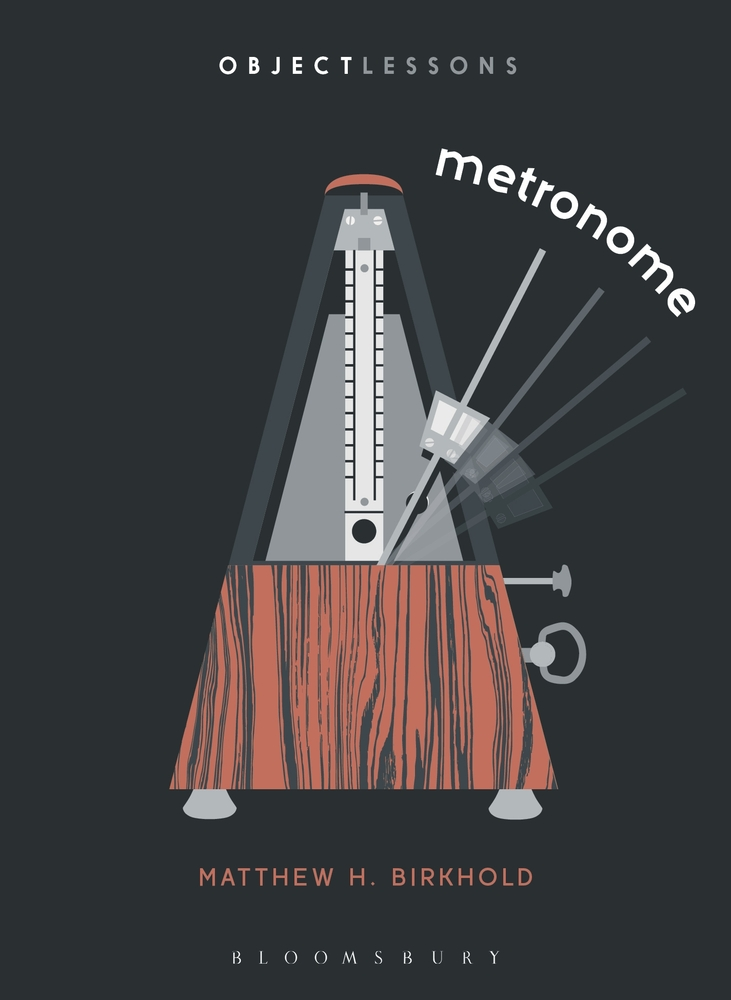 If you have ever played a piece of music, sung a song, or even remotely considered yourself a musician, you, too, have probably been victimized by the metronome. As Matthew H. Birkhold explains, “Since its invention in 1815, the metronome has aided, inspired, and plagued generations of artists with its unremitting tick.”
Metronome (Bloomsburg Academic; November 2025) is part historical retelling, part sociological examination of the place of the little object’s presence in our lives. The book is also included in the Object Lessons series by Bloomsbury Publishing; there are many other titles in the series if the historical examination of objects appeals to you as a reader. While on its surface, Metronome might seem like a dry concept, even the most casual musician will appreciate the historical gossip, philosophical ruminations and humor found within.
Metronome opens with a 1957 protest that ended with the destruction of one of Surrealist artist Man Ray’s most indelible works: a metronome with a photo of an eye on it called Object to be Destroyed. The protesting students took this literally, and shot it into pieces on the sidewalk. Every musician has wanted to destroy their metronome at one point or another, so the protesting students can hardly be blamed for such defacing. Birkhold then proceeds to interrogate why the metronome elicits such a heated emotional response from people.
The book establishes that the introduction of the metronome was revolutionary for standardizing musical performances. Humans are notoriously bad at understanding tempo, and lack an internalized sense of rhythm. The invention of the metronome is widely credited to Johann Nepomunk Maelzel in 1815, (though it turns out he might have stolen the design from a Dutchman), and the book divides its exploration of musical performance into before the metronome’s introduction and afterwards. Composers react to its presence, there are heated disagreements over how a symphony should be played, and musicians across generations grapple with a small machine that “has become such a powerful authority we do not know how to reject it.”
The metronome itself has become such an integral part of our culture that I was shocked I hadn’t noticed it before. On its surface, the metronome is a musical device, yet it appears in scientific studies and laboratory experiments throughout the 19th and 20th centuries. This small, seemingly unrelated item has been used to influence many aspects of daily life. Because it gives humans the ability to measure precise time, the metronome has been used to give electric shocks to frogs in experiments, help the Ohio State University marching band choreograph their performances, and keep factory workers and typists producing on a certain schedule and at a certain speed, to say nothing of its conventional use in music classrooms.
The book’s humor grounds this multidisciplinary exploration. There is a lot of historical musical gossip that even the most occasional musician could appreciate. Metronome includes many reference notes and an extensive bibliography, but what charmed me the most were the pictures. Photos of different artistic works inspired by the metronome (including Man Ray’s) feature throughout.
Ultimately, “does the metronome help or hurt humans in the endeavor to create compelling art?” as Birkhold asks. Instead of answering this question, Birkhold provides enough philosophical fodder for the reader to determine their own relationship with this small object that has become inextricable from both modern-day music performance and ordinary life.
 Marissa Gallerani is a queer and disabled writer and teacher living in Providence, Rhode Island. She received her MFA from The Newport MFA at Salve Regina, and has taught at multiple institutions of higher education including the New England Institute of Technology, Salve Regina University, and Write or Die. She has been published in The Harvard Review Online, the public’s radio, and The Financial Diet, among others. Marissa’s Substack, The Chaotic Reader, details her wide-ranging reading adventures. A life-long SFF fan, Marissa is currently at work on a science fantasy novel.