Reviewed by Dorothy Rowena Rice

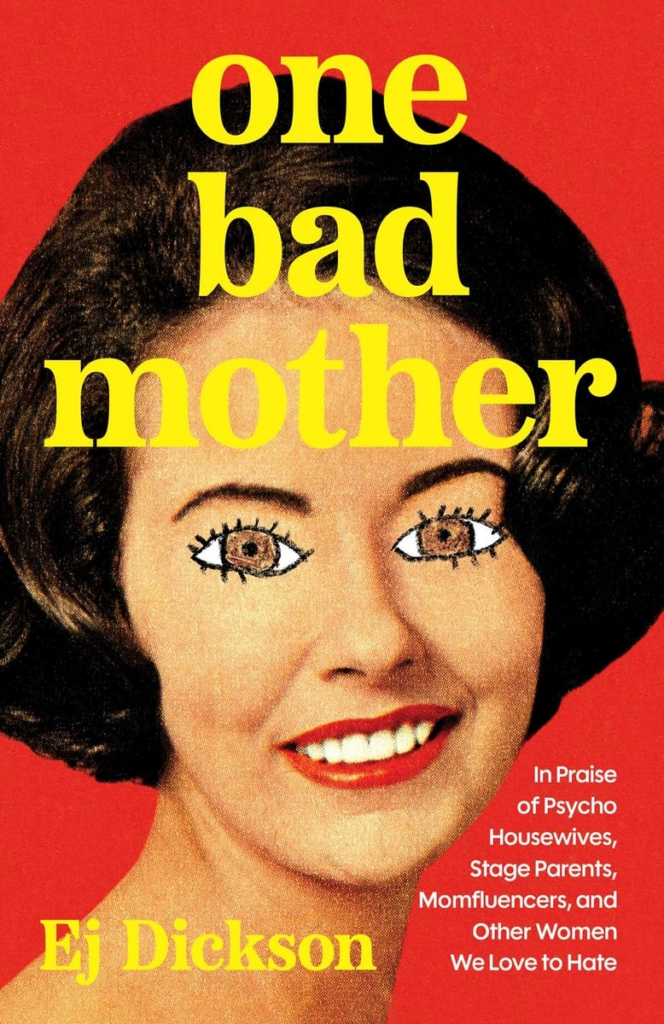 In One Bad Mother: In Praise of Psycho Housewives, Stage Parents, Momfluencers, and Other Women We Love to Hate (Simon Element, 2026), EJ Dickson dives into many of the tropes that have formed widely-held perceptions about bad mothers.
She has examined and culled examples from the historical record, films, books and popular culture. This, her first book, is timely. It is also funny, smart, thought-provoking and, sometimes, disturbing. While Dickson doesn’t purport to be definitive on the topic, the scope and diversity of what she’s brought together isn’t only impressive, it made me question my own preconceptions about motherhood and the ways I have (even if unwittingly) been conditioned to judge what makes a good mother, a bad mother, and all the shades in between.
In the introduction, Dickson acknowledges that her perspective on motherhood is inevitably framed by privilege: “For middle-class white women like me, there are few long-term material consequences for calling yourself a ‘bad mom,’ other than possibly being yelled at by other middle-class white women on the internet, the kind who immediately ask to speak to the manager when their salads come with balsamic vinegar instead of honey vinaigrette.”
This caveat is significant. Over the course of eleven chapters, Dickson illustrates the ways in which what is labelled ‘bad mothering’ is steeped in racial and class prejudice, and blind to underlying institutional and economic inequities. She paraphrases from her interview with Steven Mintz, a professor of history at the University of Texas at Austin, who observed that “many child abuse cases adjudicated in court are not instances of abuse as we traditionally conceive of it but can actually be considered ‘cases of parenting under poverty.’” The chapter titled, “One Very Bad Day, or Linda Taylor, The Welfare Queen, and the Monster of Our Own Making,” puts this particularly insidious stereotype under the microscope, from the etymology of the term “Welfare Queens,” to how it has been employed by politicians (beginning with President Reagan) to justify slashing funding for state benefits programs.
“The Marvelous Mrs. Mommy Paradox, or Why Being a Working Mother Is Like Doing Ayahuasca,” presents the often contradictory and confounding portrayals of working mothers. The chapter heading refers to Mrs. Maisel, a fictional character who pursues a career as a stand-up comic (and flirts with Lenny Bruce) and is seemingly never impeded by having two young children at home. How does she do it? Well, the kids aren’t like most kids—they mostly stay off-screen and don’t insist on Mommy’s attention. Other examples from film and TV bring us career-driven women who either don’t have time for kids (Murphy Brown), frazzled working moms who struggle mightily to balance dueling obligations (often to comedic effect), Married With Children’s Peg Bundy who can’t be bothered to work or take care of the kids, and any number of “good” TV moms of yore (think June Cleaver from Leave It to Beaver), who, nary a hair out of place, always had dinner on the table when the hubby got home.
I, like most, have by turns laughed, been shocked, and made indignant by both “bad” and “good” mother characters. One Bad Mother encouraged me to look deeper. To view these characterizations not solely as entertainment, but in terms of what these cartoons, these stereotypes, reflect about the ways we absorb content, and along with it, the biases, fears, and ugly assumptions embedded in their storylines.
Stereotypes resonate because they are easily recognizable. And we often see parts of ourselves in them. The author notes, “As a chronically stressed-out working mother, I, too, have certainly had my own very bad days.” Me too—as a one-time depressed, single mother in a low-paying job, dinner may have consisted of sugary dry cereal straight from the box while watching reruns on Nick at Nite. I was often short-tempered or zoned out and, yes, I left my boy with sitters to date men who weren’t very nice. Nonetheless, I’m with Dickson when she writes, “My kids are alive, aren’t they? So get off my dick.” Which I take to mean, we, like most mothers, did our best under the circumstances. Also, let’s get real—a majority of moms have jobs besides motherhood, whether out of necessity or desire.
The examples in “One Bad Mother” run the gamut. Over-bearing, manipulative stage moms. All those beleaguered and/or disinterested working moms. Moms who discipline too harshly and overly lenient moms. Horribly abusive moms, even moms who murder. Moms suffering mental illness. The list goes on. As do the contradictions, judgements and consequences. Further complicating the picture, we have the rise of trad-mom content on social media platforms and pro-natalist adherents (including JD Vance and Elon Musk) who believe women should have more children, with the implication that marriage and motherhood are a higher priority than work or individual self-fulfillment.
Dickson writes: “The term ‘bad mom’ is used so often, and with so little differentiation, that it should be almost totally devoid of meaning. But it still has the power to shame us, to subjugate us, to force us to sit down and shut up and stay in line. It reminds us that, no matter how much we play by the rules, women can never, ever, ever win.”
I appreciated the author’s thoroughness, her engaging (often hilarious) voice and what comes across as a genuine desire to excavate a thorny topic. We see the myriad ways mothers and mothering have been under the microscope, seemingly forever. Perhaps it’s not surprising that most, if not all, of these stereotypes were birthed by men—writers, scientists, sociologists, child-rearing “experts,” administrators of public programs, screenwriters. It sometimes seems mothers are held solely responsible and to blame for any number of crimes against children and for the adults they become. Have fathers been subjected to the same level of scrutiny and accountability? Perhaps this paradox stems from the power implicit in motherhood—the ability to birth and sustain life—and where there is power, the need to subjugate, to control and manipulate, tend to follow.
In summation, the author notes: “As quick as we are to accuse women of being bad moms, no one wants to talk about how the world makes it very, very hard to be a good one.”
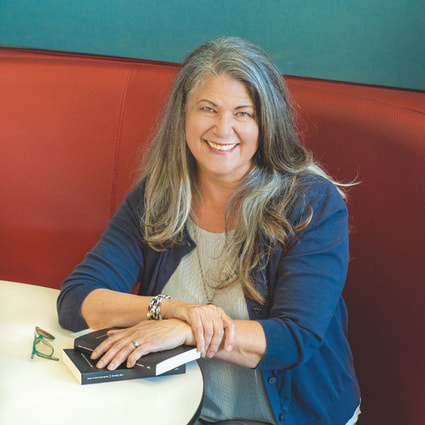 Dorothy Rowena Rice is a writer, freelance editor, managing editor of the nonfiction and arts journal Under the Gum Tree and a board member with the Sacramento area youth literacy nonprofit, 916 Ink. Her published books are The Reluctant Artist (Shanti Arts, 2015) and Gray Is the New Black (Otis Books, 2019). She is the editor of the anthology TWENTY TWENTY: 43 stories from a year like no other (2021, A Stories on Stage Sacramento Anthology). At age sixty, after retiring from a thirty-five-year career in environmental protection and raising five children, Dorothy earned an MFA in Creative Writing, from UC Riverside, Palm Desert. Learn more and find links to many of her published stories, essays, reviews and interviews at www.dorothyriceauthor.com