Reviewed by Emily Webber

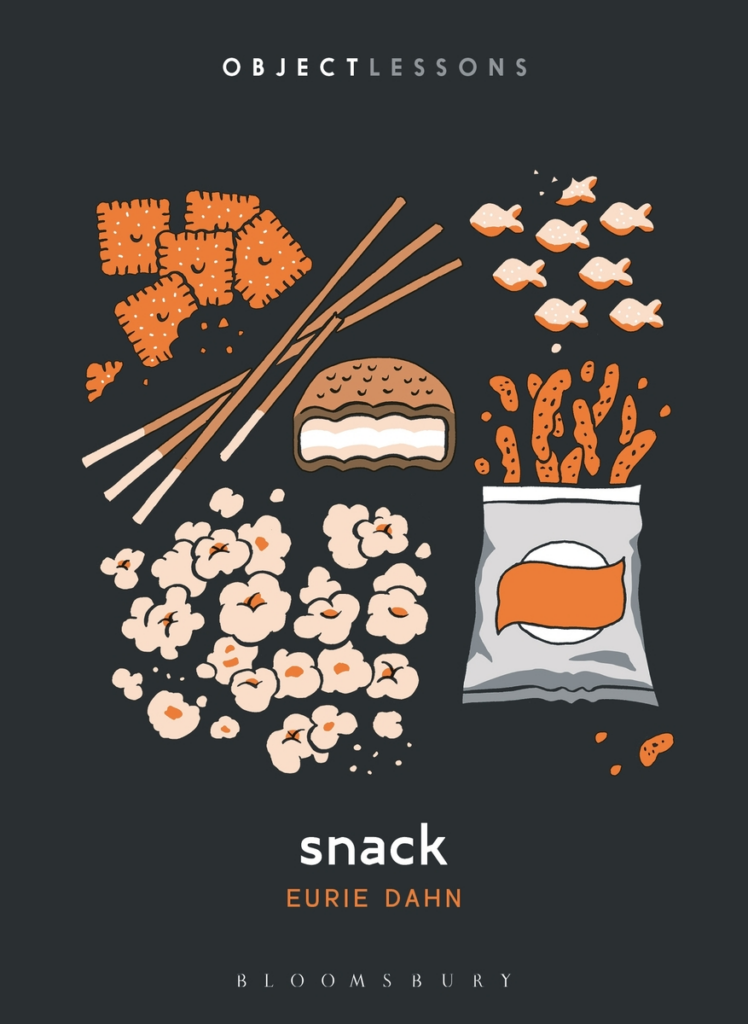 With over one hundred books published, the Object Lessons series from Bloomsbury Academic aims to uncover the “hidden lives of ordinary things.”
These slim paperbacks can be read in one or two sittings. They are all beautifully designed. Books begging to be bought in print, and delightfully entertaining and educational. A perfect way to spend a few hours and gain just enough insider knowledge on the topic. No matter what you think you already know about the subject, you will learn many new nuggets of information. The authors bring their personal perspective and approach the subject with a unique slant.
I’ve already devoured Relic by Ed Simon and Grave by Allison C. Meier, before picking up one of the latest in the series, Snack by Eurie Dahn (Bloomsbury Academic; February 2026).
Like Dahn, many of my memories are wrapped up in food. Dahn says she picked the topic because snacks are often overlooked and considered inconsequential. Yet for many people, childhood memories surrounding snacks are particularly vivid. She makes no apologies for focusing on her own perspective:
For these reasons, the book is mostly focused on the US and with all the biases, limitations, and interests that mark who I am, some of which are shaped by the fact that I am a middle-class Asian American woman, a child of immigrants, who grew up in the 1980s and 1990s. In other words, this book will not resolve the question of the limits and contours of what constitutes a snack.
The category of snacks is capacious, changeable, and culturally, historically, and intensely individually dependent. This book, like all food books, is the author’s curriculum vitae—my account of who I am and what made me, in a physiological sense and an emotional and mental one as well. Of course, I could talk about these subjects in relation to meals but I focus on snacks because, somewhat contradictorily, (a) they are seen as trivial and unserious and (b) they are an important part of my childhood and those of others. In writing about snacks, I am writing about affective connections, about affiliations, memory, and forms of nourishment, such as love.
This is not all childhood nostalgia, though; as the book’s introduction makes clear, Dahn isn’t going to turn a blind eye to the fact that “snacks as we know them today — processed and packaged — are heavily intertwined with the forces and history of capitalism.” Dahn dives in with the disputed origin story of Flamin’ Hot Cheetos and how snacks are packaged and marketed to consumers. But she’s also sharing the joy of finding in Flamin’ Hot Cheetos a snack food that mimics the flavors of the Korean food Dahn was used to eating at home.
Then she turns toward the snacks we give children — the ever-present Goldfish crackers that seem to be the undisputed favorite among kids everywhere. Along with that, she considers the marketing of “healthier” alternatives for children. For many, the snacks we give our children are also how we show our love. Dahn remembers her mother, “recounting how her maternal grandmother, who did not have much in the way of means, would bring her a secret pear meant for her and her alone.”
Snack explores the U.S. diet culture of the 90s that produced SnackWell cookies and Olestra chips (famous for causing major gastrointestinal upset). There’s a funny chapter, just one paragraph, titled “Fruits & Vegetables,” which clearly shows that this book is all about guilty pleasures. Finally, Dahn turns to the East-Asian grocery snacks she grew up eating, which will likely trigger your own snack memories.
I thought about my grandmother’s pantry that always held the blue cardboard canisters of Planter’s Cheez Balls. Much like Flamin’ Hot Cheetos, they leave that signature orange-dusted fingers and probably don’t contain a single natural ingredient. I still talk with my cousins about how amazing it was that we got to eat them, how it reminds us of our grandmother, now gone. Decades later, I took great delight in telling my son about them and letting him taste them.
The brilliance of Snack and all the Object Lessons books lies in their ability to encourage us to step away from our devices, see ordinary things in the world through a different lens, and notice more. As Dahn says in her introduction: “In writing about snacks, I am writing about affective connections, about affiliations, memory, and forms of nourishment, such as love.”
 Emily Webber is a reader of all the things hiding out in South Florida with her husband and son. A writer of criticism, fiction, and nonfiction, her work has appeared in the Ploughshares blog, The Writer, Five Points, The Rumpus, Necessary Fiction, and elsewhere. She’s the author of a chapbook of flash fiction, Macerated.