
Reviewed by Amy Roost

 The months and years ahead of me will not care about what I want. But I do not know this yet.
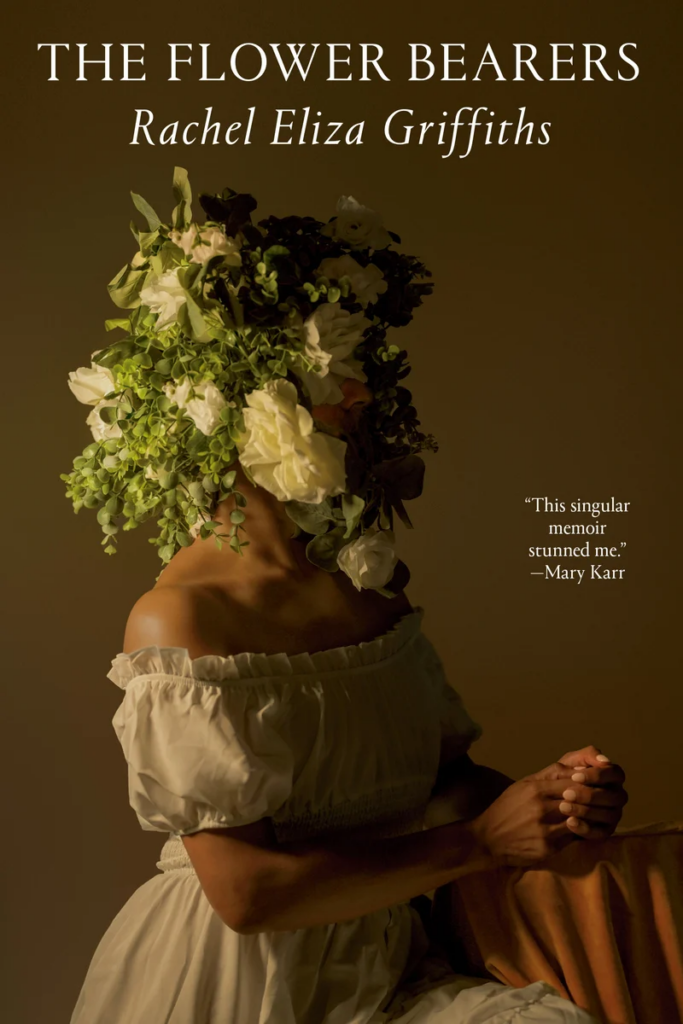
So goes one of the opening lines in Rachel Eliza Griffiths’ new memoir The Flower Bearers (Random House, 2026). And it is no understatement. Griffiths’ accounting of her life since marrying fellow-author Salman Rushdie in 2021 is Biblical. As in, Job-Biblical. She is knocked down and buffeted about repeatedly by external forces, beyond her control, ongoing mental illness, and intergenerational trauma. One cannot help wanting to reach through the pages to hold the narrator’s hand as she withstands one sneaker wave after another.
The Flower Bearers opens the night before Griffiths’ wedding to Rushdie. The reader is made to feel like a fly on the wall of a celebrity event. But not everything is as peaceful as the bride’s calla lily bouquet. Griffiths worries about a guest who has not yet arrived and asks her sister to look into it. This scenario creates a sense of impending doom that propels the story forward.
Griffiths’ childhood, college years, her close friendship with fellow-poet Kamilah Aisha Moon, and budding relationship with Rushdie is skillfully woven into the middle section of the memoir providing the reader a sense of the narrator’s strengths and vulnerabilities. For example, the narrator tells us she has a tendency to overthink, speculate and create narratives in her head when she is anxious or overwhelmed. These revelations briefly trick the reader into thinking there’s nothing to worry about.
We sidecar with Griffiths and Moon as these two ambitious and talented Black women attend New York City poetry readings and dance clubs, and share late-night plates of French fries, bonding over their mutual love of music and the Black literary canon. In a tender passage describing their friendship, Griffiths writes, “We created a spiritual geography that welcomed and encouraged us to be messy, bewildered, angry, chic, and childlike.”
We also learn more about where Griffiths’ compulsive worrying stems from (a chronically ill mother, and parents who didn’t take her writing seriously), and how she has carried forward coping mechanisms from childhood that don’t serve her in adulthood. Most significantly, Griffiths reveals she has Dissociative Identity Disorder (formerly known as multiple personality disorder).
Throughout The Flower Bearers, Griffiths pulls back the covers on the ups and downs of a writer’s life, sharing her experiences in writing workshops and at writing retreats and what it takes to make a living as a writer. Cave Canem, an intentional space for Black poets, is a safe place for Griffith. However, she often encounters hostility in her workshops at Sarah Lawerence College. She also describes herself feeling like “a fly in the buttermilk” at a Saratoga Springs writing retreat. To make matters worse, a Black elder poet she hoped would mentor her instead admonishes her, leading to Griffiths having a dissociative episode, and quitting poetry for four years.
She details how the killings of Black youth such as Trayvon Martin and Tamir Rice influenced her poetry and inspired her activism and does a superb job explaining to a white reader such as myself how the news of every killing wore her out and how it links arms with the trauma of her ancestors. Not all is sad in Writersville as illustrated by a moving chapter about Griffiths being introduced to her literary hero Toni Morrison, a magical moment when she walks down a New York sidewalk in conversation with E.L. Doctorow, and, of course, the charming tale of her meet-cute with Rushdie.
But New York can be a harsh place to live on a writer’s salary and her struggle to succeed and subsist messes with Griffiths’ mental health. In one harrowing chapter, Griffiths describes how a call for help to a suicide hotline leads to her being brutally handcuffed in her own apartment and then taken to an ER against her will. Through all of this, self-loathing is the narrator’s constant companion.
Griffiths creates a quiet dialogue between herself and the reader about how she feels estranged from a deep sense of self and is afraid to be herself for fear of being abandoned by her parents, Aisha and others who might conclude her work is trivial or her personality is “too much.” In the process she works and succeeds at seeing her loved ones fully and fairly.
The death of Griffiths’ mother (as well as a divorce from her first husband) marks a turning point for her and the book. Griffiths understands she only has herself to rely on and she begins imagining and prioritizing a new, more expansive life. Griffiths bravely confronts her past traumas that caused her to dissociate. In so doing, she describes how she fought to overcome the stigma and fear around which she felt so much shame, and admits to shortcomings without the reader losing faith in her.
Returning to the near present, we watch as Griffiths navigates the lockdown together with Rushdie, the COVID-related deaths in her family, and the muder of George Floyd in Minneapolis.
Eventually, we return to the wedding day. We see Griffiths’ dress, shoes, veil and bouquet. We meet her friends and family and get a sense of Rushdie’s deep abiding love for his wife-to-be. We also learn the fate of the guest who was a no show and watch on in horror commiseration as Griffiths breaks down and blacks out.
It is not a spoiler to reveal Salman Rushdie was stabbed multiple times while onstage at a literary event in Chautauqua, New York in August 2022. Griffiths was home reading and sipping coffee when she received word of the attack. In a poignant chapter about the immediate aftermath of the stunning, headline-making event, Griffiths writes arresting prose about her vicarious trauma and recounts the guilt Rushdie felt for failing to fulfill his promise to Griffiths’ father to keep her safe. I found Griffiths’ accounting as compelling as Rushdie’s in Knife because it captures the ripple effect of an act of violence, how not just the victim but so many others are affected by it.
The stabbing takes place less than a year after the wedding and throws Griffiths into a deeper tailspin than the one she’d yet to emerge from. Or, as Griffiths describes, “My body feels preoccupied by violence, by weariness, shock, and severe exhaustion.” I resonated with how she described her loss of identity, the numbness, and the isolating feelings that often accompany grief. Like a true poet, Griffiths turns her devastating lived experiences into a work of art we can sit with and learn from.
Riveted, I read how Griffiths somehow managed to survive—not without speed bumps—her complex grief. In the hands of a less gifted writer, this portion of the memoir may have read like self pity at Rushdie’s expense. But Griffiths’ retelling balances the entwined story of two people fighting to survive in such a way that the reader wants to set up a meal train and offer to walk their dog so they can focus on recovering not just their health but their fragile, young marriage.
At the end of The Flower Bearers, Griffiths turns for comfort to a tribute her close friend Aisha Moon wrote about Lucille Clifton. Moon hailed Clifton’s “permission to keep it real, to be shameless and unabashed. To be vulnerable as a sign of strength. To wonder and to be amazed.”
When Griffiths finally triumphs over the chaos and obstacles life threw her way in quick succession, she is a changed person. She is, as I see it, an heir to Clifton who leaves the reader in a changed state of their own, and with a keen appreciation for the vulnerability-as-strength that Griffiths somehow manages to so gracefully model.
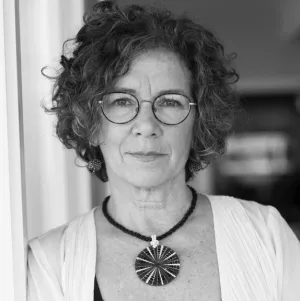 Amy Roost is a freelance writer residing in Bellingham, Washington currently working on a memoir entitled Replacement Child. She is the co-editor of two feminist anthologies and recently earned her MFA in creative nonfiction from Pacific University in Oregon.