
Review by Sarah Evans

 Once upon a time, less than 30 years after World War II, two rock stars walked into a speakeasy in London dressed head-to-toe in Nazi regalia, complete with swastika armbands. The landlady, whose husband had died in a concentration camp, nearly fainted. Unfazed, the two men moved on to a German beer garden. One of them entered with a loud “Sieg Heil!” before they both goose-stepped their way around the room.
Their names: Vivian Stanshall of the Bonzo Dog Doo-Dah Band, and Keith Moon of The Who.
Those who witnessed the men’s actions condemned them, as did some publications at the time. However, over the years, most just brushed it off as two young ruffians trying to make a performative joke, ignorant to the idea that it might be offensive. Boys will be boys. Or, in this case, rock stars will be Nazis.
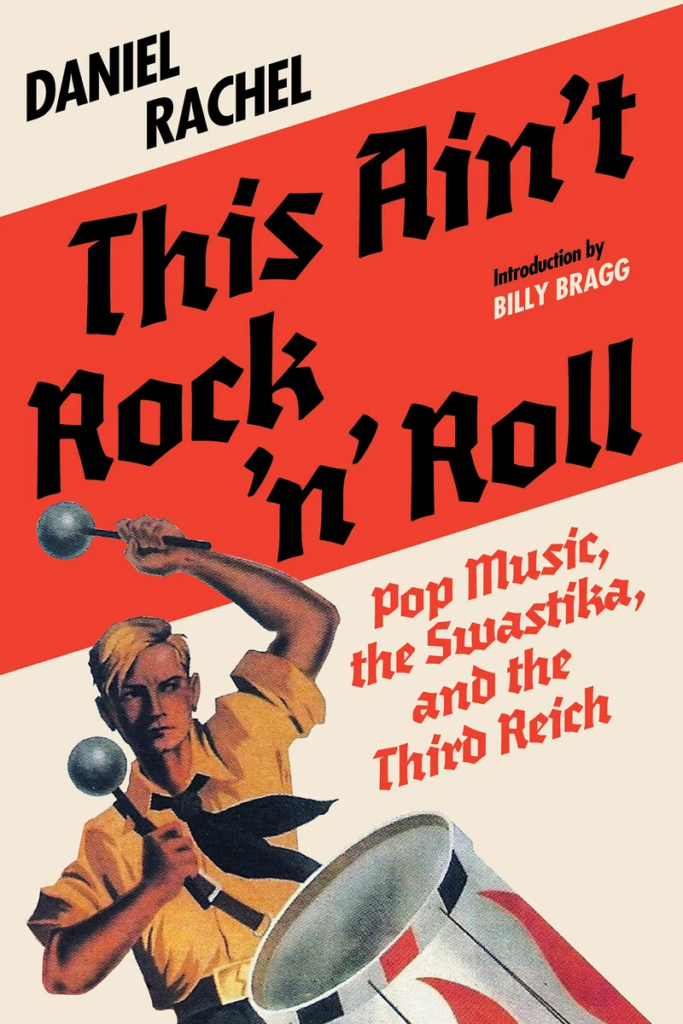
As Daniel Rachel lays out in meticulous detail in his new book, This Ain’t Rock ’n’ Roll: Pop Music, the Swastika, and the Third Reich (Akashic Books; February 2026), Stanshall and Moon are far from the only musicians who have flirted with Nazi adulation or imagery in the 80-plus years since the war ended.
Everything Rachel describes in his book was already public knowledge, but he is the first to compile it all in one place. The result: the compelling yet repugnant revelation that flaunting Third Reich imagery wasn’t just the misguided decision of a few artists, but a long-running trend that has continued to linger for decades.
In the first chapter, Rachel notes that Hitler and the Nazis were “easy targets for mockery” by early rockers, but they also “evoked a sense of wonder and reverence.” And he’s not just talking about small-time musicians who faded into obscurity. John Lennon, The Rolling Stones, Joy Division, and Siouxsie Sioux are just some of the artists whom Rachel places under the magnifying glass. The book borrows its name from the famous words David Bowie utters at the beginning of “Diamond Dogs”: “This ain’t rock ’n’ roll—this is genocide!” Those words came from one of his many personas, the Thin White Duke, whom Bowie once described as “a very Aryan, fascist type.” In an interview at the time with NME, Britain’s famous music publication, Bowie said, “Watch out mate! Hitler’s on his way back.”
To be fair, in the 1990s, Bowie expressed regret for these statements and behaviors. But too many others never reckoned with the harm of their Nazi flirtations, and some even doubled down or defended their actions.
Multiple early British rock and pop stars, many of whom were born during or immediately before World War II and remember hearing bombs drop, made a visual connection between the clamorous crowds at Hitler’s rallies and the adoring fans who packed into massive concert venues. They’re not exactly wrong—on the surface, both feature thousands of people cheering, screaming, and casting worshipful looks at the performers on-stage. Still, there’s a difference between recognizing this fact and idolizing it. “Adolf Hitler was one of the first rock stars,” Bowie once told journalist Cameron Crowe. “Look at some of his films and see how he moved. I think he was quite as good as Jagger. It’s astounding. And boy, when he hit that stage, he worked an audience. Good God!”
Several early punk rockers in Britain were famous for wearing swastikas. Sid Vicious frequently donned one on a t-shirt. Malcolm McLaren and Vivienne Westwood’s first clothing store, Too Fast to Live, Too Young to Die, housed Nazi memorabilia. Many of these punks claimed they were using the symbol as a “fuck you” to their parents’ generation, something to purposely rile up their elders. When asked, many said they were actually anti-fascist, and that their clothing was only for shock value. Tell that to all the neo-Nazis in the ’80s and ’90s who co-opted British skinhead culture and turned it into a racist, fascist, head-bashing affair. Or the young impressionable teens who displayed the swastika because it was “punk,” without knowing or thinking about the meaning behind it.
Therein lies one of the greatest problems with many of the musicians Rachel calls out in his book. When asked, they frequently said that of course they were anti-Nazi, and that they were just making an artistic statement or being provocative. But when you release your “statement” into the cultural ether without providing additional context, then you can’t expect all your fans to automatically know they are supposed to condemn the ideas behind it.
This is especially true if you present the images in a way that looks intriguing, cool, or even sexy. Rachel details the long-term influence of a controversial 1974 Italian erotic drama film called “The Night Porter,” about a sadomasochistic relationship between a former officer from a Nazi concentration camp and one of his inmates. The visual sexualization of a uniformed SS officer — and the Jewish prisoner’s costume of long black gloves, a German peaked cap, and suspenders with no shirt — popped up in not one, but two Lady Gaga music videos (“LoveGame” and “Alejandro”).
The problem with presenting any sort of Third Reich-era imagery in a context that might be seen as positive or even alluring is summed up perfectly by Rachel: “For survivors of Nazi persecution, the swastika is not merely a relic of history — it is a living symbol of oppression. Whether exhibited as a statement, a provocation or an attempt at subversion, it remains deeply painful. So when a public figure displays a swastika without explanation, how should we interpret it?”
The timing of this book is impeccable, as America’s gargantuan fascist elephant keeps tromping his way around the global room in a way that looks eerily similar to Hitler’s ascension. Whether the people with the microphones are intentionally fascist and anti-Semitic, or simply too ignorant to consider the true harms of their actions, it’s critical that everyone else calls them out, and loudly. For too long, too many rock and pop stars got a pass. Thank goodness we now have Daniel Rachel’s book to help us hold them accountable.

Sarah Evans
ReviewerSarah Evans is an Oregon writer and social justice activist who tries to raise marginalized voices by reviewing books written by and about people of color, women, and those who identify as LGBTQ+. She has an MFA in nonfiction writing from Pacific University.