
Reviewed by Kim Kankiewicz

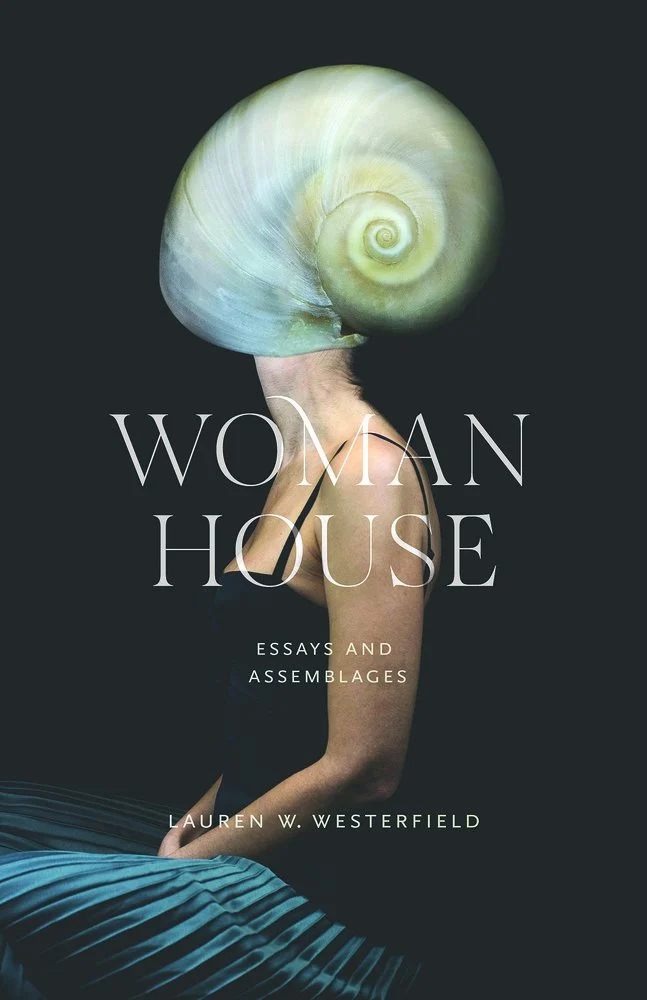 Lauren Westerfield’s memoir in essays, Woman House: Essays and Assemblages (University of Massachusetts Press; March 2026) is, among other things, a book about secrets.
The most sensational secret Westerfield uncovers is an incident from her mother’s past.
Since her parents’ divorce in Westerfield’s early twenties, she’s been her mother’s closest companion and primary caregiver. The women see or talk with each other almost daily. But one chapter in the older woman’s life remains unspoken until, in a conversation about a health history form, Westerfield discovers that her mother was raped by a stranger in the 1970s. Her testimony against the rapist, Westerfield learns, helped launch the career of feminist attorney Gloria Allred.
Because the book’s promotional copy spotlights the rape and its historical significance, I expected Woman House to read like literary true crime—perhaps something like Alex Marzano-Lesnevich’s The Fact of a Body. But true crime is not Westerfield’s intention.
The details of the incident and her mother’s brush with fame are less compelling to her than the event’s resonance in both women’s lives. The assault makes sense of her once free-spirited mother’s “many rules and clinging love.” Westerfield writes: “My mother fears for my body and my soul because she has had to fear for hers, far too many times.”
After adjusting my expectations, I found myself, like Westerfield, more intrigued by the ripple effects of violence than by the crime and its more immediate aftermath. Her mother’s revelation is one among many items that Westerfield examines to understand how the past affects the present. I pictured Westerfield as a researcher in a massive archive, unboxing an eclectic inventory for close inspection: her parents’ medical histories; the paintings and sketches of French artist Louise Bourgeois; a novella about Bourgeois; film adaptations of Jane Austen’s novels; a book called The Developing Genome: An Introduction to Behavioral Epigenetics; and the curios of language. I share, and therefore enjoyed, Westerfield’s habit of musing over the definitions and etymologies of words like seizure, conception, epigenetics, and context.
Most prominent among the artifacts in Westerfield’s archive are her embodied memories and emotions. In an essay about her mother’s chronic illness, Westerfield realizes: “I cannot write the story of her almost-death without reopening memories I have worked, via neglect, to render less potent. To get them back, I must confront the complicated feelings.” Confrontation, for Westerfield, means turning memories and emotions into objects of study. This could have had a distancing effect, but I found the approach paradoxically intimate. By externalizing the internal, Westerfield granted me closer access, inviting me to find meaning alongside her. Similarly, Westerfield’s occasional use of second- and third-person voice, along with the more dominant first-person, added dimension that made the prose feel tangible to me.
Through her exploration, Westerfield comes to see that it’s not her mother alone who carries the weight of violence. She finds within herself something “more echo than memory, more knowing than wound. A rape that, perhaps, she’s inherited.” This inheritance explains why the initially “heady” feeling of being physically desired as a college student begins to “scorch” her from the “heat of collective eyes.” It explains why intimacy with a partner Westerfield loves contains within its beauty “a tiny, dark specter of unwanting; of choicelessness; of danger.”
As a participant in Westerfield’s exploration, I felt the commonness of this legacy. This was especially true as I read the collection’s title essay, which braids together sections on the 1940 film The Philadelphia Story, Westerfield’s ambiguity about her first sexual experience, and a series of artworks by Louise Bourgeois depicting women with houses as heads. “The woman who resides within a house might be powerful or she might be trapped. She might be content or strategizing an escape,” Westerfield writes. “More likely, many of these things are true for the woman.” That woman, the essay implies, could be anyone: the protagonist of The Philadelphia Story, Westerfield, her mother. It could be me, or you.
The agency within this ambiguity, I believe, is the real secret at the heart of Woman House. A woman who hides is also “active, thinking,” Westerfield reasons. “Why else would she think to hide?” Westerfield chooses, along with Bourgeois, to embrace the contradictory: “Innocence and sexuality. Freedom and constraint. The rotund, organic female body and the geometric shape of the manmade world.” I longed, impossibly, for Westerfield to show us how to dismantle the manmade world. She extended something less cathartic but maybe just as necessary: the clear-eyed grace to embrace the inevitable contradictions within ourselves. For that gift and its artful rendering, this collection is a must-read.
 Kim Kankiewicz writes essays, reviews, and short stories for publications including The Atlantic, Creative Nonfiction, Colorado Review, and The Normal School. Her narrative nonfiction book, Bellwether: A Telephone Operator, a Landmark Court Case, and the Women Whose Voices Connected a Nation, will be published by Union Square in March 2027. She’s online at www.kimkankiewicz.com and on Bluesky.