
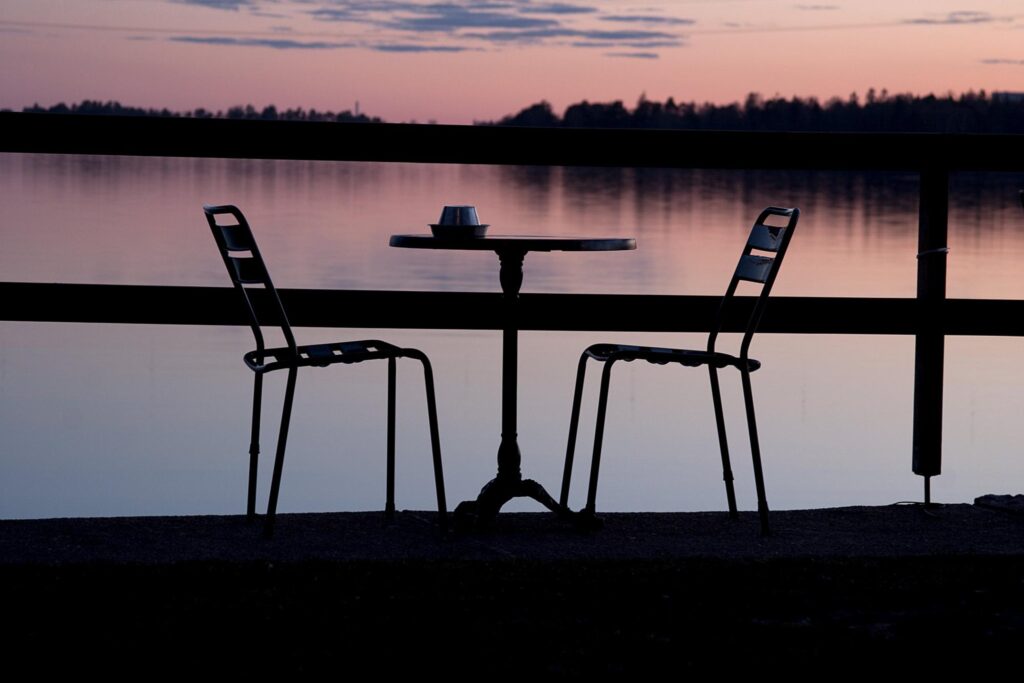
I lean on the deck rail and savor dusk’s drift toward night — the glitter-caps rippling Kachemak Bay, the pine silhouettes shadowing the Kenai Peninsula across the water.
Julie abandons our husbands’ fishing stories and YouTube searches for 80s music videos to join me. We situate ourselves side by side in Adirondack chairs, sip cabernet, and chat about workouts and weight loss, our kids’ doings and their undoing of us until we laugh ourselves loose, eventually settling into a rare silence.
“The last day I saw my father…” Julie’s words trail off. She leans forward, elbows on knees. The last day she saw her father. I don’t know anything about that day. When he died, her youngest child, now twenty-one, was a toddler, and our friendship had not yet wrapped itself in the comfort it wears today. A single memory from the funeral slides into focus: Julie, her husband, and three small children standing in front of the church holding hands, their reflections vivid in the glossy black side of the hearse.
Moonlight catches the gray threading her dark hair. “That day when he left, I kissed my father on the lips because that’s what we did.”
Kiss on the lips — we did that. In greeting and good-bye, my father would stand, arms extended, even when age and pain protested.
Julie exhales a slow whoo. “My stepmother chastised me: ‘I hope you didn’t kiss your father on the lips. He doesn’t need to catch your cold.’” Julie shakes her head. “I worried about making him sick.”
I try to remember his cause of death. Illness? Did I ever know? It was sudden.
Julie weaves her fingers together — unweaves, weaves — then peers across the bay toward the outline of jagged ridges striped in snow. “He kept saying he wanted me to have this or that.” She glances my way, unfolds back into the chair, and adds, ‘in the event of.’”
“In the event of” hangs in the air between us. How old was her father when I last saw him? Maybe his mid-fifties.
“He was…troubled. He had struggled with depression before. I just didn’t realize.” She slows. “Wanting to give things away didn’t make sense. I asked him, ‘Dad, do you think you’re dying?’” Her head, now relaxed on the chair back, rolls toward me. She offers a brittle, closed-lip smile. “Within days he was gone. Then I was glad I’d kissed him.”
Breezes rustle amid cottonwood leaves, then break free to race downhill. Our husbands’ guffaws erupt from behind the closed windows. But our eyes hold. Her full meaning lands in my core, the thud nearly audible. He had died suddenly.
Julie tilts toward the stars, the silent summer scatter. I cannot pull away. I want to speak to her grief, tell her I’ve met grief, that we’ve become acquaintances since my father died three years ago. That I know how it travels, sometimes in wide loops of quiet, sometimes in ringlets, relentless. A quilted flannel shirt, a soup started with sauteed celery and onions, my uncluttered thoughts, all pull my father from shadow. I want to greet him with smiles, but a tightness in my jaw prohibits it. Sometimes when the ache persists, I dull its demands for attention by sharing it with a worthy someone.
Today, I am someone, a guest in a friend’s grief. I want to say something comforting or profound — to show I’m worthy. But what? My churning stomach recommends silence. I settle into the chair, rest my head along its back. The cool evening raises goosebumps on my arms; whispers of our husbands’ conversation escape the glass. In the stillness, I close my eyes and see what I missed earlier — the significance of having done the thing they always did. Julie kissed her father goodbye on the lips, a familiar act made more precious by its finality. In that gesture of comfort and connection, she found gratitude. I wonder how and when. When does our gratitude catch stride with our grief so the two can travel side by side?
The crack of a broken branch yanks my eyes eastward. I tilt toward the darkness. Search. Julie remains still, then sighs — heavy, like a period pressed slowly to the page. Words bottleneck in the back of my throat. I want to know more. For my own journey. But tonight is not my story.
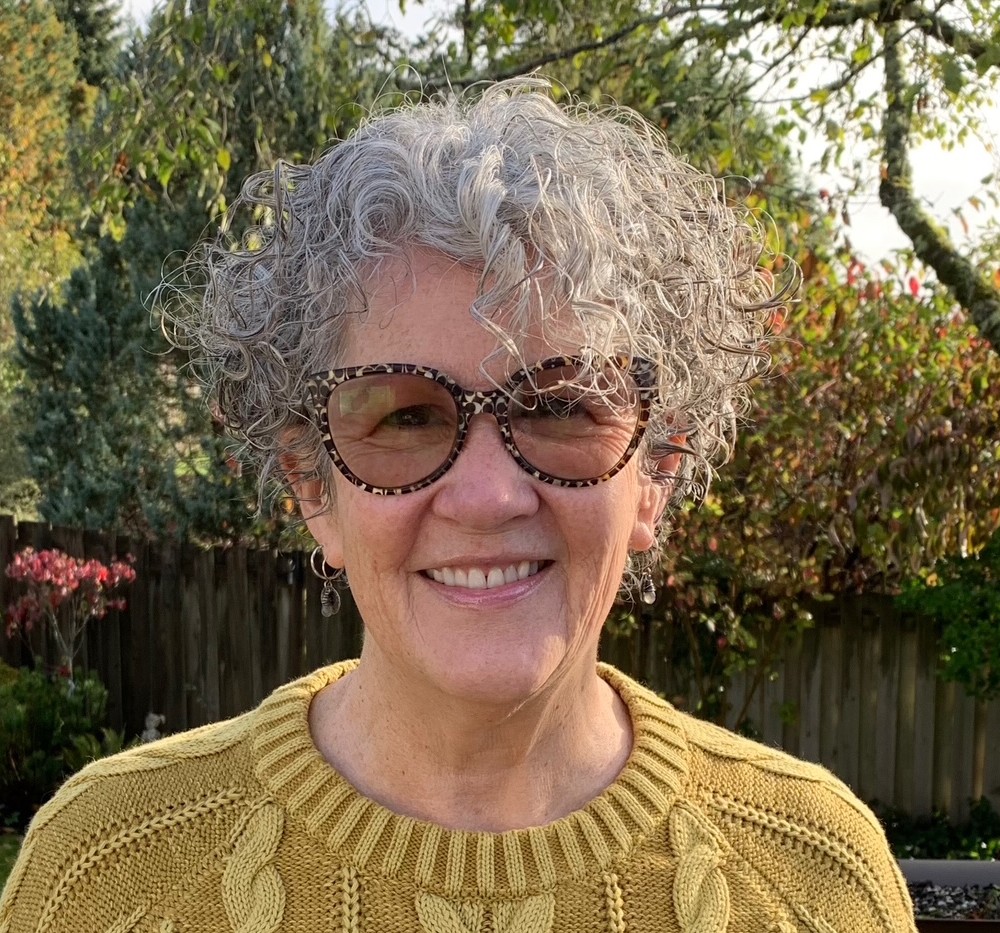 Annette L. Brown is a poet and creative nonfiction writer who has pieces reflecting her love of nature, family, beauty, and humor in several publications, including Flash Fiction Magazine, Every Day Fiction, Bad Day Book (Parenting), Pictura Journal, and several volumes of the Personal Story Publishing Project (Randell Jones). Annette is grateful for the support and friendship of her writing group, the Taste Life Twice Writers. Read more from this author at annettelbrownwriting.com.
Image Credit: Flickr Creative Commons/Kimmo Räisänen