

My friend Andrea made me a mixtape in high school after I’d kissed my first boyfriend. The mixtape centered around the made-up fairytale of “Princess Kristine and Prince ___,” and between the chunks of narration Andrea had written and read aloud, she played relevant ‘90s-era songs like “Kiss Me” by Sixpence None the Richer. The mixtape Andrea made for me was dubbed on top of another tape, erasing what was there before, creating a new story.
***
A mixtape is an erasure. It is that simple and concise. A mixtape is a culling of what distracts. A mixtape is a compilation telling the narrative you want to tell.
A mixtape requires the removal of disrupting elements from the original sources.
A mixtape tells a story by what a narrator decides to keep. A mixtape is an erasure essay, is what I am saying, and that is why I want to talk to you about how teenage girls have been writing erasure essays for decades.
***
I am also trying to find a way to collar you by the bathroom line to drunkenly insist that you hold still so I can tell you THAT BOYFRIEND AND I USED SONG LYRICS IN OUR EMAIL TITLES TO COMMUNICATE TO EACH OTHER and that MY EMAILS WERE A FORM OF ERASURE ESSAY WRITING because I never used the actual lyric I wanted him to hear, I always used the line right before it — I encoded every one of my emails to him, inexplicably expecting he would scan the next verse in the song I’d quoted to determine what I had really wanted to say; all he’d had to do was scratch his fingernail across the liner notes to see what was left behind.
***
An erasure essay, for the record, is made exactly like an erasure poem. Words, and sometimes letters, are removed from a primary text and what remains on the page is then collected into paragraphs (this is how it becomes an essay).
And a mixtape is made much like an erasure essay, because both artforms require a significant amount of time spent with that original text. I cannot count how many hours I spent, as a teenager, re-listening to albums so I could curate songs to evoke the correct mood on a mixtape. I spent so much effort determining which songs to cull and pull to polish into my own invention. If you can imagine all the albums from 1996-2000 as one large text — like a spool of printer paper that could be pulled around the world — you can understand how creating a mixtape is like creating an erasure. There is so much to perforate and excise before getting to the real message you want to reveal on the page.
After working my tail off to memorize the shortest possible poem to fit my freshman English class’s recitation assignment requirements, my teacher told us that the legendary bards of yore used to travel from town to town, declaiming their long epics to rapt audiences. Someone in my class wondered aloud if poems were just the songs of the olden days, and since then, I’ve often thought about how many “poems” I have, in fact, memorized. How many fragments, but also how many entire epics, entire albums I can still sing along with when I’m driving in the car.
If song lyrics are poems, composing a mixtape is like editing your own anthology. But writing an erasure essay is like editing your anthology down to the most poignant lines — the lines for which you’d picked those songs in the first place — to emphasize the particular points you want to make sure don’t get missed.
***
As a teenager in the late ‘90s, I made many mixtapes — mixtapes with ridiculously obvious themes I thought were obfuscated, loaded with ridiculously obvious songs I also thought were, somehow, “subtle hints” to my boyfriend. The mixtapes did not achieve their anticipated outcomes, even when I sang into his ear those lyrics I’d selected, making my intentions as ridiculously obvious as I could. My boyfriend broke up with me after I made one too many lyrical lunges at him — via email, on the phone, through a mixtape or in-person; it did not matter which mode it was in particular that pushed him over the edge because it was likely the accumulation of them all.
I was devastated. I’d read countless books and magazine articles trying to understand how to “succeed” at my teenage girlhood, but I was mortified that my floundering failure to hold onto the first boy who’d kissed me proved I hadn’t learned anything.
I grew up, he grew up, he still sent me sporadic emails using song lyrics in the subject lines, I still replied to his emails using penultimate song lyrics in the subject lines. We created a mixtape of what it looks like when two people who should have erased each other long ago kept flinging other people’s words at each other.
***
I tried to write about him quite a few times, particularly in a mixtape I once wrote, though I’d called it an essay at the time.
The problem: I could not separate my thoughts or memories of him from the song lyrics of my teenage years. That is not a new problem, nor is it novel or particularly interesting, which I think is what actually makes it interesting — the ubiquity. I will ask you to take a moment to recall the song lyrics that remind you of your own first love. The words you cannot separate from that time with them, the particular curve of a voice hitting a note in a lyric that still breaks your heart because it does, and will always, remind you of them.
Since I couldn’t separate my first boyfriend from the song lyrics, I decided to smash them together. I selected the song lyrics I could not do without, and then I wrote a gargantuan and overblown essay before putting the entire essay in footnotes to the lyrics. Those lines I had to isolate and force into an even clearer view than they’d ever been before — they appeared to be the primary content of the essay.
Yes, I was aware that it was very derivative of Jenny Boully’s “The Body.” And yes, as you must have assumed, the mixtape/essay was terrifically unpublishable, and so I shelved the piece shortly after finishing it. By the end of the mixtape/essay, my writing had devolved into self-talk as I realized, on the page, I’d been repeating all of these lines to the only person who really needed to hear them — the only person who would ever be interested in the obscure details — which was myself, as a teenager.
I sat with my frustration until I came across a 1963 etiquette book published by Seventeen magazine. Overcome by the need to redact — in order to emphasize — the book’s casual instructions for teenage girlhood success, I began erasing the 26 chapters methodically to document what I felt I’d really learned. I understood that the resultant book I’d created, “Teen Queen Training,” was also written to myself as a teenager as a different sort of instruction manual, recounting all the lessons I’d learned in exquisitely humiliating detail as a teen girl, clipped and pasted into a mixtape to say what I’d wanted to know so badly.
But I kept returning to the concept of what I had done with that original mixtape/essay — how I had removed all the extra words in songs I’d already pruned from the soundtrack of those years, and I had left behind only the utterly unleavable. The true words at the core of my experience.
I’ll say it again: isn’t a mixtape just an erasure essay after all?
***
I meant to convince you that not only are erasure essays mixtapes, and mixtapes erasure essays, but also that erasure essays are the natural way to understand teenagers, by the transitive property.
An erasure essay is a mixtape, removing the parts of our teenage experience we didn’t want to see (the spitballs, the embarrassment, the interest in anyone but ourselves). A mixtape is an erasure essay, emphasizing what we did want to see (the palm-up hand between movie theater seats waiting to be held, the boyish handwriting, the interest in ourselves). As a teenager both terrified of exposing who I really was and also desperately wanting to be seen for who I was, I made mixtapes to conceal and reveal to those who cared to look. As an adult, I wrote erasure essays to reveal what I had still concealed from myself.
Writing erasure is a sort of reclamation of power. A redaction of codified narratives, perhaps a reformation of truth, but an erasure reveals something only its creator saw hidden inside. I took a Seventeen etiquette book apart because, as a teenager, I’d cried as I copied magazine advice into a mixtape of my failures. I listened to it for a long time. And then I erased it.
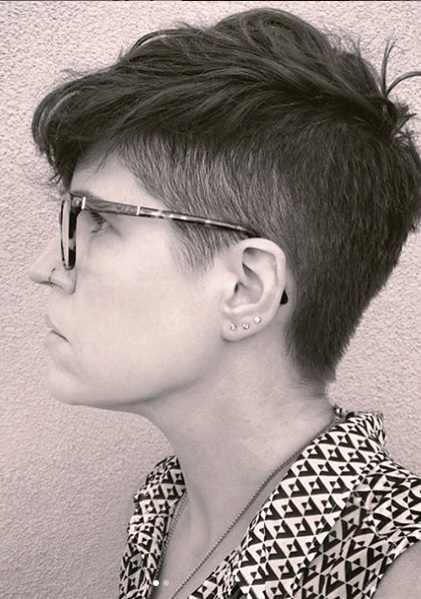 Kristine Langley Mahler is the author of three nonfiction books, Teen Queen Training, A Calendar is a Snakeskin, and Curing Season: Artifacts. Her work has been supported by the Nebraska Arts Council and Art at Cedar Point, and thrice named Notable in Best American Essays. A memoirist experimenting with the truth on the suburban prairie, Kristine makes her home outside Omaha, Nebraska. She is the director of Split/Lip Press.