
 I’m opening this interview with a bit of trepidation, much like when I was a child, lifting the cover of a childhood favorite, The Monster at The End of this Book. In that story, Grover, a Sesame Street character, frantically tries to prevent the reader from turning the page, only to find out that the monster is actually sweet, lovable Grover. Originally published in 1971, its author, Jon Stone, was ingenious in his structure, inviting the reader to become the protagonist.
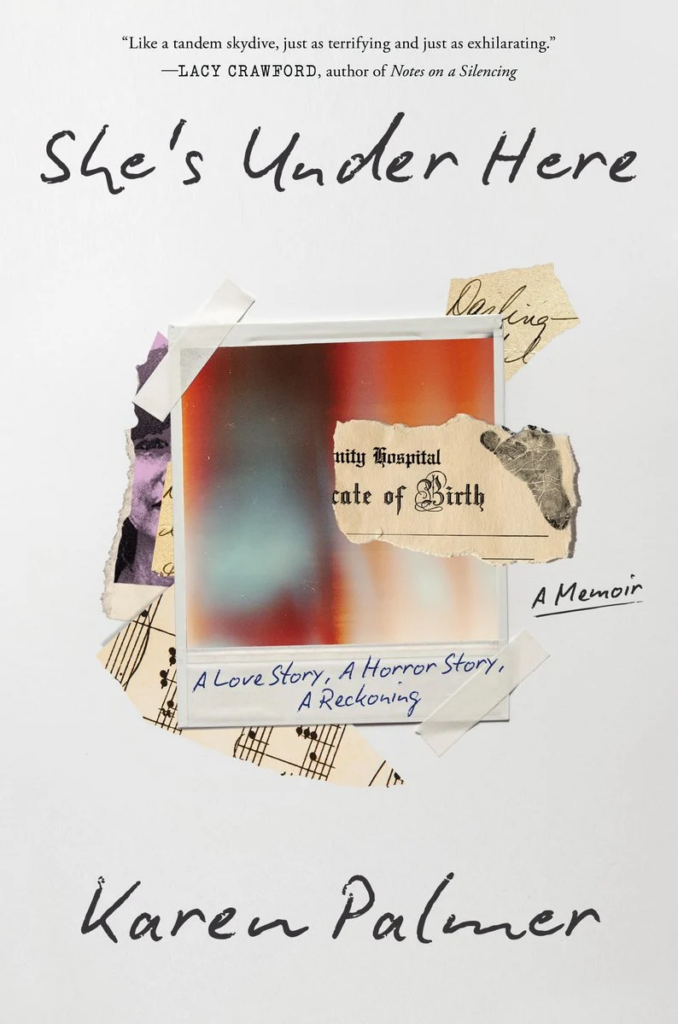
Now, as I write about Karen Palmer’s She’s Under Here, (Algonquin; Sept. 2025), I lift the cover with worry and nostalgia; I know what’s under there.
In 1989, Karen Palmer was fleeing her ex-husband, Gil, who threatened to cut off Palmer’s head and leave it in the refrigerator for their daughters to find. He threw rotten meat into her yard, sliced her tires, cut his head from all the pictures of them together; burned her precious childhood photographs, and kidnapped their 3-year old daughter. And more. So much more.
In 1989, my mother threatened to kill me and my sister. She thought my father was the devil and he should die, too. She sliced our backyard trampoline with a knife. She locked herself inside the house, covering the windows with bed blankets then and pillaged everything. She took the photo albums, my diary, my trust. She kidnapped my little sister. And so much more.
In 1989, Karen Palmer had been remarried for about a week to a man named Vinnie. She had two daughters, Erin and Amy, who were seven and three. She and Vinnie pulled the girls out of school, buckled them into the back of a car they paid for with cash, and left California. In the trunk, they had pillows and blankets, four place settings, one pot, one pan, some clothing, and a sack of money containing every penny to their names.
But what names? Who are you if not your name? Palmer and Vinnie needed new ones, so did the girls. This was the beginning of their journey of disappearance, reinvention, and resilience. Palmer explores the lines between victim and perpetrator, protagonist and reader, desire and fear, captivity and freedom. I found this story utterly propulsive and could not stop turning the page until I reached the very end, and who was there? Karen? Myself? You?
Please join me in conversation with Karen Palmer.
Leslie Lindsay: Karen, I am still shaking after reading She’s Under Here. First, thank you for your honesty and vulnerability in sharing this very intimate part of your life. I think my first question has to do with how and when you decided to write this story and the ‘unreliable narrator.’ Given that the name on the cover is Karen Palmer, I was wondering, is this her real name? A fake one?’ I was concerned you were deliberately outing yourself, allowing Gil to find you, then I thought, ‘is Gil dead? In prison? What’s going on here? How can she write this?’ What happened that gave you the ‘permission,’ the ‘why now’ to write She’s Under Here?
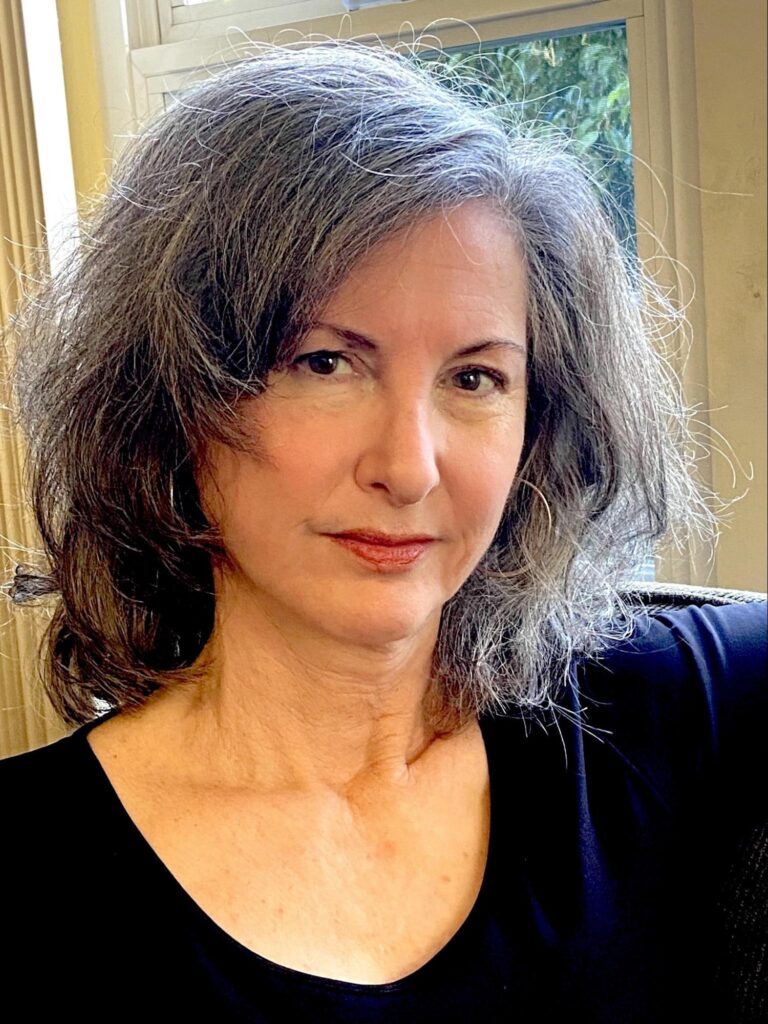
Karen Palmer: Karen Palmer is my fake name — which later became my legal name. I was born “Kerry,” but by now, I’ve lived a long time as “Karen.” (If I’d known that name would become the most hated woman in America, I might have chosen something else.) For years I wanted to write about disappearing, but couldn’t, partly because of the nature of what happened to my family, partly because I was worried about Gil finding us, and partly because I couldn’t figure out how to tell the story; I was definitely an “unreliable narrator.” It was only after Gil died that I felt safe enough to get everything down. Then began the long process of making meaning.
LL: I understand the first few chapters were originally an essay you wrote and submitted to the Virginia Quarterly Review. Someone picked it out of the slush pile and Leslie Jamison later selected it for Best American Essays. What a thrill. Was that catalyst enough? What were some of your early drafts of the book like?
KP: I spent five years on the book before that essay was published in VQR, and at that point, I’d largely given up. There were a couple of versions driven solely by events — this happened and then this happened — with very little emotional content or self-examination. I think it was just too hard for me to face. That essay (“The Reader Is the Protagonist”) was written as a standalone account of my family’s first week in Colorado after landing as other people in Boulder. It’s about having interviewed for a job as a copyeditor at Paladin Press, which published survivalist guides and instructional manuals on bomb-making and assassination and how to establish a new identities; given our circumstances, perusing their shelves was a deeply weird experience and I wound up running out of their office. The essay about all this initially felt extraneous to the book, but it wound up giving me another way in. It allowed me to widen the lens.
LL: Even before Gil, you had a troubled childhood. You are adopted; your parents were often unavailable or combative. Your father was an alcoholic. You had a teen pregnancy, and were forced to give the child up for adoption. And then as a 17-year-old working after school as Gil’s secretary, you fell right into 36-year-old arms. He was charming in ways, but something niggled you. Can you speak a little about the teenage you and how some of your upbringing influenced your decisions?
KP: I was an only child, used to entertaining myself; I’d spend hours constructing cities out on our patio, or aiming a mirror at the ceiling and pretending to walk on the beams. Getting pregnant at 16 at first felt like more make-believe, a fairytale and an inevitability, given that I was adopted myself. As the pregnancy progressed, of course, it became all too real. My parents were Catholic and they were mortified. Keeping my son was not an option. Surrendering him devastated me. I met Gil soon after, while still grieving. I couldn’t deal anymore with teenage boys and thought we were well-matched. I rationalized the age difference, mistaking grief for maturity. Now, I recognize his behavior as grooming. It’s infuriating that a man his age thought it was okay to seduce a teenager.
LL: I was delighted to discover the floor plan of your childhood home in the book. You’re a writing instructor and you’ve often had students participate in an exercise in which they draw a floor plan of their childhood home, then pick a room and write about a memory or event that occurred there. Responses have been rich and deeply detailed. I love this! It reveals so much. Can you speak into this, please?
KP: This is my favorite exercise to give students. After they’ve sketched a floor plan, I have them label individual rooms and add some detail: beds, sofas, tables, people. Out in the margins, they jot down a line or two about things that happened in various rooms. Then they select a memory that really speaks to them and write about it for 15 minutes. This may be a good memory or a difficult one. Drawing the space first gets at events from a different angle. It’s nonverbal, less threatening, and can be playful, filled with sensory information that helps the writer access emotion.
LL: Interestingly, She’s Under Here began as a way to hide, to disappear, but I found it as a way of becoming more visible, of resurfacing. Was that intentional, or one of the gifts that the subconscious process of writing gives us?
KP: I originally thought of the book as an account of a disappearance. Yet even as I was getting down different parts of the story, I was blinded by the drama of my first marriage. I didn’t understand what anything meant. I knew I didn’t want to write a victim narrative — that felt dishonest, another kind of hiding — but for a long time I was stumped. Finally, I relented and wrote about the long aftermath of running, which became the “reckoning” of the subtitle. It was, as you say, a way of resurfacing, of stepping into the light.
LL: What I felt from you, from this book, is your lifelong desire to create, to make art even in the midst of a very difficult situation. In 1989, I turned to architecture as a way to soothe the corners of my mother’s state of mind by drawing floor plans. I think architecture — compartmentalizing — saved my life. Would you say the same for yourself? That creating — writing, forgery — saved you?
KP: I’m so glad you found respite in architecture. With my whole heart, I believe that art can save us. The forgery I perpetrated did that quite literally. I’d worked for years as a graphic artist, and time in the studio with pencils and paints and lines of type was a joy. So there was satisfaction in using those skills to create a new life, to invent a different story. From a young age, books were heaven to me, words on a page entry to a magic kingdom. After we ran, I longed to create my own. So I wrote two novels as far from my own experience as could be. With the memoir, I found myself in different territory. What I wanted most from that book was to make art from pain.
LL: It’s really important to give voice to the abuse you endured. Some might call this ‘just another book about domestic violence,’ which really gets under my skin. It’s about private violence, about desire and fear, victim and perpetrator. Many women, even now, are not taken seriously when they sound the alarm. How can women be heard? What will it take?
KP: “Just another book about domestic violence” is such a damning frame. Because any one woman’s story is always much larger than her abuse. Because I’d assumed a false identity, I was interested in the question: How do you know who you are? That was my entry into the book, but there are a million other questions an abuse narrative might address.
As for women being heard, there has been some change since I ran. For instance, if you are in fear of your life, Social Security has a process for getting a new number so that you can be safe. There are restrictions. It’s not for everyone. Numerous organizations that didn’t used to exist can also help. It’s still not enough. He said/she said is too often the way it goes. In this country, in this particular moment, it’s heartbreaking that we seem to be moving backward, undoing gains made through painstaking advocacy. What will it take for progress to stick? I don’t know. Anecdotally, I will say that our older daughter Erin has three young boys, and she and her husband spend a lot of time teaching them to respect women and modeling that behavior at home, hoping to counter what’s out there in the culture. This gives me hope.
LL: How will it end? Who is the monster at the end of the book? This really speaks to reinvention, and resilience. She’s Under Here is about the breakdown of a family, but it’s also about resilience, not just bouncing back, but taking a horrific situation and making something new, something better. How has your family supported you in this process? And is there anything else you’d like to share?
KP: Vinnie, Amy, and Erin always understood that I had to tell this story. They were supportive in every way. There were so many ups and downs during the writing, but my family never suggested I give up. After the book was published, I did an event in Washington DC with Erin; she was my conversation partner. It was so moving, because she lived through it all too and has her own perspective.
As for what I’d like to leave you with: For anyone who finds themselves in a situation like mine, keep an eye out for the helpers. Be open to it. During my first marriage, I was so isolated. I didn’t know anyone who’d been abused—or perhaps I should say that, while I almost certainly did know someone, I was unaware. There is a veritable army of us out there. And we will move heaven and earth to get you out.
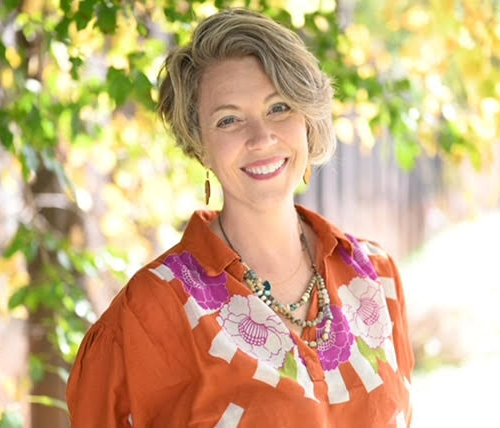
Leslie Lindsay
Staff InterviewerLeslie A. Lindsay is the author of Speaking of Apraxia: A Parents’ Guide to Childhood Apraxia of Speech (Woodbine House, 2021 and PRH Audio, 2022). She has contributed to the anthology, BECOMING REAL: Women Reclaim the Power of the Imagined Through Speculative Nonfiction (Pact Press/Regal House, October 2024).
Leslie’s essays, reviews, poetry, photography, and interviews have appeared in The Millions, DIAGRAM, The Rumpus, LitHub, and On the Seawall, among others. She holds a BSN from the University of Missouri-Columbia, is a former Mayo Clinic child/adolescent psychiatric R.N., an alumna of Kenyon Writer’s Workshop. Her work has been supported by Ragdale and Vermont Studio Center and nominated for Best American Short Fiction.