

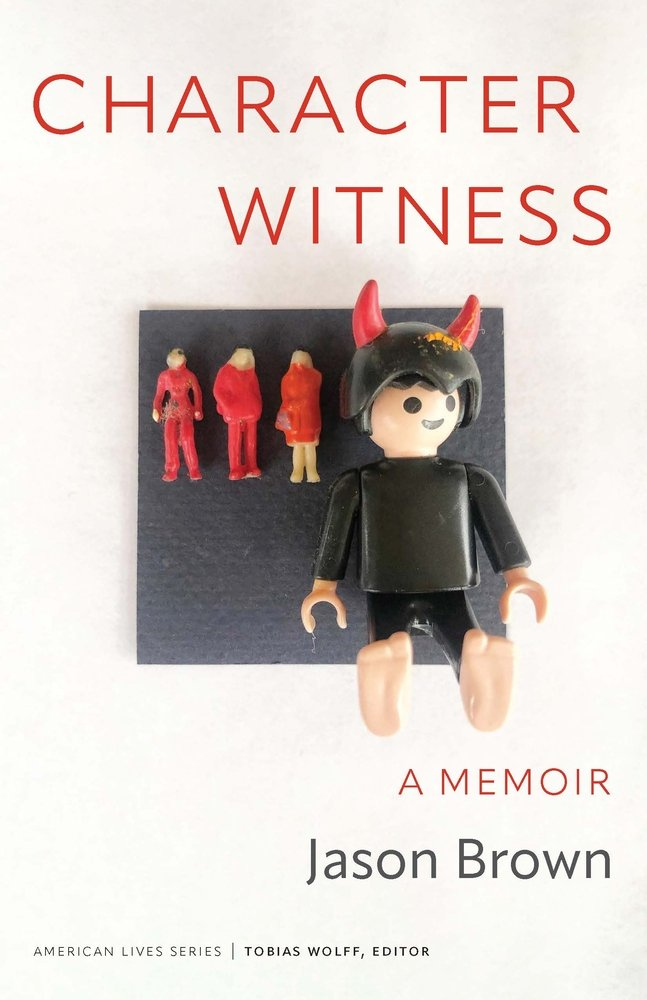
 How do you review a car wreck?
Let me be clear. It’s not the subtly beautiful, yet oftentimes frighteningly gripping writing within Jason Brown’s Character Witness: A Memoir (University of Nebraska Press; Sept. 2025), a memoir-in-essays, that I would — even metaphorically — describe as a crash. It is the emotional setting, the true inciting incident that long predates the purported inciting incident (the arrest of the author’s mother on charges of theft), of the memoir, encapsulated within the prologue:
“When one becomes the sexual object of one’s parent… there is a part of oneself that becomes sealed off like an insect in amber. Over time, one begins to suspect—especially during important moments in relationships, at work, with friends and family—that one is not fully present, not wholly there.”
Character Witness held me in awe, demanding my intercessions from the very outset to understand the redemption that I, as a reader, needed for such a horrifying thing: incest between a mother and her son. But Jason Brown presents the impacts of his trauma on his mental health with both clarity and immediacy and, as a result, presents a journey to that redemption-like state with equal parts clarity and terror. Despite my aversion to visual horror, despite the pounding trepidation within my veins as I turned each page, I could not look away.
One of the things Character Witness clarifies for the reader within its eponymous first essay is how both Jason and his mother Susan view the book. What’s more, Jason sets forth the ground rules for any other writer whose work depicts a parent, a child, a sibling, or a spouse.
“I’d talked to her about writing down some of the stories from her life and my own life. She called it ‘our book’ and hoped it would make a lot of money, even though I told her it wouldn’t. Even if I showed it to her, and I would, and sought her approval before putting anything out in the world, as I would, it still would be written from my life.
In part because the border between us—where she ends and I begin—has always been uncertain. I want those involved in this true tale to succeed, and as a result, maybe I to some extent have turned my mother into a character to salvage her for my own sake…. I do know that if I fail to see her as a fully human, I will fail both of us.”
As the book unfurls, one of the constants within the prose is Jason’s willingness to remind (perhaps himself and) the reader that he continued to seek answers, to better understand himself and his mother. There is a brief moment in the essay, “A Chest of Drawers,” where Jason’s questions come into bright focus: “My mother lived in a world not designed for her. To what extent, I wondered, had I made the world a harder place for her to live in? To what extent did sickness live inside us?”
He concludes that paragraph with one additional question, one I find to be the most thought-provoking and perhaps most relevant for our collective experience of the last year: “To what extent was our society sick and making us sick?”
Reading this part of Character Witness within the ongoing irrational brutality that is life within the United States, I recalled this thought from Jiddu Krishnamurti: “It is no measure of health to be well-adjusted to a profoundly sick society.” Knowing that, while reading Character Witness, prompted a pause within my horror and offered me the opportunity to extend grace both to Jason and to his mother, products not only of the United States with all its cruelties, but products of generational trauma as well. The father and stepfather, who both abused her mother. The distance between Jason and his father that echoed, Jason believes, the distance between his father and paternal grandfather. The isolation that both Jason and his mother had thrust upon them and, in turn, that each reinforced and expanded.
The book’s second part begins with an essay titled “Control of Nature.” Suddenly, we shift, for several pages, away from Jason’s mother to a woman named Nicola, someone Jason is falling deeply in love with, so deeply, in fact, that he forces himself to call his Alcoholics Anonymous sponsor to assess his feelings. This AA contact elides into Jason’s thoughts on his more than two decades of sobriety, into a paragraph whose ending had me nodding with self-recognition (from the perspective of my erroneous morbid anxiety diagnosis and the concomitant (mis-)treatment plan).
“Even if we change, we are always the people we used to be…. For me, change was like walking next to your former self. Always keeping your eye on him. Stay where I can see you.”
Boom. This is precisely how I feel about my past wilder, less stable, selves. “Stay where I can see you.”
“Control of Nature” concludes with a harrowing description of the birth of Isabella, Jason and Nicola’s daughter. I can only know that I had grown so invested in Jason and his redemption, and by extension one of the sources of his redemption, his wife Nicola, because the vivid descriptions of Jason’s fears and fright as the complications brought on during Isabella’s birth have both Jason and I wondering, hoping, praying for whatever miracle it ultimately is that resuscitates Isabella after Nicola’s difficult labor and Caesarean section.
But Susan, Jason’s mother, is still as much in orbit around Jason as he is around her, perhaps much more so as the redemption proceeds (because Jason, as he describes it, continues to view his own redemption as necessarily parallel to his hopes for a similar redemption for Susan). In the last essay, “Animal Stories,” the reader encounters the vertiginous inertia of Jason’s life with Nicola and Isabella, particularly as they spend time living on a remote mesa in Colorado. Life there separates Jason from Susan in her apartment in Eugene, Oregon, where Jason and family also live, albeit in their own, separate home. Susan’s apartment is one of self-created squalor, and its decay brings Jason to action when the landlord requires Susan’s eviction for the damage she has created.
But the essay brings us two deaths. The first occurs on the mesa, where a horse smashes the skull of one of Jason and Nicola’s Australian shepherd dogs. This is no accident, however, and Jason sees the dog’s willingness to challenge and defy Jason as part and parcel with his mother’s equally stubborn challenges.
I won’t reveal the second death, but I will quote the author’s speculations one final time, from near the end of the essay.
“What if, I wondered, everything we would lose and all that would cause us pain was not a threat but rather the very shape of who we were? Our days not empty because they would end and be forgotten but extraordinary because we were here for such a short time.”
May all of us, readers and writers, find solace in this framing. May all we lose, and may all that pains us bring shape to the extraordinariness of our short lives. May our redemptions be found within our loving hands.
Brian Watson
ReviewerBrian Watson’s essays on queerness and Japan have been published in The Audacity’s Emerging Writer series and TriQuarterly, among other places. An excerpt from Crying in a Foreign Language, their memoir’s manuscript, appeared in Stone Canoe in the September 2025 issue. They were named a finalist in the 2025 Pacific Northwest Writer’s Association’s Unpublished Book contest, and in the 2024 Iron Horse Literary Review long-form essay contest. They also won an honorable mention in the 2024 Writer’s Digest Annual Writing Competition. They share Out of Japan, their Substack newsletter, with more than 600 subscribers. In 2011, their published translation of a Japanese short story, “Midnight Encounters,” by Tei’ichi Hirai, was nominated for a Science Fiction and Translation Fantasy Award.