
 I was in my mid-twenties when my first therapist taught me the definition of binary thinking: a cognitive tendency to view complex issues through a reductive, all-or-nothing lens.
A common feature of the evangelicalism in which I grew up, binary thinking led me to see everything as either good or bad, holy or sinful, an expression of God’s will or my own errant desires — and never could the two co-exist. Over the past several years, I have been working to extricate myself from evangelicalism and the binary thinking it engenders.
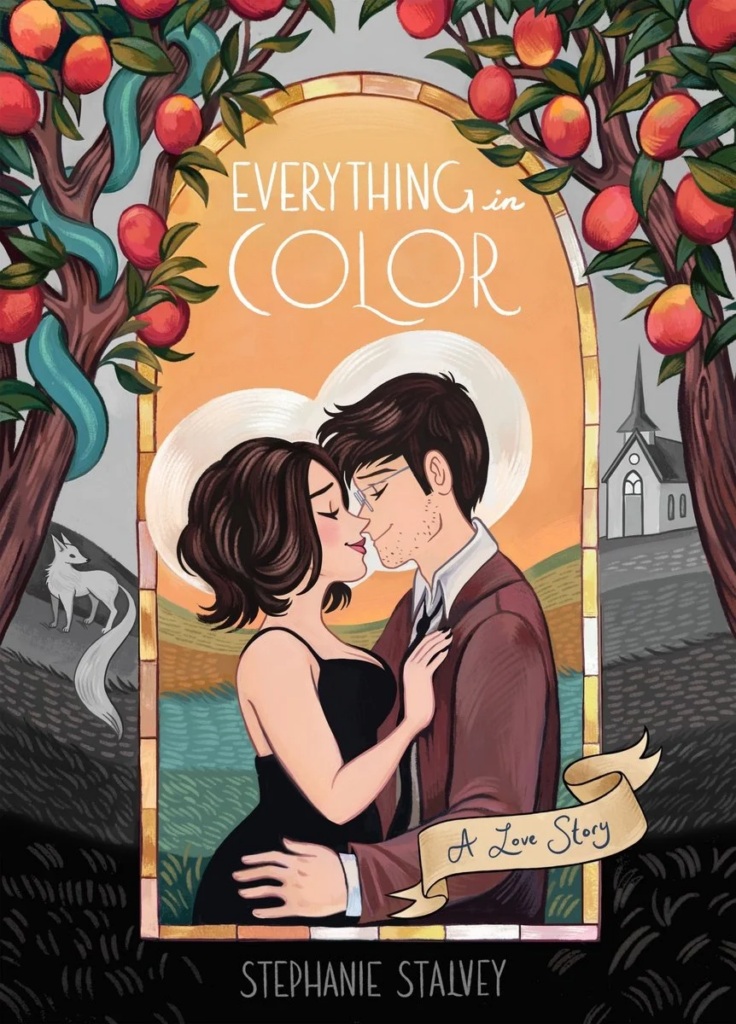
This is the same journey that Stephanie Stalvey presents in her debut graphic memoir, Everything in Color: A Love Story (23rd St; April 2026). Stalvey and I grew up in similar strains of evangelicalism, both of us learning at a young age that we were sinners who deserved to spend eternity in hell.
The reasons people cite for leaving evangelicalism are numerous: its teachings against homosexuality, embedded patriarchy and lack of leadership options for women, the damaging effects of purity culture. All of these issues appear in Stalvey’s book, some granted greater focus than others.
However, Stalvey demonstrates that all these issues are symptomatic. The true rot resides in the way evangelicalism teaches its adherents, particularly children, to see themselves as depraved sinners who deserve nothing more than death.

“I kept trying to reconcile what I thought our faith was about,” Stalvey writes, “the way in which we are healed by giving and receiving compassionate grace — with what I kept encountering: an ice-cold theological equation that ultimately justified the disposal of anyone who ‘got it wrong.’” Stalvey’s work, like a well-aimed arrow, sticks right in the heart of the issue, showing all those other complications as ripples that reverberate out from this corrupted center.
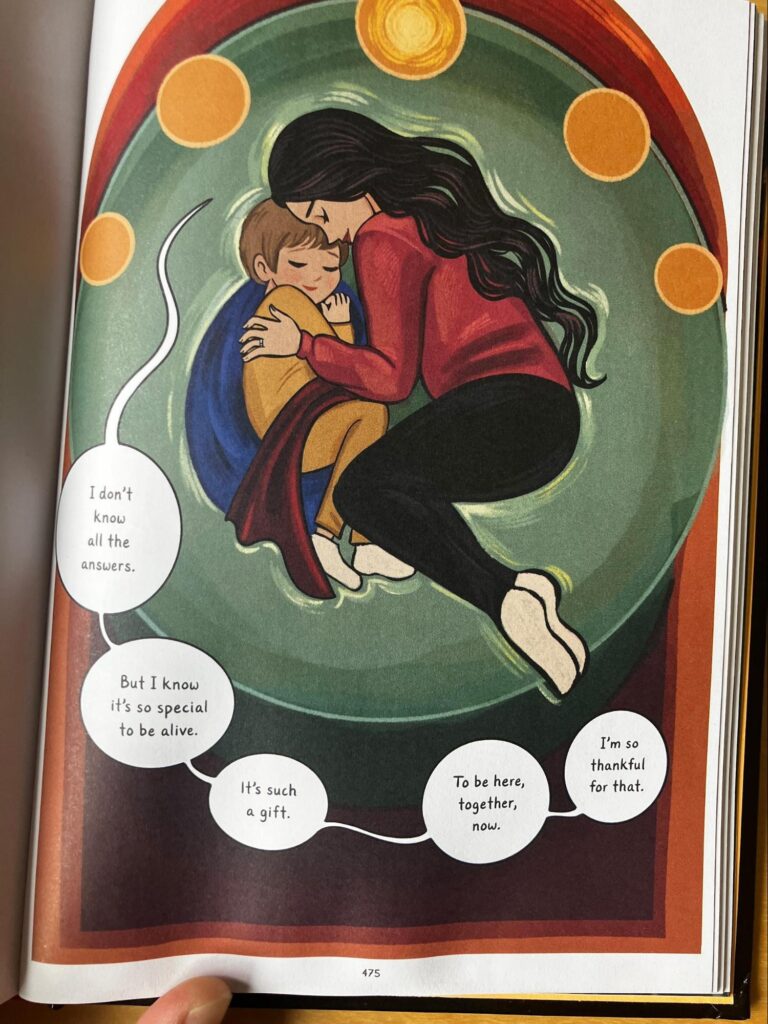
Stalvey provides some of the clearest and most straightforward writing and visual storytelling coming out of the post-evangelical community today. The simplicity of the graphic memoir form keeps her rooted in specific scenes and examples, which she then extrapolates in the form of striking visual archetypes.
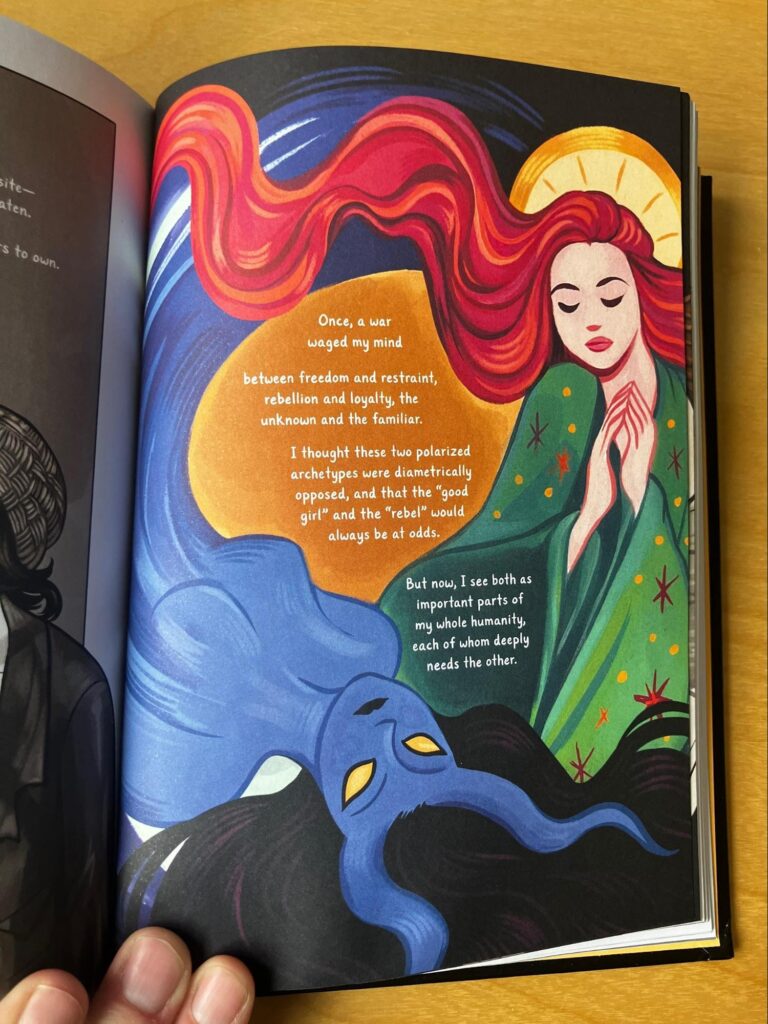
One of the most straightforward but effective tactics Stalvey uses is to render the scenes saturated by binary thinking in grayscale: a literal depiction of the black-and-white limits placed on her life. Echoing Virgie Townsend’s breathtaking short story chapbook, Because We Were Christian Girls (Black Lawrence Press; October 2022), Stalvey writes, “We were church kids raised in a world without gradients.” Stalvey is telling her own story, exploring its turning points and the moments when the rigid framework she was given wasn’t enough to contain the nuances of a life fully lived.
But in her selective use of the first-person plural, Stalvey also writes for a generation of believers who grew up saddled with the expectations of evangelical purity culture. I felt like certain scenes Stalvey depicts were lifted right out of my life, passages cribbed from my adolescent journals. This isn’t to say Stalvey’s work is derivative or unoriginal; just the opposite. Rather, she takes experiences that were intimately familiar for so many of us — particularly white women raised Christian in the ‘80s, ‘90s, and early 2000s — and pairs those memories with adult insights and reflections that cut right to the core of them.
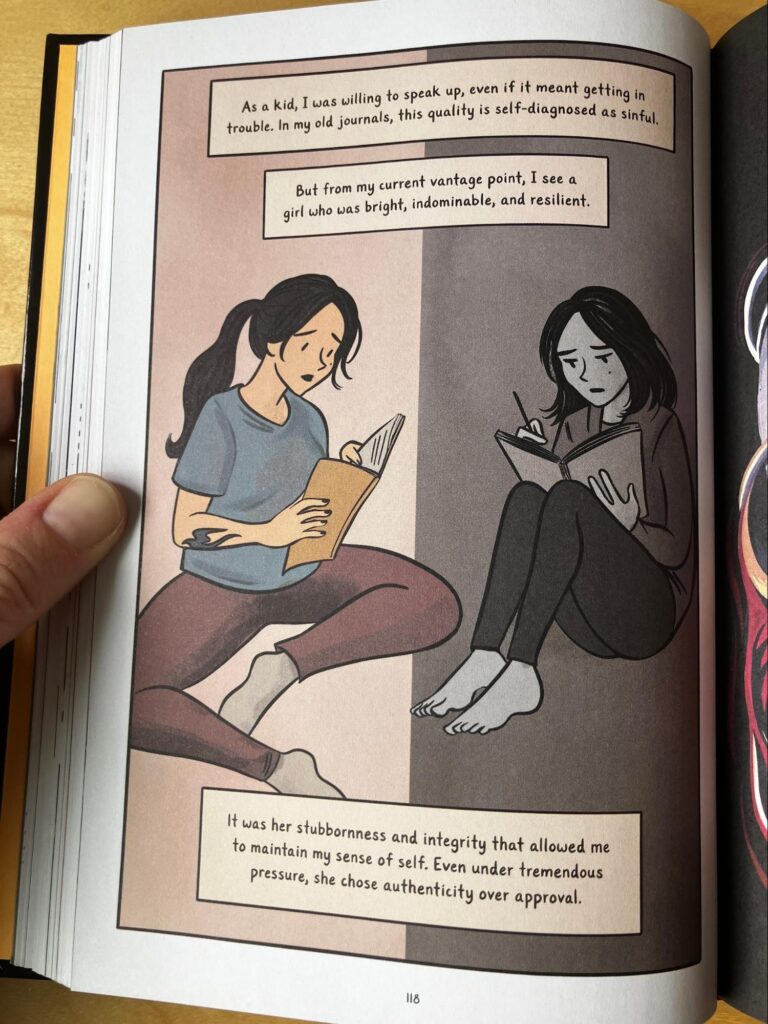
Stalvey shows how the teachings of her childhood led her to see herself as sinful, but she also offers the redemption of a different perspective: one that recognizes her earlier impulses as reasonable efforts at self-protection. “She wasn’t trying to hurt me,” Stalvey writes of her younger self, the version she formerly understood as evil. “All along, she was fighting to keep me safe. She was never a demon[/] just a girl who felt demonized.”
I first encountered Stalvey’s work on Instagram. The visual format of the photo-sharing app is well-suited to showing off Stalvey’s rich illustrations, most of which are hand-painted. But Stalvey’s skills as a visual storyteller extend far beyond what the app can capture in ten or twenty gridded slides. The graphic memoir allows her narrative to blossom on its own terms, filling 528 pages with a sweeping story that spans decades and yet reads almost effortlessly.
The reader grows with Stalvey from childhood to adolescence, through her college and dating years, and into marriage and parenthood. Interactions are conveyed through dialogue and Stalvey’s endearing facial expressions. Meanwhile, text boxes placed throughout the image panels allow adult Stalvey, the reflective narrator, to call attention to the gaps between what her younger self would say versus what she was actually feeling. This divide between feeling and performance was integral to my experience of evangelicalism. At the time, I thought the unease I felt was my “flesh,” my inherent sinfulness pulling me away from God, the devil tempting me into unrighteousness. Now, I might characterize those same feelings as intuition, alerting me to the misalignment between my experience and what I’d been taught.
Many people I’ve encountered who explore departures from evangelicalism err on the side of negativity. After being raised within a teleological framework that punishes deviance with damnation, those of us who have left that community often feel compelled to defend our apostasy. We can go above and beyond when articulating what was wrong, exchanging one kind of narrow binary for its inverse. In this way, some ‘ex-vangelical’ writing can be reduced to polemic or propaganda: ‘hysterical’ arguments against the creeds to which we formerly clung. We use big words and heady arguments — like I’m doing now — to hide our woundedness.
Everything in Color doesn’t do this. Stalvey’s work has an expansiveness, an integrity, that propaganda lacks. She is comfortable enough with her story to openly admit what she misses. In one scene, she and James, her husband, are cradling their newborn in the middle of the night, and she asks James if he thinks they should take the baby to church. James pulls back, wide-eyed, surprised by her question. “The good stuff,” Stalvey recalls. “It was really good, wasn’t it?” She names what she loved about church, but her fondness for the community doesn’t obscure her awareness of its harms. She holds both realities at once, not allowing either to minimize the other. “What do you do,” Stalvey asks, “when every single memory you have — the good and the bad — is connected to this one thing? Like, do you think it’s even possible to separate the good parts from the bad? Or . . . is it all too intertwined?” By fully acknowledging both the good and the bad, Stalvey has not merely swapped the values of black-and-white binary thinking; she is moving beyond it.
Stalvey’s gorgeous illustrations, playful sense of humor, and clear-eyed criticisms of purity culture and evangelical exclusivity all make this book a worthwhile read, but this ability to hold both the good and the bad truly sets her work apart. Everything In Color chronicles Stalvey’s departure from narrow beliefs that would have her reject the beauty of the world. Embedded within its pages are startling works of art that speak to the expansive nature of the divine and reclaim the body and its expressions as good and holy. This book is a gift to read, and I will cherish it for a long time.
 McKenzie Watson-Fore serves as the executive editor of sneaker wave magazine, the inaugural critic-in-residence for Mayday, and the founder and host of the Thunderdome Conference. Her work has been published or is forthcoming in Electric Literature, the Rumpus, Full Stop, the Christian Century, and elsewhere. You can find her at mwatsonfore.substack.com.