
Reviewed by Sara Pisak

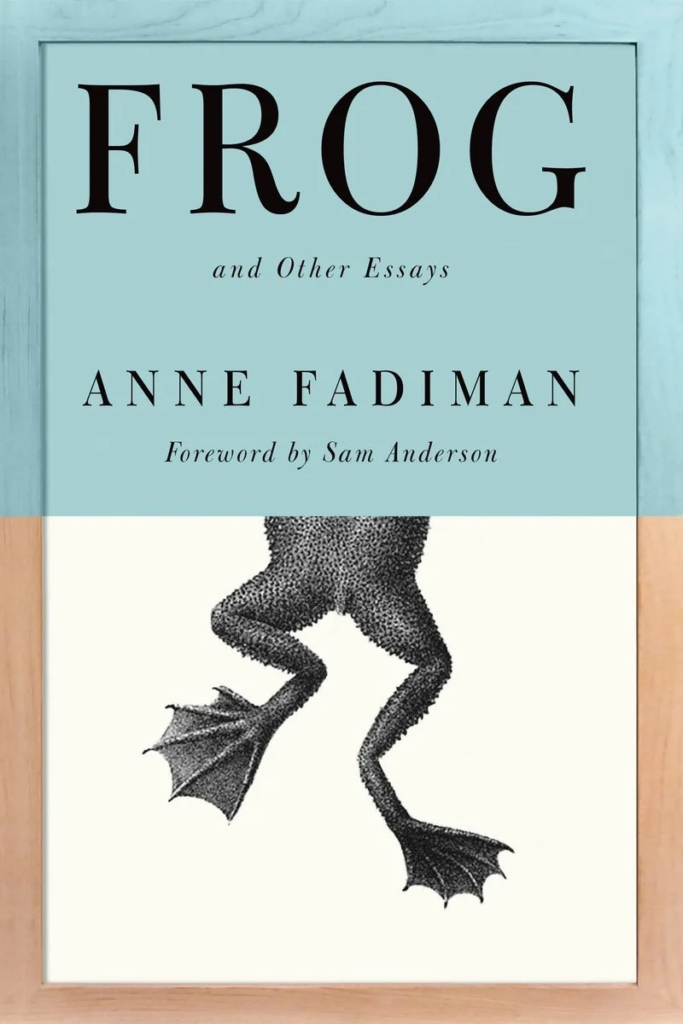 Personally the best essays, the most enlightening ones to read and write, are those that deal with the everyday. Great essayists discover everyday life, whether an ordinary event like making coffee or an everyday item like your favorite pen, can spark a well of creativity, research, and insight. Anne Fadiman’s Frog and Other Essays (Farrar, Straus and Giroux; Feb. 2026) is a masterclass in how the ordinary of everyday life can lead to the extraordinary.
The ordinary leading to the extraordinary is brought to the reader’s attention early in Sam Anderson’s foreword. Anderson makes note of Fadiman’s expertise with similes. The first simile he notes is Fadiman’s thoughts on a radish: “It was more like a bee-sting than a vegetable.” Most people would not associate the snapping bite of a radish with a bee. However, seeing the unexpected in a radish elevates the mundane that surrounds all of us. This simile encapsulates not only the beauty of Fadiman’s writing but the genre of essay writing as a whole.
Every essay in Frog and Other Essays can be used as an example of elevating the everyday. Fadiman uses the title essay, “Frog,” to find meaning in owning a pet. Most readers would note that loving and taking care of their pets is a daily occurrence. It is part of their routine or schedule. Most readers would declare their love for their animals without question. Others would be quick to note that their pet is fluffy, a constant companion, and have human-like features and behaviors.
But Fadiman flips this script describing the household pet. “Bunky was an aquatic frog who surfaced only occasionally (he had lungs and breathed air, but not very often), at which time his googly eyes would protrude above the waterline, lending him a faint resemblance to a two-ounce hippopotamus.” Again, Fadiman’s keen eye for description means the reader sees Bunky not as the pet, but as a tiny hippo ogling her from the tank.
She continues to describe Bunky: “We’d always thought that because Bunky looked so odd — as if a regular frog has been bleached and then put in a panini press — he had been specially bred in some kind of Frankensteinian laboratory.” In a single sentence, Bunky is now further away from a typical household pet. Bunky becomes a pet of mythical, Frankenstein portions.
These descriptions all precede Fadiman calling Bunky “the anti-Typo.” Typo, the family dog, is compared to Bunky, who is not pettable, cold, not cuddly, and unable to learn tricks or how to be a companion. Fadiman finds meaning in upending the typical routine of taking care of a pet. She leads the reader to ask themselves, what defines a pet? Is it these traditional characteristics like warmth or fur? What does a pet mean to each individual reader, especially if it is a nontraditional pet?
To answer these questions, readers need to interrogate not only themselves, but the essay form. Fadiman’s essays center themselves on what some would call average subjects including her HP printer, Zoom lectures, and many others commonplace items. At their core, essays may be average in subject, but that does not mean these subjects are average in meaning. It takes a strong, descriptive, and curious essayist like Fadiman to help these common topics reach their full storytelling potential.
Average could also be seen as a synonym for availability. The everyday availability of these subjects is in stark contrast to the more pronounced, rarer, and obvious subjects that are already filled with heavy meaning such as the birth of a child or the impact of a more traditional pet like a dog. Fadiman chooses not to select these readily available topics, because essays ask a writer to find meaning that is most often missed in the run-of-the-mill events in our lives, just like the emotional meaning Fadiman found in Bunky.
When Bunky passes years later, Fadiman and her husband George place Bunky in the freezer so they can bury him when their children return home. As more time passes, they realize that it is time to move on and that Bunky might have held more meaning in death than in life. At Bunky’s funeral, George eulogizes Bunky. “You used to put your face up against the glass when I fed you in the morning. You came right to the surface and snapped up your food. [….] You… you…you did everything a frog should do.”
In the end, Frog and Other Essays does everything an essay collection should do: challenge a reader to find meaning where they least expect it and when it is the least obviously and readily available, and to look at the average, everyday parts of their life with the sublime wonder of an essayist.

Sara Pisak
Community Content EditorSara Pisak is a reviewer, essayist, and poet. Sara participates in the Poetry in Transit Program and has work in The Rumpus, The Fourth River, LandLocked, Hippocampus, the Deaf Poets Society, Door is a Jar, and Appalachian Journal, among others. In total, she has published over 130 pieces. When not writing, Sara can be found spending time with her family and friends.
Role: As community content editor, Sara creates written and visual content for Hippocampus social channels and website, helping promote our magazine and uplift our contributors.