

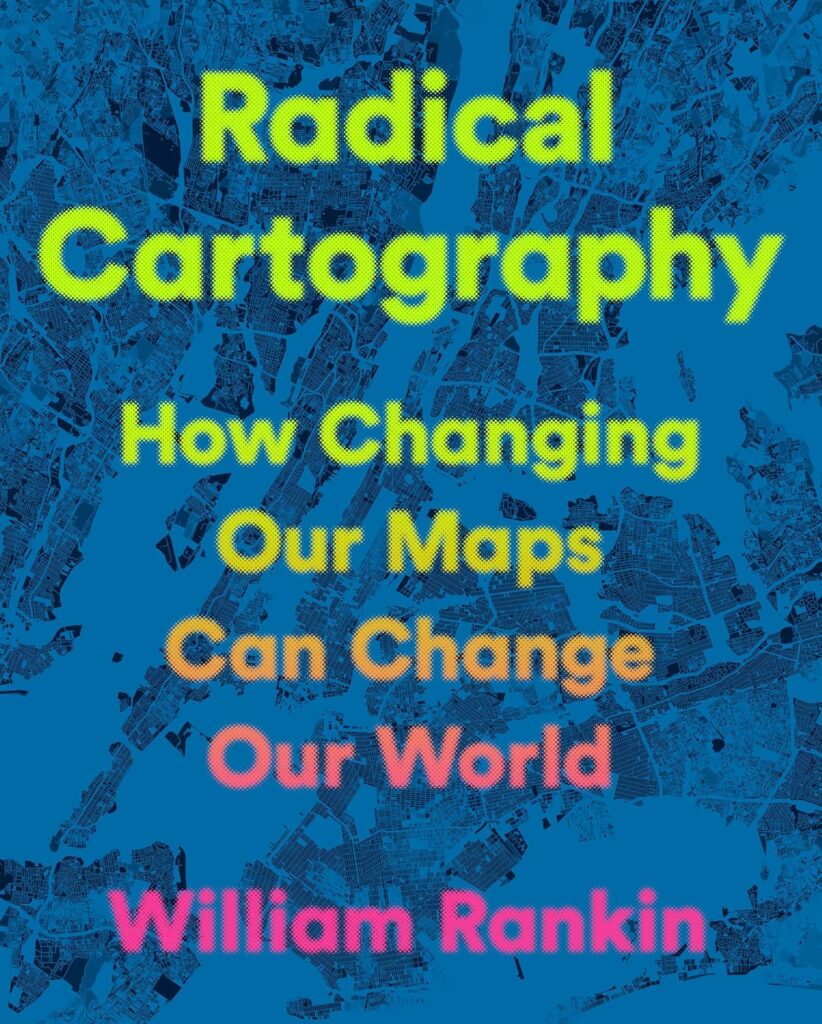
 Anyone who reads Yale professor William Rankin’s Radical Cartography: How Changing Our Maps Can Change Our World (Viking; Nov. 2025) should start with the conclusion. That section provides the best guide through his densely detailed book.
For over a century, he says, maps have been created and read with the values of neutrality, objectivity, sharp classification, and deference to data. “The central claim of this book is that these values have not served us well.” …“They make the world appear more orderly — and more familiar to Euro-American eyes—than it really is.” To remedy this, the author proposes uncertainty, subjectivity, and multiplicity. Rankin stresses how “a map’s values can be found in the graphics of the map itself.”
By starting with his conclusion, Rankin’s seven chapters — boundaries, layers, people, projections, color, scale, and time — become more understandable. We — or at least I — need some handholding because his text brims with information that’s turgid and prolix, leading a reviewer in The Chicago Review of Books to admit a need to pore over some passages more than once, like this one: “This also means that I’m again confounding Jacques Bertin’s ideal of monosemic clarity, since I’ve prioritized the visual denominator by introducing (or perhaps acknowledging) uncertainty in the visual numerator, with basic acts of data reading — how many people live in Baltimore, what percent are enslaved in Chatham County — giving only approximate results.”
Despite such prose, Radical Cartography offers worthwhile reading, but not because of the author’s stated goal. His book is not especially radical, except here and there. Some of his maps, which use dots instead of solid shapes to show ethnic transitions, do approach the novel. Several were deemed innovative enough to put in Memphis’ National Civil Rights Museum.
But Radical Cartography’s best achievement is explaining what maps can do and why it’s worthwhile to learn more about them. He opens our eyes to the many lessons maps have taught in the past and continue to offer today. Different people portray the world in different ways with myriad goals. Geographic knowledge is always partial, situated, inflected, and reading his work makes one thing clear: maps are not neutral descriptions of data. They are “proactive tools of geographic sorting — ethnically, politically, environmentally — from the scale of neighborhoods to the scale of countries and empires.” Maps have physical power. “Maps don’t just show data; they help construct the world.”
Consider what most baby boomers saw in their classrooms—the Mercator projection. The northern hemisphere consumed more than half the planet. Greenland’s area eclipsed South America; Europe occupied the center of the world and loomed as large as Africa, a continent that can easily swallow Europe, the USA, and gulp down China for good measure. Antarctica didn’t exist. No wonder Mercator’s map encouraged Europeans to colonize the global south. In the 1920s and 30s, the Goode polar view, which displayed the Western Hemisphere comfortably far from Europe and Asia, supported the arguments of American isolationists. Conversely, the Harrison map made the case for wartime intervention; its projection showed how close the United States was to Europe. Incidentally, the Harrison map became the emblem of the United Nations, turning an advocate for war into a symbol of peace. There was also the Peters projection that, while more accurate in depicting a nation’s area, squashed Europe and Canada while turning Africa and South America into eel-like continents.
Equally interesting are the large number of maps this author includes, maps that convey information ranging from the frequency of lightning strikes per square kilometer to a map of France that illustrates how many times people kiss when they greet a friend. (From one to four, depending on the region.)
More noteworthy, Rankin provides examples of how maps send messages and become tools of change. Take the American Midwest. You can define the region by its landscape, its labor culture, or its low precipitation. One map contains a hundred overlapping possibilities, each shifting the region’s boundaries.
Perhaps the author’s most significant example is Francis Bicknell Carpenter’s large painting, “The First Reading of the Emancipation Proclamation of President Lincoln.” It’s a portrait of Lincoln presenting the document to his cabinet, but barely noticeable in the bottom right is what Lincoln called, “the slave-map.” It lights up the spread of enslavement at the time of the 1860 census. “Every county in the South is shaded to show the enslaved percent of the total population. The darkest counties were over 80 percent enslaved, while slaves made up less than 10 percent of the counties left blank.” The map drew from Europe’s tradition of “’moral statistics’ — jigsaw-puzzle maps showing everything from French crime and prostitution to British illiteracy and underage marriage.”
Another “slave map” helped create a new state. Unlike most of Virginia, which was full of dark counties, its mountainous west had almost none. Slavery was rare there, and this map supported the argument that the region should be carved out of the confederacy. It was. It became West Virginia.
The chapter about time is particularly interesting, for it teaches how a map can merge the past with the present, and possibly with the future. Rankin’s best example is the Mississippi River flood of 1927, which inundated an area larger than Ireland and left 700,000 homeless. The event still impacts this country. As people argued about how to stop it from happening again, one Harold Fisk produced a map plotting the river’s bends and meanderings over the last two thousand years, with pastel colors representing its different courses. His work embodied a warning and a promise. “The map showed the river’s past, but its argument pointed to the future,” for the Mississippi was a “poised river.” His product became a godsend to the Army Corps of Engineers. As an aside, the multicolored map was so gorgeous that someone tattooed it across the length of their body, from the left shoulder down to the right ankle.
Radical Cartography held my attention, especially because charts have fascinated me since childhood. Others who are less enthusiastic may find it slow going, but the next time they consult Google Maps or Waze, they will have a greater appreciation of the history behind those apps.
Anthony J. Mohr served for twenty-seven years as a judge on the Los Angeles Superior Court and still sits on a part-time basis. His work has appeared in, among other places, Cumberland River Review, DIAGRAM, Hippocampus Magazine, The Los Angeles Review, North Dakota Quarterly, War, Literature & the Arts, and ZYZZYVA.
His debut memoir Every Other Weekend—Coming of Age With Two Different Dads was published in 2023 and placed first in nonfiction in the Firebird Awards, first in nonfiction in the Outstanding Creator Awards, and first in the autobiography/memoir category of the American Writing Awards. Australia’s BREW Project named it 2025 Memoir of the Year. A six-time Pushcart Prize nominee and a 2021 fellow of Harvard’s Advanced Leadership Initiative, he reads for Hippocampus Magazine and Under the Sun. He is also the co-managing editor of the Harvard Advanced Leadership Initiative Social Impact Review.