
 “Death Valley erupts in wildflowers in sign of developing superbloom,” says a recent headline from The Guardian about how higher than usual rainfall has brought about a rare burst of yellow and purple.
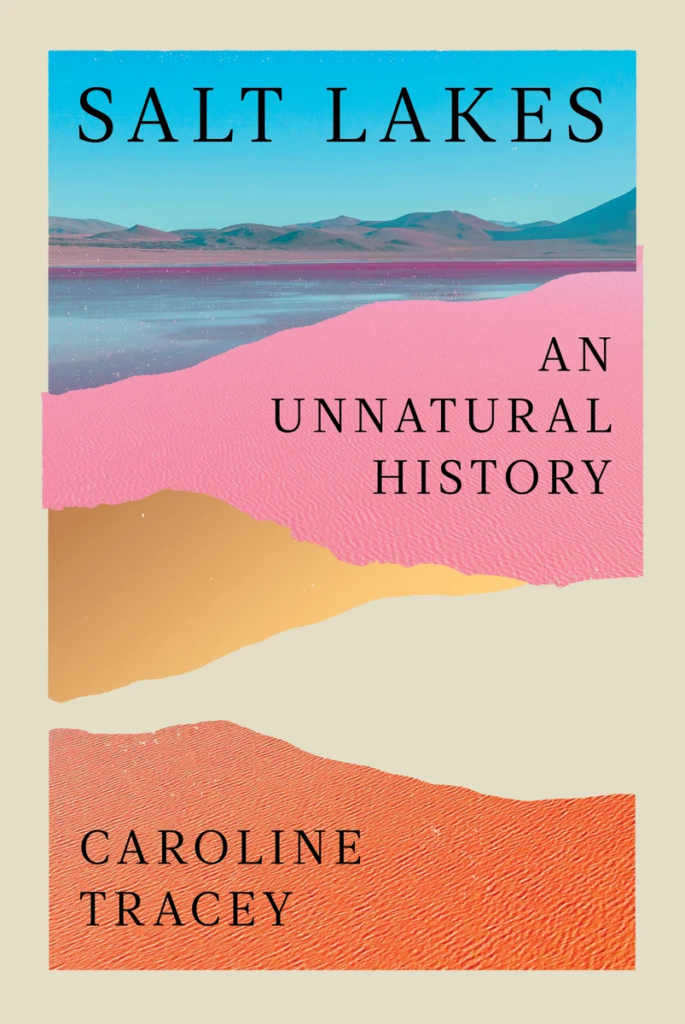
The juxtaposition of “death” and “wildflowers,” a sign of life in opposition to the valley’s name, the idea of harshness and beauty intermingling signals a kind of queerness. In Salt Lakes: An Unnatural History, Caroline Tracey exquisitely weaves queer beauty into a narrative that is also largely about the death of the ecosystems around salt lakes, turning them into graveyards.
We see this towards the end of the book when Tracey and her wife, Mariana, are walking around their Mexico City neighborhood. “The path was lined with lavender, citronella. Mariana broke off a piece of lavender and stuck it through the buttonhole of her shirt.” Lavender is a classic symbol of queerness. The two of them walking down a path is a kind of procession. Tracey knows that the city had been built on top of the dried remains of Lake Texcoco. However, her wife reveals that Lake Texcoco had once been a salt lake; a shock to Tracey, who had been researching the salt lakes around the world for years at this point. This is especially true for Tracey and the salt lakes as she says at the outset, “…I kept finding them–or they kept finding me.” They are in some ways haunting each other.
We follow Tracey’s journey as she leaves the place she called home for most of her life, the suburbs of Denver, to find the place that feels like home. When most people think of the American West, cowboys likely spring to mind, a connection reinforced by dozens of movies, books, and artwork. The cowboy that haunts our collective imagination is almost always a rugged, solitary figure, and almost always male. Tracey does start with a cowboy in the dust of the West, but not as we expect. “When I was twenty-four, I worked as a cowboy in New Mexico.” By not changing “boy” to “girl,” this classic Western image is made fresh, enthralling because Tracey has flipped it from the traditional, the masculine, to the queer, the feminine.
Throughout the book, Tracey challenges gender norms and figures out her queerness, in tandem with her exploration of how capitalism and other colonial forces are destroying our ecosystems. Our home, yes, but also the home to many other species of plants and wildlife that are threatened by increasingly hostile environments. She makes this concrete, real for the reader in “Richness in Damaged Places.” When visiting the Salton Sea with her then boyfriend, Dylan, all the fish have floated to the surface in a mass death caused by overfishing and toxins being flushed into the water.
Tracey’s writing influences from the American and Russian environmental writers are evident in the striking landscape imagery she creates throughout the book. As in “Closed Basins and Sacred Lakes,” a chapter about the Great Salt Lake, she describes how youth activists “held a funeral and die-in for the lake, consisting of a silent procession in which they carried gravestones hallowing the dying lake…where they read poems and eulogies honoring it.” A macabre image that wouldn’t be out of place when describing a haunted house. By making the carnage being done to these ecosystems corporeal, Tracey takes what could have seemed only theoretical and makes it personal, which then allows it to be personal for the reader.
Tracey discusses the queerness of nature in tandem with her own. She begins the book in a straight appearing relationship with Dylan. However, as her interest in the salt lakes grows, her research leads her away from her relationship, giving her the necessary emotional distance to explore her queerness. As a researcher and journalist, she naturally begins navigating her queerness by reading queer theory, mirroring the way she gets to know the lakes–starting with theory until it becomes her lived experience.
The author’s very personal connection to the lakes creates an intimacy that I find unexpected from how I usually think of science writing. I usually think of it as cold or distant. However, the opposite is true here because Tracey’s writing about all of her subjects is warm and inviting as it is informative, offering a welcome sensitivity to the discussion. When I talked to Tracey about this piece, she mentioned that a friend of hers had skipped the science writing sections of the book before realizing that she had to read them to understand the personal arc of the book. I fully agree with this. It reinforces the biggest message of the book: we are not separate from the land we live not only on, but with.
A beautiful illustration of this is in “The Common Good,” when she describes how Mono Lake in California is vibrant with algae and the brine shrimp that have adapted to the lake’s specific chemistry. It is also an example of how every ecosystem is connected through what lives on it, with it. The shrimp attract birds to Mono Lake, allowing the cycle of the food-chain to continue. As Tracey writes, “People often refer to salt lakes as ‘dead,’ inferring that they are absent of life. But the lakes overflow with life–just in specific, small forms.” Tracey’s love for the lakes, their habitats, are evident throughout the book allowing her affection for them to transfer to the reader.
Salt Lakes, as Tracey describes, is part eulogy for the evaporating lakes. However, not all is lost. This is illustrated when an owl making its home by the Salton Sea helps Tracey feel “enchanted all over again.” Her sense of wonder is what allows her to find home within herself, as well with Mariana. And while Salt Lakes doesn’t turn away from the dread of climate change, it does, like the wildflowers in Death Valley, offer something queer, radical in our collective moment: hope.
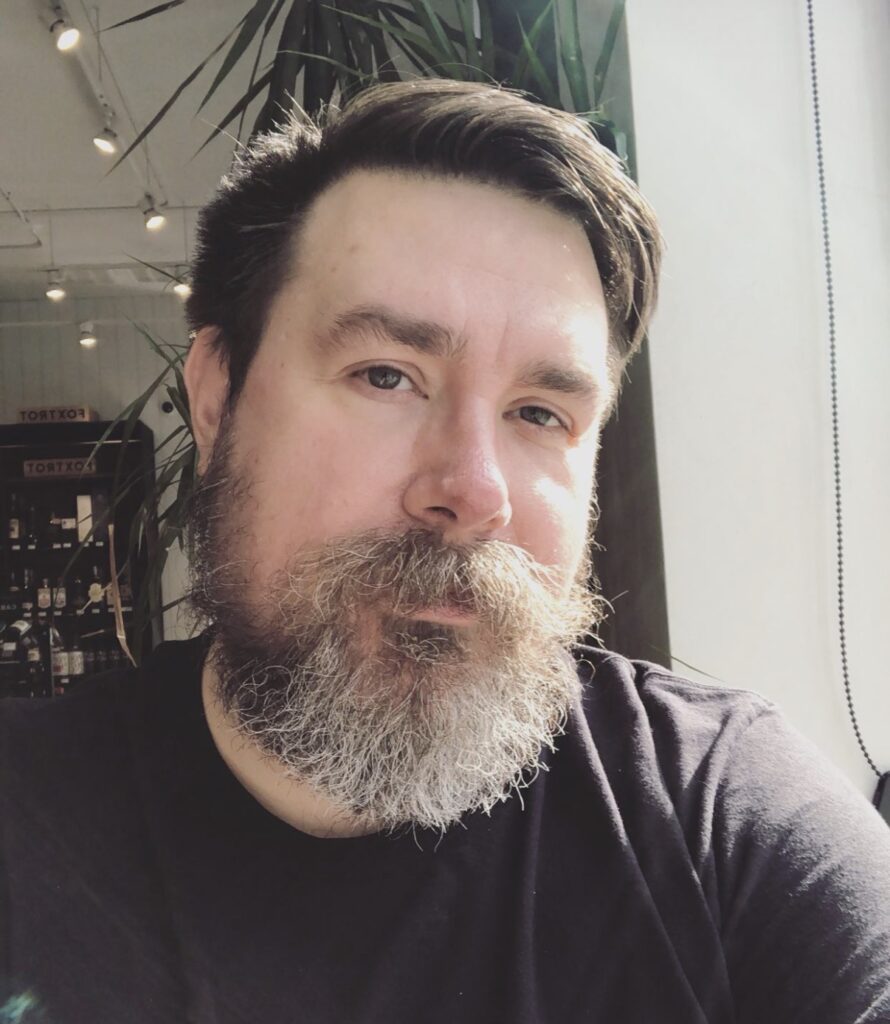 August Owens Grimm is an acclaimed horror writer, editor, and essayist. They co-edited Fat and Queer: An Anthology of Queer and Trans Bodies and Lives. Fat and Queer won the 2022 AASECT Book Award for a general audience from the American Association of Sexuality Educators, Counselors, and Therapists. Their work appears in, among others, The Rumpus and in the Los Angeles Times bestseller, It Came from the Closet: Queer Reflections on Horror. They coined the term Haunted Memoir. They are a 2025 Lambda Literary Fellow in nonfiction.