Reviewed by Amy Roost

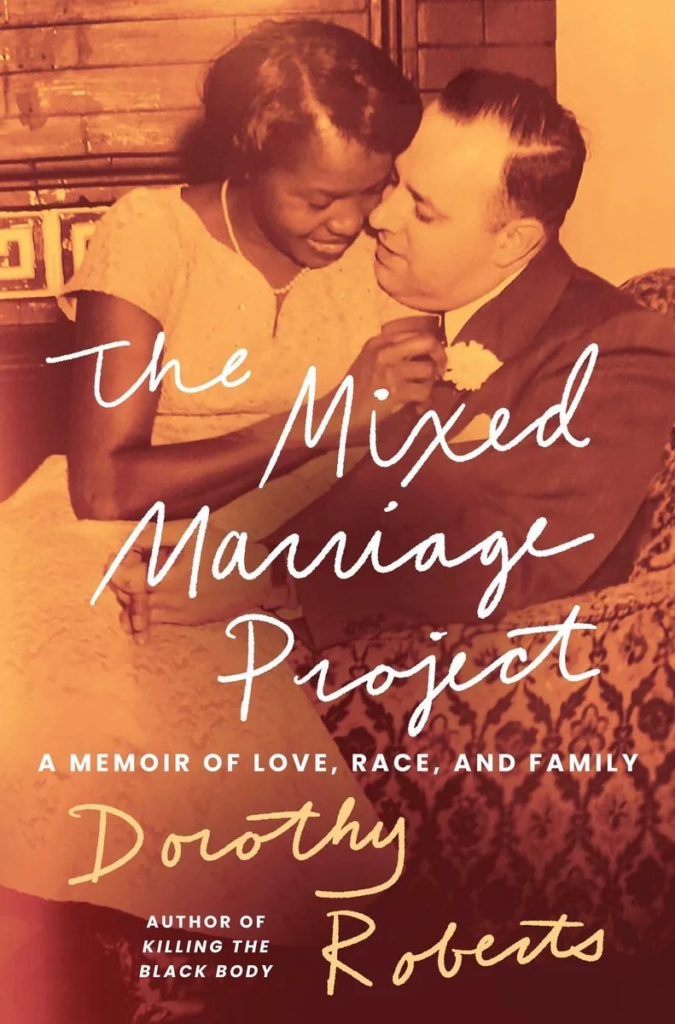 I thought I knew a lot about racism. Then I read The Mixed Marriage Project: A Memoir of Love, Race, and Family by Dorothy Roberts.
After his death, Dorothy Roberts, a professor of sociology and civil rights at the University of Pennsylvania, was the designated keeper of her father Robert’s papers. Robert was an anthropology professor at Roosevelt University in Chicago who conducted the first sociological analysis of Black-white marriages from the 1930s through the 1960s. His findings were never published.
The boxes of his interviews with mixed race couples collect dust over the years until the author finally decides to take an entire summer to herself — living in a rented condo near her childhood haunts on the South Side of Chicago — to read through them. A metaphorical Pandora’s-box tale ensues, as what she discovers alters her understanding of her family and herself.
Roberts had always assumed that her father’s obsession with mixed race marriages was motivated by falling in love with her Black Jamaican mother. As she begins to sort through his papers, she realizes her father began his research a decade before meeting her mother. This revelation shakes her to the core for reasons that unfold over the course of Roberts’ hybrid memoir.
The reader sits with Roberts as she sips tea in her living room, office, and kitchen and reads interview upon interview her father (and later her mother) conducted with mixed-race couples. What is revealed in these interviews sheds new light on the complexities of race relations and the nuances of racial prejudice. The reader learns about anti-misegenation laws (at their peak, thirty states prohibited mixed-race marriages), eugenic sterilization, the so-called one-drop rule (a knuckled-headed concept that any amount of “Black blood” makes a person Black), colorism, the extreme prejudice directed at Black women, the practice of Black Americans “passing” as whites mostly for economic reasons, the Great Migration’s impact on Chicago demographics resulting in a Black Belt where Black residents were contained, and the parallel “flight” of affluent whites to the suburbs that decimated property values in the city. I was familiar with all of this before reading The Mixed Marriage Project, but Roberts’ incisive analysis taught me to think in new ways—and more deeply—about racism.
For instance, here is a passage about the plight of Black women vis a vis mixed-raced unions:
“Black women’s relationships with white men seem as if the women are capitulating to a white supremacist and patriarchal hierarchy, while Black men’s relationships with white women are countering it. But I can also see the opposite. Those exceptional white men who love, admire, and commit to Black women are nothing like exploitative enslavers—and the Black women who love them in return aren’t victims of exploitation. By contrast, those Black men who see having romantic relationships with white women as a badge of liberation, a prize that no Black woman can offer, do nothing to oppose the racial hierarchy. In these admittedly skewed scenarios, the white men are contesting white supremacist disparagement of Black women, whereas the Black men are playing into it.”
Roberts’ father did more than study mixed-race unions; he sought to promote them, believing racial barriers designed to uphold White Supremacy could be dismantled through mixed-race marriages. As one interviewee put it, with enough successful mixed-race marriages, white people would realize that integration would work, adding, “[Mixed-race marriages] would prove that white Americans could also work, attend school, live in neighborhoods, ride buses and eat in restaurants alongside Black Americans.”
Roberts is skeptical. She notes that her father—who ardently believed our shared humanity could transcend the false stereotypes that divide Black and white Americans — failed to account for how colonialism and White Supremacy erased cultural bonds between black and white people, “obliterating the kinship that might have connected them,” and the systemic bias that persists beyond individual bias. Evidence of the second point can be found in the Supreme Court’s 1967 Loving v. Virginia decision. While the Court ordered an end to anti-miscegenation laws, structural forces continued to discourage and punish interracial relationships. Nor was racial equality instantly achieved with Brown v. Board of Education, or the Civil Rights and Voting Rights acts of the mid-60s.
The reason The Mixed Marriage Project is a memoir and not just an exegesis is that it traces the evolution of Roberts’ thinking about her identity and her father’s research — not only what motivated it, but its efficacy. As a child Roberts was encouraged to eschew racial identity and embrace her parents’ emphasis on social equality and shared humanity. She was proud of her mixed family and thought of it as a “living symbol of racial harmony.” As Roberts individuated, she formed her own opinions about identity and race. She came to view her father’s dream — that one day integration alone would dismantle racism—as naive. She joined a Black student union at Yale, began to identify as Black, was inspired by the Black Liberation movement and, for a period of time, tried to erase her white identity. She married a Black activist and became one herself.
As Roberts reads through her father’s papers, the reader begins to detect a shift in her thinking. She starts out pondering uncomfortable questions such as what are the ethics of her father pursuing a relationship with her mother when she was a student of his? Did he marry her mother because he fetishized Black women, was obsessed with mixed-race marriages, or because her mother’s refinement allowed her to travel in white academic circles? Did her father use her and her sisters as guinea pigs in his research? Roberts’ father died in 2002 so he’s unable to answer her questions but it seems the questions themselves are enough to unlock new ideas about race, prejudice, her family, and ultimately herself.
By the end of The Mixed Marriage Project, Roberts’ thinking about her father and herself has evolved significantly making for a satisfying narrative arc. She reconnects to the memories of her idyllic childhood in Liberia, Kenwood (Chicago), and Egypt. She sees her parents’ qualities and herself in them, and no longer fears the perception that having a white father makes her less Black. Finally, she better appreciates the role integration in general, and interracial marriage in particular, plays in the dismantling of White Supremacy.
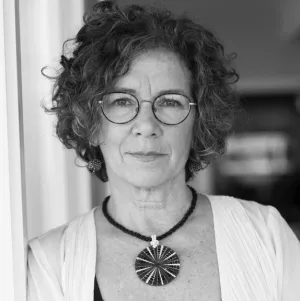 Amy Roost is a freelance writer residing in Bellingham, Washington currently working on a memoir entitled Replacement Child. She is the co-editor of two feminist anthologies and recently earned her MFA in creative nonfiction from Pacific University in Oregon.